Most people who batch cook for a training week think about protein and calories first. Micronutrients get less attention, and in UK winters that is where meal prep can quietly go wrong. When you cook five lunches on a Sunday, you tend to repeat the same vegetables, grains and a few sources of iron and magnesium, and the variety that keeps your intake broad disappears by Wednesday. This guide looks at how winter meal prep UK nutrition plans change what you actually absorb, which nutrients slip first, and how to cook so your performance food still delivers. It also explains where a supplement belongs alongside a diet that is doing most of the work.
Key Insight |
Explanation |
|---|---|
Batch cooking narrows your food range |
Five days of the same lunch means the same few vegetables. Rotate at least three vegetable and protein combinations across the week. |
Vitamin D needs its own plan |
Food alone rarely covers vitamin D through UK autumn and winter, so meal prep cannot be the only fix for it. |
Beans and greens need a partner |
Iron from plant foods absorbs less readily than iron from meat. Pair these meals with peppers, tomatoes or citrus, and keep strong tea away from the plate. |
Cook greens briefly |
Steam or stir in greens at the end of cooking rather than boiling them into grey mush, which loses more vitamins into the water. |
Cool and refrigerate fast |
Shallow containers and prompt chilling protect food safety, which matters more than small nutrient losses during cooling. |
Electrolytes are a training-day question |
A soup can help with fluid, but it does not replace salts lost on long or hot indoor sessions. Plan those separately from the batch cook. |
In summer, many people eat more fresh salads, soft fruit and light meals without thinking about it. Winter pushes most households towards stews, roasts, pasta bakes and rice dishes, which are filling and convenient but often built on fewer vegetable types. The shift is not automatically bad, but it changes which micronutrients you get by default.
A 2015 narrative review in Nutrition Research Reviews noted that nutrition research has focused on individual nutrients and dietary patterns, with relatively little attention to the meal as a unit. That gap matters for meal prep. If you judge a week of food by one nutrient target, you miss how a single repeated lunch shapes the whole week. In practice, the meal is where your habits actually live.
Winter also changes what your body asks of you. Many people move indoors for training in the darker months, and energy timing and recovery food get squeezed between work and commuting. A pot of stew cooked on Sunday can feel like the easy answer, but it only works if the ingredients cover the week ahead.
Three nutrients tend to fall short in batch-cooked winter diets, and they are not always the ones people worry about. The pattern is consistent. The meals are filling and the protein is adequate, but the gaps appear in vitamin D, iron and magnesium, along with the smaller micronutrients carried by a narrow range of vegetables. Knowing where to look is more useful than trying to track everything.
Few foods supply much vitamin D. For most people in the UK, sunlight on skin is a major source from spring to early autumn, and that source becomes unreliable in the darker months. A plate of oily fish or fortified foods helps, but meal prep cannot fully close this gap on its own. A daily supplement may be the more realistic option, and it is worth raising with a GP or pharmacist if you have a health condition or take other medicines.
Batch cooks built around beans, lentils and leafy greens are an efficient way to add plant protein and fibre. The BBC Good Food roundup of protein-packed winter dishes leans on pulses and quinoa for this reason, including a Mexican chicken stew with pinto beans and quinoa. Iron from plant foods is absorbed less efficiently than iron from meat, so pair these meals with a vitamin C source such as peppers, tomatoes or citrus, and avoid drinking strong tea alongside them.
Magnesium is found in nuts, seeds, wholegrains and beans, which makes it easy to get from a well-built batch plan. The usual weak point is the grain. Swapping white rice and white pasta for wholegrain versions across a week of meals raises intake without extra cooking effort. Sweat losses on hard sessions are a separate issue, and that is covered in the hydration section below.
The way you cook food affects what ends up on the plate. Heat, water and time remove or degrade some micronutrients, particularly vitamin C and some B vitamins, while others barely change. You do not need a laboratory to make better choices. You need a few habits that you repeat every week.
Most of the losses come from long cooking in plenty of water and from repeated reheating, not from a single sensible warm-up. The methods below focus on the steps where you have the most control. They also keep the food safe, which is the non-negotiable part of any batch plan.
Boiling spinach or kale until it turns grey is the fastest way to lose both volume and some vitamins into the cooking water. Steam greens for a few minutes, or stir them into a hot dish at the end. The BBC Good Food chicken stroganoff recipe suggests serving it with steamed spinach for fibre and vitamins, which is the right instinct because the greens are cooked briefly and eaten the same day.
Batch cooks sit in the fridge for days, so food safety matters more than nutrient retention. Spread large pots into shallow containers rather than leaving them on the hob to cool, then refrigerate promptly. Nutrient losses during cooling are a minor concern compared with the risk of leaving food at room temperature, so this is the one habit you should never skip.
Reheating the same container every day means repeated cycles of warming and cooling, which do little for food quality. Portion the week into single meals before you chill them, then reheat each one thoroughly and eat it. Stews reheat evenly, while roast vegetables are better warmed briefly in the oven than blasted in the microwave until they dry out.
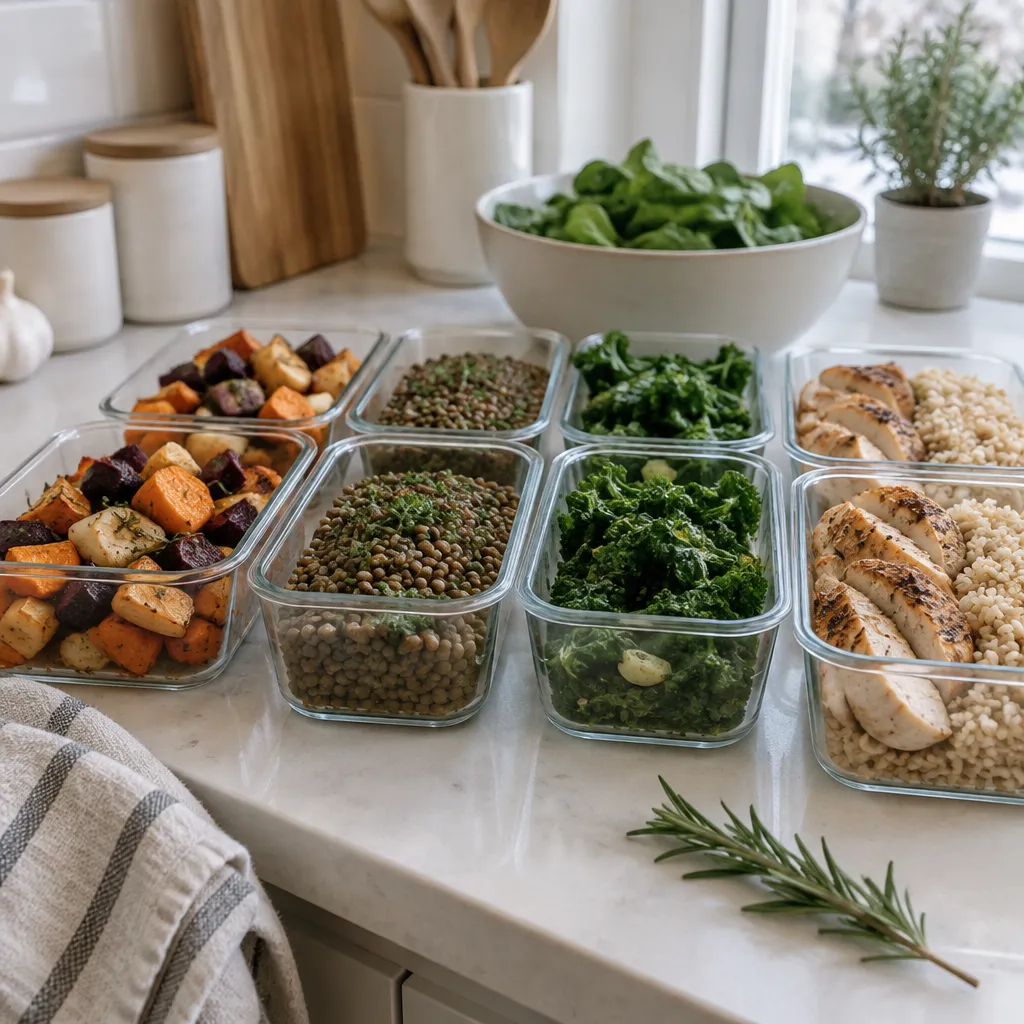
A good winter plan starts with three base recipes rather than seven identical meals. Choose one protein-rich stew or bake, one grain and bean dish, and one fresh salad or grain bowl. Cook them on a single day, and you get variety without doubling your workload.
The structure matters more than the exact recipes. A plan built on three bases can be rotated, topped up and adjusted for training load, while a plan built on one dish usually fails by midweek. The next three subsections show how to set it up.

Mexican chicken stew with quinoa and beans is a strong base because it covers protein, fibre and slow-release carbohydrate in one pot. The Peruvian chicken, avocado and quinoa salad works as a chilled lunch that does not need reheating, which helps if your workplace has no microwave. Chicken and bean enchiladas bring more vegetables in, and the BBC Good Food roundup says they cover four of your five-a-day in one dish.
Repeating chicken every day is the simplest way to lose variety. Rotate between chicken thigh, lentils, tinned fish and eggs so that iron, zinc and B vitamins come from more than one source. The NHS Borders Eating Well in Winter guidance advises at least five portions of a variety of fruit and vegetables every day and bases meals on starchy carbohydrates such as potatoes, bread, rice or pasta. Use that as a test for any plan, because if the variety is missing, the micronutrients usually are too.
On weeks with long sessions, or when a charity run or event is coming up, one cook is rarely enough. Add a midweek top-up of fresh vegetables and a simple protein, such as tinned beans or pre-cooked chicken, so the plan does not run out by Thursday. Plan your pre-session food as well, and our guide to pre-workout hydration in the UK covers how to time it.
There are three common ways people approach winter meal prep for training, and each suits a different kind of week. The table below sets out what each covers well and where it tends to break down. Prices are the starting prices for the Plusssz products that match each approach.
Approach |
What It Covers Well |
Where It Falls Short |
|---|---|---|
Whole-food batch cooking only |
Full control over ingredients, good fibre and protein, and a low cost per meal when you cook in volume |
Vitamin D and some micronutrients can stay low through the darkest months, and variety drops when the same recipes repeat |
Batch cooking plus a daily multivitamin |
Fills small gaps across the week. Options include Plusssz 100% Multivitamin + Iron from £6.95 and Plusssz 100% Multivitamin MEN Complex from £6.95 |
Does not replace vegetables or protein, and a tablet cannot fix a diet with very low variety |
Batch cooking plus a training-day electrolyte |
Supports fluid and electrolyte replacement around hard sessions, such as Plusssz Electrolytes SPORT 100% Complex from £5.95 |
Only useful on training days, and it adds cost if you do not sweat heavily |
The right choice depends on where your week is weakest. If your meals are varied and you train lightly, whole-food batch cooking may be enough on its own. If you train hard in the dark months and sweat through indoor sessions, the electrolyte approach addresses a need that food alone rarely covers. Most people will find that a combination of the first and one of the others makes the most sense.
A supplement works best as a gap filler once your meal plan has a clear structure. Dietary supplements should not be used as a substitute for a balanced and varied diet, and that is the rule we apply to every product. Start with the meal plan, check which nutrients your week is missing, and then decide whether a product is worth adding.
If your week is heavy on beans and greens but light on red meat, an iron-focused option such as Plusssz 100% Multivitamin + Iron from £6.95 may be relevant. Iron needs vary, so check with a GP before taking any iron product regularly. If your week is thin on wholegrains and nuts, Plusssz 100% Magnesium Forte + B-Complex from £8.95 addresses a different problem. Taking both because both sound useful is a common error.
Write out one typical day and count the vegetable portions, the wholegrains and the sources of protein. If you are reaching five portions of fruit and vegetables and eating fish or pulses regularly, a general multivitamin is less essential. If you are not, a supplement will not solve the problem, and the meals need changing first. Keep that list on the fridge for a month, and the pattern becomes obvious.
A meal plan shows what you actually eat. A supplement can only cover what the plan misses.
Pro tip: Write your week's shopping list by food group before you buy any product, and only add a supplement for a nutrient your list clearly lacks.
Cold weather hides sweat, so people often drink less on indoor sessions even though they still lose fluid and salts. Heating, dry indoor air and layered clothing all play a part. Hydration is a planning issue rather than a feeling, and your meal prep should support it.

Soups and stews from your batch cook can contribute fluid and some sodium, which helps after a session. They do not replace the electrolytes lost during a long or hot indoor workout. For sessions longer than your usual routine, Plusssz Electrolytes SPORT 100% Complex from £5.95 is a more direct option. Our guide to indoor training hydration in the UK covers how to plan this across autumn and winter.
Spread fluid through the day rather than drinking a large volume at the gym. Have a drink before you start, sip through the session, and rehydrate with a meal afterwards. Food-based rehydration works well when the meal includes some salt and carbohydrate, which a batch-cooked soup or rice bowl can provide.
Not everyone in a household has the same needs. Plusssz Electrolytes SENIOR 100% Complex from £5.95 and Plusssz Junior Electrolytes Complex from £4.95 are formulated for different users, so check the label and seek guidance rather than sharing one product across the family. This matters most in homes where one batch cook feeds several people with very different training loads.
Pro tip: Weigh yourself before and after a long cold-weather session. Any drop points to fluid you need to replace, and a batch-cooked soup with a glass of water is a simple first step.
Plan three base recipes, rotate the vegetables and protein sources, and cook greens briefly. Freeze the portions you will not eat by midweek so the later meals do not fall back on the same few dishes.
Repeated reheating causes more loss than a single careful warm-up. Reheat each portion once, thoroughly, and avoid cycling the same container through the fridge several times.
Vitamin D is the most likely gap in UK winters, followed by iron on plant-heavy plans and magnesium when wholegrains and nuts are missing. Check these against the foods you actually cook rather than assuming a balanced week covers them.
No. A multivitamin can fill small gaps, but it does not provide fibre, the wide range of plant compounds in vegetables, or the satisfaction of a proper meal. Vegetables should remain the foundation, and a supplement sits on top of them.
Not necessarily. Electrolytes are most useful for longer or sweatier sessions, where fluid and salt losses are higher. For shorter sessions, a balanced meal and steady fluid intake through the day are often enough.
We would love to hear which winter meal you batch cook most often and whether you have noticed any change in your energy or recovery since you started planning your weeks more carefully.