Most people pick a multivitamin based on whatever is on offer at the pharmacy. That is a mistake. The biological differences between men and women are not minor, and when it comes to micronutrient requirements, a formula designed for one can actively shortchange the other. Women of reproductive age, for example, need more than twice the daily iron of men of the same age. A generic, one-size-fits-all tablet cannot bridge that gap. If you have been recommended Plusssz by someone who already uses it, it is worth understanding exactly why a women's multivitamin UK formula and a men's formula are not interchangeable, and what to look for in each.
Key Insight |
Explanation |
|---|---|
Women of reproductive age need significantly more iron |
Monthly menstrual losses mean women require roughly 14-18 mg of iron daily, while men need closer to 8 mg. Using a men's formula as a woman leaves a critical gap. |
Folate is non-negotiable in a women's formula |
Folate (especially as methylfolate for better absorption) supports reproductive health and healthy cell division. Men need it too, but at lower priority levels. |
Men need more zinc and selenium than women |
Zinc and selenium directly support testosterone production, prostate health, and sperm quality. Women's formulas include them but at lower doses. |
Calcium and vitamin D are more critical for women post-40 |
Women face faster bone density loss, especially around and after menopause. A women's formula should reflect this with higher calcium and D3 levels. |
B vitamins serve different priority functions by sex |
Men benefit heavily from B6 and B12 for energy metabolism and testosterone support. Women benefit from B6 for hormonal balance and PMS symptom management. |
Magnesium matters for both, but especially for active men |
Magnesium supports muscle function, reduces fatigue, and aids recovery. Men training regularly have higher depletion rates through sweat and exertion. |
Effervescent formulas improve nutrient assimilability |
Effervescent delivery (as used by Plusssz) means nutrients dissolve in water before ingestion, supporting faster and more efficient absorption compared to standard tablets. |
The argument for gender-specific multivitamins is not a marketing construct. It is rooted in physiology. Men and women differ in body composition, hormonal environments, reproductive demands, and metabolic rates. Each of these differences shifts the baseline requirement for specific vitamins and minerals, sometimes substantially.
The amount of any given micronutrient a person needs is set by what their body actually uses and loses. Women lose iron monthly through menstruation. Women face accelerated bone density reduction after menopause due to declining oestrogen. Women of childbearing age carry a genuine clinical need for folate that men simply do not share to the same degree. These are not preferences. They are physiology.
On the other side, men typically carry more muscle mass, produce testosterone as their primary sex hormone, and have a higher prevalence of cardiovascular risk earlier in life. Their micronutrient priorities reflect that. Zinc, selenium, and higher B-vitamin loads serve different functions in a man's body than in a woman's.
A multivitamin that tries to serve everyone equally ends up serving no one optimally. The most important formulation decision is choosing the one built around your actual biology, not the one with the longest ingredient list.
A quality women's multivitamin UK formula needs to account for several biological realities that standard products routinely underdeliver on. Getting these right is what separates a useful supplement from an expensive placebo.

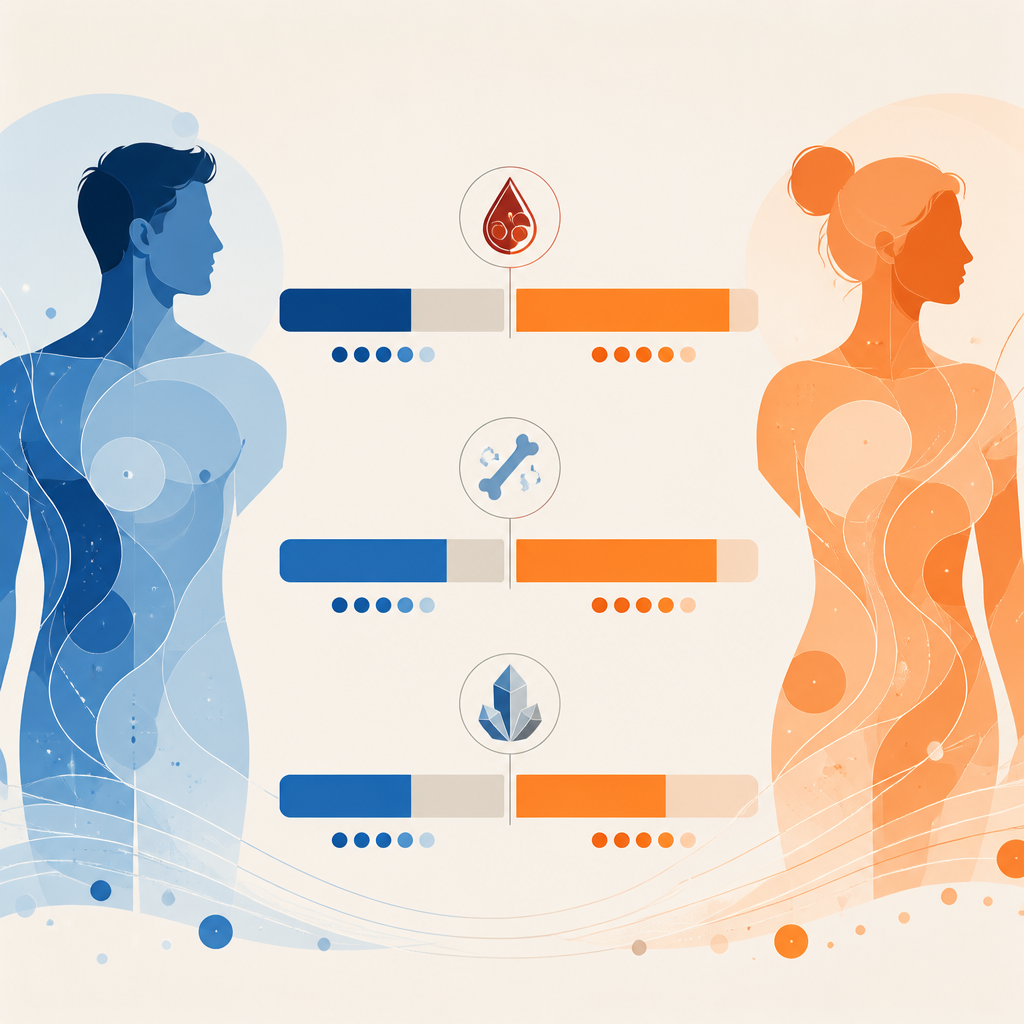
Iron is the starkest numerical gap between men's and women's requirements. Premenopausal women need approximately 14-18 mg of iron daily, while men of the same age need around 8 mg. Monthly menstrual blood loss is the direct driver of this gap. Active women are at even greater risk of iron insufficiency because exercise itself can increase iron losses through sweat and gastrointestinal micro-bleeding.
A women's formula that skimps on iron because it wants to appeal to both sexes is not doing its job. The Plusssz Multivitamin WOMAN formula is built with this requirement explicitly in mind, rather than using a compromised middle figure.
Folate plays a central role in DNA synthesis, cell division, and the healthy development of the nervous system. Women of childbearing age are routinely advised to ensure adequate folate intake. When a formula lists methylfolate rather than basic folic acid, that is a meaningful formulation choice. Methylfolate is the bioactive form that the body can use directly, bypassing conversion steps that a significant portion of women do not perform efficiently due to common genetic variants.
The inclusion of iodine in women's formulas is also important. Iodine supports thyroid function, and thyroid health has particular relevance for women, who are more prone to thyroid-related issues than men.
Both sexes need calcium and D3, but women face a steeper trajectory of bone density loss, particularly around and after menopause when oestrogen levels drop. A women's multivitamin should include higher calcium levels alongside vitamin D3 and vitamin K2, which helps direct calcium to bones rather than soft tissue. This trio works as a system, not as isolated nutrients.
Pro tip: If you are an active woman who trains regularly, pair your Plusssz Multivitamin WOMAN with the lusssz electrolyte formula on training days. The electrolyte product replaces sodium, potassium, and magnesium lost through sweat, while the multivitamin covers your baseline micronutrient needs. These are not competing products; they serve genuinely different purposes.
A dedicated men's multivitamin UK formula serves a different set of biological priorities. The common mistake is assuming that men simply need "less" of everything a women's formula contains. That is wrong in both directions. Men need less iron and less calcium relative to premenopausal women, but they need meaningfully higher amounts of zinc, selenium, and specific B vitamins.
Zinc is arguably the most important mineral in a men's formula. It contributes directly to the maintenance of normal testosterone levels, supports sperm production and quality, and plays a role in immune function. Men need approximately 11 mg of zinc daily, compared to around 8 mg for women. A generic multivitamin often doses zinc conservatively to appeal to a broad audience, which means men training regularly may fall short.
Selenium works alongside zinc as an antioxidant that protects cells from oxidative stress, supports immune function, and contributes to normal male reproductive health. Both nutrients are prioritised in the Plusssz Multivitamin MEN formula precisely because they reflect real male physiological needs rather than average-of-both figures.
B vitamins, particularly B6, B12, and B3, support energy metabolism, cognitive function, and the production of red blood cells. For active men, this is not trivial. B12 and B6 have also been linked to supporting normal testosterone levels, which is particularly relevant for men over 35 who experience a gradual natural decline.
Magnesium belongs in this conversation too. Active men deplete magnesium more rapidly through sweat and muscular effort. Magnesium contributes to normal muscle function, reduction of tiredness and fatigue, and the maintenance of normal bones. When a formula uses magnesium bisglycinate rather than cheaper magnesium oxide, that signals genuine attention to bioavailability, not just label-filling.

Iron is the clearest example. Men storing excess iron have no good mechanism to excrete it, and high ferritin levels have been associated with cardiovascular concerns in some research. A men's formula should not include the same iron dose as a women's formula aimed at premenopausal users. This is not a detail, it is a meaningful health consideration.
Pro tip: For men who train hard and use Plusssz electrolyte tablets around workouts, the Plusssz Multivitamin MEN should be taken with your largest meal of the day, not immediately before training. Digestive resources are partly redirected during exercise, and fat-soluble vitamins in particular absorb better alongside dietary fat.
The fundamental problem with a generic multivitamin is that it tries to satisfy two sets of different physiological requirements with one set of ingredient levels. The result is a formula that is consistently too low in some nutrients for one sex and potentially mismatched for the other.
A common practical failure: a woman using a generic or men's-targeted formula gets inadequate iron and insufficient folate. An active man using a standard women's formula gets more iron than he needs and less zinc than his physiology demands. Neither outcome is optimal, and both are avoidable simply by choosing a formula built around your actual biology.
The issue is compounded for active individuals. Training raises your baseline micronutrient requirements. You lose more through sweat, use more in cellular repair and energy production, and absorb some nutrients less efficiently when training volume is high. This means a formula calibrated for a sedentary average is already underspecified before you add the sex-specific gaps on top.
The table below summarises the key formulation differences between the Plusssz gender-specific multivitamin formulas, based on what a well-constructed women's versus men's formula should prioritise according to established nutritional science.
Nutrient or Feature |
Plusssz Multivitamin WOMAN |
Plusssz Multivitamin MEN |
|---|---|---|
Iron |
Higher dose to address menstrual losses |
Lower dose appropriate for male physiology |
Folate (as methylfolate) |
Priority inclusion for reproductive health and cell division |
Present but at lower priority dose |
Zinc |
Included, moderate dose |
Higher dose to support testosterone and prostate health |
Selenium |
Included, standard dose |
Elevated dose for male hormonal and reproductive support |
Calcium and D3 |
Higher relative dose for bone density support |
Included for bone and muscle function, lower relative dose |
B Vitamins (B6, B12) |
B6 prioritised for hormonal balance and PMS management |
B6 and B12 prioritised for energy metabolism and testosterone support |
Delivery format |
Effervescent tablet for improved assimilability |
Effervescent tablet for improved assimilability |
Added sugar |
No added sugar |
No added sugar |
Target users |
Active women, women seeking hormonal and bone health support |
Active men, men seeking energy, testosterone, and recovery support |
A question that comes up often in the Plusssz community: if you are already using Plusssz electrolyte hydration tablets around your workouts, do you still need a dedicated multivitamin? The short answer is yes, and the reason is that these two products solve different problems.
Electrolyte products replace what you lose acutely during exercise. Sodium, potassium, and chloride are the primary electrolytes lost through sweat, and replacing them during or after training supports hydration, muscle function, and recovery. A multivitamin covers your baseline daily micronutrient status across vitamins and trace minerals, most of which are not meaningfully depleted in a single training session but accumulate as insufficiencies over weeks and months if dietary intake is inconsistent.
In practice, the combination makes more sense than either product alone for someone training regularly. The electrolyte formula handles the acute daily demands of an active lifestyle. The gender-specific multivitamin handles the chronic baseline requirements that training raises and diet often does not fully cover. Both categories have a place in a serious routine, and neither duplicates the other's function.
If you found Plusssz through a friend or training partner, this is probably the clearest explanation of why they use both products rather than just one. The acute need and the chronic need are genuinely different, and trying to solve both with a single product means compromising on at least one of them.
It is not recommended as a long-term substitute. The MEN formula has lower iron and folate levels than a woman of reproductive age needs, and using it consistently leaves real gaps in two of the most important nutrients for female physiology. If you are postmenopausal, the iron differential becomes less critical, but folate and calcium levels would still be mismatched.
For premenopausal women, a higher iron dose in a women's formula is not only safe but necessary. The formula is calibrated for women who are actively losing iron monthly. However, if you have been diagnosed with haemochromatosis or another iron storage disorder, you should always consult your GP before taking any iron-containing supplement.
Evidence supports that men who train regularly can have lower zinc status than sedentary men, partly due to losses through sweat and the increased demand for zinc in muscle repair and immune function. A men's multivitamin that doses zinc at or toward the upper end of the recommended range makes more sense for active men than one calibrated for sedentary average needs.
Standard folic acid needs to be converted by the body into its active form before it can be used. A meaningful proportion of the population carry a common genetic variant that slows this conversion. Methylfolate bypasses this step entirely because it is already in the bioactive form. When a women's formula uses methylfolate rather than folic acid, it is a genuine formulation upgrade, not just a label change.
A balanced diet is always the foundation. However, consistent dietary adequacy across all key micronutrients is harder to achieve in practice than in theory, particularly for active individuals with variable eating patterns, high training volumes, or calorie-controlled diets. A well-formulated gender-specific multivitamin is not a replacement for good food choices. It closes the gaps that real-world eating leaves open, and it does so with doses and forms calibrated to your actual biological requirements rather than a population average.
Yes, and for people training regularly, using both makes logical sense. The electrolyte tablets address acute hydration and mineral replacement during or after training. The multivitamin addresses your daily micronutrient baseline. They serve different physiological purposes and there is no meaningful overlap that creates risk at the doses each product provides.
If you use either the Plusssz Multivitamin WOMAN or the Plusssz Multivitamin MEN, share what has changed for you in terms of energy, recovery, or general wellbeing. Peer experiences are often the most useful signal for people deciding whether a specialized formula is worth the switch from a generic product.