Ask most active adults in the UK whether vitamin E matters for training and you will usually get a shrug. Yet it sits at the centre of one of the more useful debates in sports nutrition: does dampening the damage caused by hard training help you recover, or does it also blunt the adaptations you trained for? Most people reach for electrolytes, protein and creatine first and treat antioxidants as an afterthought. That is a mistake in both directions. Vitamin E has a real biological role in exercising muscle, and it is also one of the easiest antioxidants to overdo. This guide sets out where the evidence stands and where a multivitamin antioxidant fits into a sensible routine.
Key Insight |
Explanation |
|---|---|
Exercise does create oxidative stress |
Contracting muscle produces free radicals, and output rises with intensity and duration. Long, hard sessions produce the most. |
Vitamin E is not a performance enhancer |
Research cited by the Gatorade Sports Science Institute finds that common antioxidant supplements, including vitamin E, do not improve exercise performance on their own. |
Megadoses may blunt training gains |
The main argument against supplementation is that very high antioxidant doses can dampen the training response that drives adaptation. |
Diet is the first place to check |
The strongest case for supplementing exists for athletes whose diets fall short of recommended antioxidant intakes. Assess your food intake before buying anything. |
Stacking products is the common error |
Multivitamins, greens powders and recovery drinks can each contain antioxidants. Add up the totals across everything you take. |
Check medicine interactions |
Vitamin E can interact with some medicines, so anyone on prescription treatment should speak to a GP or pharmacist first. |
Contracting skeletal muscle produces free radicals, and the rate of production rises with exercise intensity and duration. A 2014 Sports Science Exchange article by Powers, Sollanek and Wiggs notes that prolonged exercise at roughly 65 to 80 per cent of VO2max increases radical production in working muscle. That radical load often causes oxidative damage to muscle fibres, and this damage contributes to fatigue.
In practice, a 90-minute tempo session or a heavy leg day on a poorly slept body creates far more oxidative load than a relaxed 30-minute jog. Not every session deserves the same level of concern. The people who benefit most from thinking about antioxidants are those whose weekly volume is high, whose sessions are long or intense, and whose recovery is already compromised.
A 2020 review by Higgins, Izadi and Kaviani, published in the International Journal of Environmental Research and Public Health, summarises the problem clearly. Oxidative stress during exercise produces free radicals that can lead to muscle damage, fatigue and impaired performance. For a recreational runner or a gym regular, the most noticeable version of this is delayed soreness and a slower return to full training readiness.
The damage is also cumulative in a way that is easy to miss. A session that leaves you sore for three days is not just uncomfortable, it can compress the quality of the next two or three sessions. That is why the question is worth asking, even if the answer turns out to be that supplements add little.
The same review points out that free radicals may act as signalling molecules, and that they can enhance protection against greater physical stress. This is the reason blanket antioxidant dosing is a blunt tool. You are not trying to eliminate radicals, because your body uses them to trigger protective responses.
The useful question is not whether exercise creates oxidative stress, because it does. The useful question is how much your body produces in your training, and whether your diet already gives it the tools to cope.
Pro tip: Keep a simple log of your hardest sessions for four weeks. If your soreness and fatigue cluster around the same days, you have a training load problem that no capsule will fix.
Vitamin E is not a single compound. It is a group of fat-soluble tocopherols, and their main job in the body is antioxidant activity within cell membranes, where oxidation of fats is a real concern. That location matters because membranes are where much of the early oxidative damage from intense exercise occurs.
PeaceHealth's health information on vitamin E for sports and fitness describes it as important to athletes because it is an antioxidant that may help prevent some of the oxidative damage that can occur during exercise. The wording is deliberately cautious, and it should be. "May help" is the accurate level of confidence for most of the evidence in this area.
Think of vitamin E as one part of a defensive network rather than a standalone shield. Other antioxidants, including vitamin C, work alongside it, and the body has its own enzyme systems. Supplementing one part of that network does not guarantee the whole system performs better.
For active adults, the practical takeaway is that vitamin E belongs in the category of protective nutrients. It supports the system you already have. It does not turn you into a faster athlete.
Plenty of products promise faster recovery and less soreness, and vitamin E is often part of that pitch. The honest position is that the evidence for a specific recovery benefit from vitamin E is weaker than the marketing implies. Where it exists, it tends to concern the reduction of exercise-related oxidative damage rather than a dramatic change in how you feel the morning after.
In practice, if you are sore for three days after every long session, supplements are the last thing to adjust. Sleep, total carbohydrate intake, protein spread across the day and a gradual progression in training volume will usually do more. A vitamin E capsule is a marginal addition to that list, not a replacement for it.
The GSSI article is direct on the performance question. Studies it reviews show that supplementation with common antioxidants, including vitamin E and vitamin C, does not improve exercise performance. If you are buying vitamin E to get faster, the evidence does not support that purchase.
The strongest argument against antioxidant supplementation is not that it does nothing. It is that high doses may work against you. The GSSI article identifies the main concern as the possibility that megadoses of antioxidants, such as vitamin E and C, can diminish the training response to endurance exercise.
This is a counterintuitive idea for many people. Training works because it creates a stress that the body responds to by adapting. If the same stress that triggers those adaptations is heavily suppressed, the signal weakens, and the adaptation can be smaller than it would otherwise have been.
The 2020 review states that current evidence suggests antioxidant supplementation may impair these adaptations. The word "may" is doing important work there, and the research is not settled. But the direction of the concern is consistent with the signalling role of free radicals described earlier.
For a serious endurance athlete training for a specific event, this is a real trade-off. For a general gym-goer chasing strength or body composition, the risk is probably lower, but the logic still applies. Adding a high-dose antioxidant on top of a hard training block is not a neutral act.
A megadose is a dose far beyond what you would normally get from food, taken every day over an extended period. Most people do not reach that level through a standard multivitamin. The problem usually starts when several products each contribute a meaningful amount and nobody adds up the total.
A common scenario looks like this. A vitamin E capsule is taken for "recovery", a vitamin C powder is added for immunity, a greens blend is taken for micronutrients, and a recovery drink adds more antioxidants on top. Each product looks modest on its own. Together they can produce an intake far higher than anyone intended.
Pro tip: Write down every product that contains vitamin E or vitamin C, then add the amounts per day. If the total surprises you, reduce one product before you change your training.
The clearest case for supplementation is an athlete who does not eat a well-balanced diet. The GSSI article makes this point directly. If a nutritional evaluation shows that an athlete consumes less antioxidant vitamin than the recommended daily allowance, supplementation designed to reach that standard appears warranted.
That is a narrower group than the supplement aisle suggests. It is also a group that can be identified with a simple dietary review rather than guesswork. The distinction between "I might be low" and "I have measured my intake and I am low" is the difference between a sensible purchase and an expensive habit.
Several patterns in UK eating can leave active adults short. Those who follow restrictive diets, cut calories hard during a training block, or eat very few nuts, seeds and plant oils may have a gap. Vegans and vegetarians who do not plan their fats carefully are also worth checking, as are people who train very early and skip breakfast routinely.
Older active adults should also think about absorption and medicines. Fat-soluble vitamins depend on dietary fat for absorption, so a very low-fat eating pattern can reduce how much you take in from food and capsules alike. If you take regular medication, the interaction question matters more than the dose question.
Start with a seven-day food record. Log everything, including oils used in cooking, handfuls of nuts and seeds, and any fortified foods. Then compare your typical intake against the recommendations in the NIH Office of Dietary Supplements fact sheet for health professionals, which covers dosing, sources and deficiency symptoms in detail.
If the record shows reasonable intake, a vitamin E capsule adds little and carries some risk of overlap. If it shows a clear shortfall, you have a specific target to fix with food first, and a supplement becomes a reasoned choice rather than a reflex.
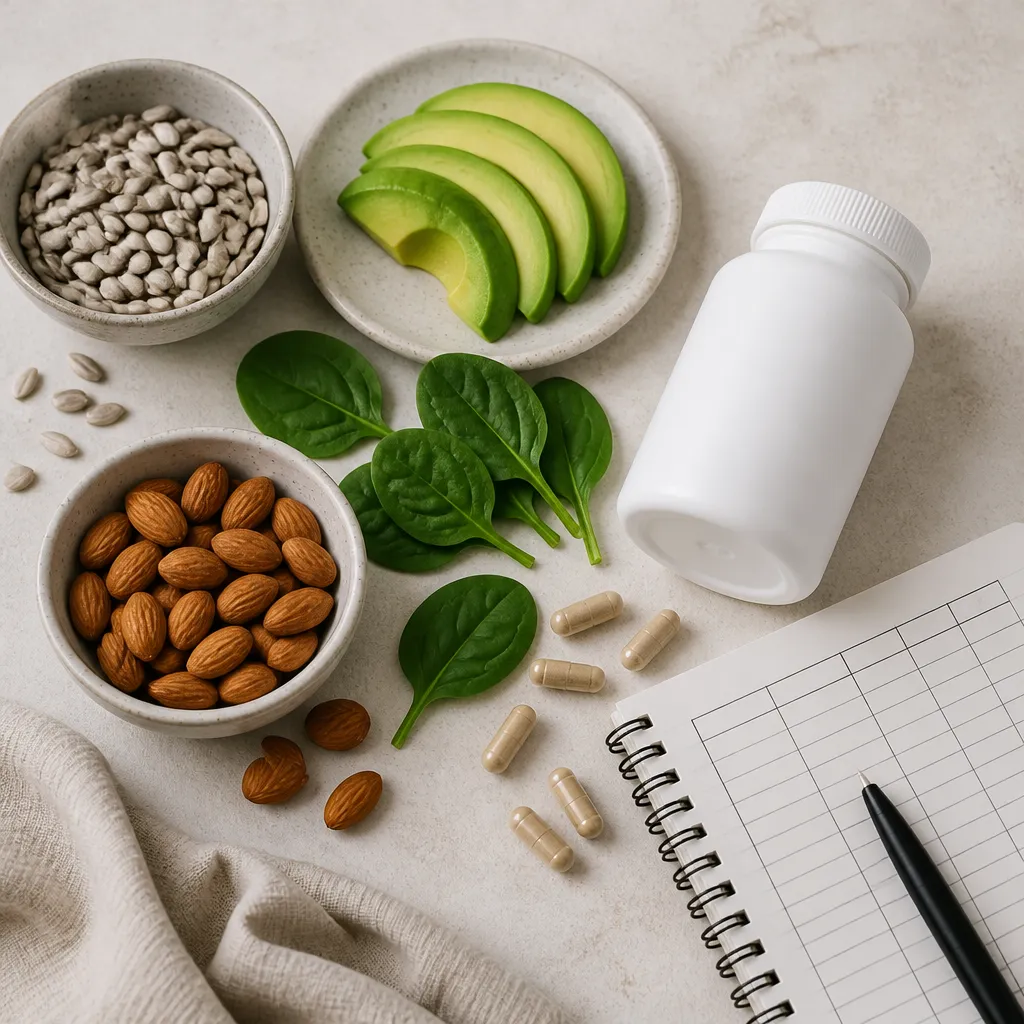
Vitamin E is found across a range of everyday foods, and most of them are easy to build into a training diet. The main sources include nuts, seeds, plant oils and leafy green vegetables. These foods also bring fibre, healthy fats and other micronutrients, which matters because vitamin E rarely works in isolation in a real diet.
A food-first approach has a built-in safety margin. It is very difficult to overshoot your vitamin E intake by eating a handful of almonds, a spoonful of sunflower seeds and a plate of spinach. That is not true of a concentrated capsule taken daily on top of other products.
A simple pattern works well for most people. Eat a small handful of nuts or seeds every day, cook with a plant oil rather than a solid fat where practical, and include leafy greens at least several times a week. Put nut butter on porridge or wholemeal toast before a long session, and keep a tub of seeds in the cupboard for snacks.
The aim is consistency, not perfection. Most people fail on food because they rely on one meal to do everything, then eat very little for the rest of the week. Spreading the sources across days is more effective than one large portion.
Food delivers vitamin E in amounts that are hard to exceed by accident, alongside the other nutrients that support the same systems. A capsule delivers a fixed, concentrated dose regardless of what else you eat that day. For someone whose intake is already adequate, that concentrated dose is an unnecessary addition with a real downside.
In practice, I would rather see an active adult fix their weekly food pattern for four weeks before adding any supplement. If the change in diet does not solve the problem they are trying to solve, that is useful information, and it makes the supplement decision much clearer.
Most active adults in the UK have three realistic routes to antioxidant support. They can rely on food, take a standalone vitamin E product, or use a multivitamin complex that contains antioxidant ingredients. Each one suits a different person, and each carries a different risk.
Approach |
What It Gives You |
Main Risk |
|---|---|---|
Food-first diet |
A modest, varied intake with fibre, healthy fats and other nutrients that work together |
Gaps if your diet is restricted or very low in fats |
Standalone vitamin E capsule |
A precise, fixed dose that is easy to target if a shortfall has been confirmed |
Easy to overshoot, and possible interactions with some medicines |
Multivitamin with antioxidant ingredients |
Covers general nutritional gaps at moderate levels without extra effort |
Hidden overlap with other antioxidant products, so totals can climb quietly |
The table reflects a simple rule. The more concentrated and isolated the source, the more carefully you need to track the total. A food-first pattern rarely needs tracking at all, while a standalone capsule demands it.
For most readers, the sensible order is food first, then a multivitamin if general gaps are likely, and a standalone vitamin E product only after a confirmed shortfall. Reversing that order is where the trouble usually starts.
For many active adults, a multivitamin is the main place antioxidants enter the routine without any deliberate decision. That is not a problem in itself. A well-formulated multivitamin covers general gaps at moderate levels, which suits people with busy schedules who cannot plan every meal. At Plusssz, our multivitamin complexes are built for active people, but the same label discipline applies to any product you choose.
The question to ask is not whether a product contains antioxidants. Nearly every good multivitamin does. The question is how much it adds to what you already eat and what else you take.
Check the amount of vitamin E per serving and compare it with the amount in your food record. Look for other antioxidant ingredients, including vitamin C, and note whether they appear in separate products on your shelf. Check the number of servings too, because a label that says one tablet can hide a larger total if the instructions say two.
Finally, look at the form and the source of the nutrient rather than the marketing claims on the front. The front of the pack is designed to sell. The supplement facts panel is designed to inform, and it is the document worth reading.

Some people ask whether vitamin E should be taken before or after training. The evidence for a specific timing advantage is weak. Consistency matters far more than timing, and a supplement taken with a meal that contains some fat is a sensible default if you do decide to use one.
If you are using a multivitamin, take it at the same point each day so it becomes part of a routine you can review. A supplement you take sporadically is almost impossible to assess, and that makes it impossible to know whether it is doing anything for you.
The mistakes around vitamin E and exercise are predictable, which makes them easier to avoid. Most come from treating antioxidants as a shortcut for things that matter more, or from assuming that a natural label means a product is safe at any dose.
The most common mistake is starting a high-dose antioxidant after a hard week and expecting it to fix the fatigue. If the real problem is poor sleep, insufficient calories or a training jump of 40 per cent in a fortnight, a capsule will not solve it. The supplement becomes a distraction from the changes that would have helped.
A better habit is to change one variable at a time. If you add a supplement and change your training in the same month, you will never know which one made a difference, or whether either did.
Vitamin E can interact with some medicines, and the NIH fact sheet covers interactions as part of its health professional guidance. The safest approach for anyone on prescription treatment is to check with a GP or pharmacist before starting any new supplement, including a multivitamin with antioxidant ingredients.
Pro tip: Bring the label of any product you plan to take to your pharmacist. Asking them to check it against your current medicines takes five minutes and can prevent a problem that is much harder to fix later.
The evidence reviewed by the GSSI article indicates that supplementation with common antioxidants, including vitamin E, does not improve exercise performance. If your goal is to go faster or lift more, other parts of your training and nutrition will have a far bigger effect.
Not automatically. The first step is to check whether your diet already provides enough, using a food record. Daily supplementation makes sense only when a shortfall is confirmed, and high doses carry the risk of blunting the training response.
For many active adults, yes. A regular intake of nuts, seeds, plant oils and leafy greens covers a good portion of needs, and the risk of overshooting from food is very low. Restricted diets or very low-fat eating are the main situations where food alone may fall short.
Yes, vitamin E can interact with some medicines. Anyone on prescription treatment should speak to a GP or pharmacist before starting a new supplement, and should check the interaction information in the NIH fact sheet.
It can, if it contains antioxidant ingredients such as vitamin E or vitamin C. Add up the amounts from your multivitamin and any other products you take, because the total is what matters rather than the amount in any single product.
There is no reliable evidence that vitamin E will prevent soreness on its own. It may help with some of the oxidative damage that exercise causes, but sleep, nutrition and sensible progression in training usually make a bigger difference to how you feel.
We would like to hear how antioxidant supplements have worked for your training, so tell us what you have noticed about recovery and energy in the comments.