Half term arrives in the middle of autumn, when most routines are already stretched thin. Mornings slide, lunches come from a service station, and the bag that held your daily tablets stays on the kitchen counter. For active adults and families who take a multivitamin or an electrolyte drink, one loose week can quietly undo a month of good habits. This guide explains how to keep your supplement routine on track during the UK half term, without turning the break into a checklist exercise.
Key Insight |
Explanation |
|---|---|
Attach your dose to a fixed moment |
Choose something that survives the week, such as the kettle, the school drop-off or the first cup of tea, and use it every day of the break. |
Pack a dose-ready pouch |
Keep the week's tablets in a small labelled container in your day bag so the supplement travels with you. |
Keep supplements out of hot cars |
Glovebox and dashboard temperatures climb fast in direct sun. Keep products in a bag inside the cabin. |
Use electrolytes for real sweat loss |
Reach for an electrolyte drink during long walks, swimming, soft play or hot days, not as a default drink for every hour. |
Give each person their own product |
Adults and children need different formulations. Never share adult tablets with a child. |
Restart on a normal weekday |
Resuming on the first school or work day gives your routine a fixed point, and it stops you from doubling up to catch up. |
Most supplement routines do not fail because people stop caring. They fail because the anchor that held the habit in place disappears. For a working adult, that anchor is usually the commute, the desk or the gym session. During half term, all three vanish, and the tablet or sachet gets pushed down the list behind breakfast, school runs and the question of what everyone is eating for lunch.
In practice, the break follows a predictable pattern. The first day or two goes smoothly because it still feels like a weekday. By the third day, mealtimes have drifted and bedtimes have moved, so the supplement that was taken "with breakfast" has no breakfast to attach to. By the end of the week, most people have missed several doses without noticing.
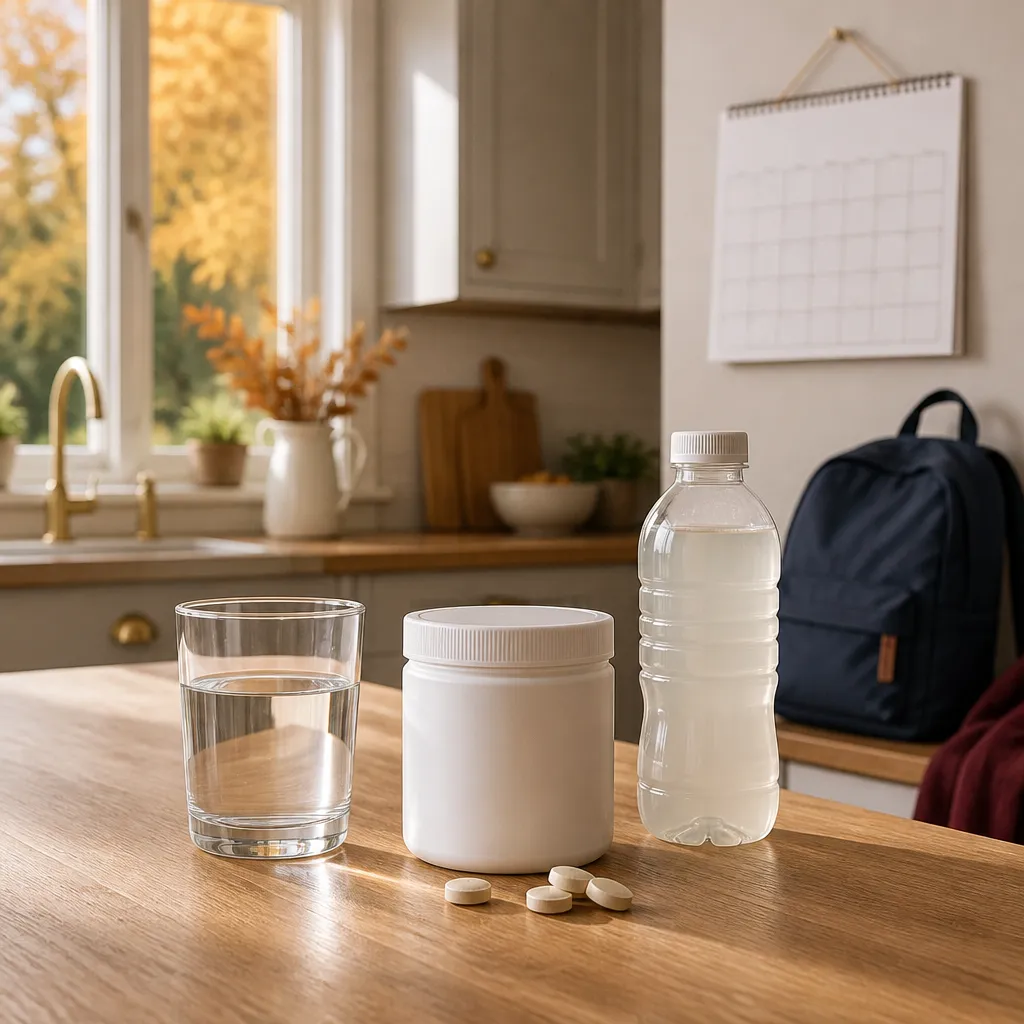
The weak point is almost never the supplement itself. It is the moment you normally take it. If your multivitamin sits next to the coffee machine and your coffee machine is switched off at the start of the holiday, the habit has nothing to hold on to. Routines built around a place are more fragile than routines built around a person's own daily sequence, so the fix is to move the dose to whatever you will definitely do on day three.
A common mistake is trying to keep the exact timing of a normal workday. Half term is not a workday, and forcing a 7am dose onto a day that starts at 9am usually leads to skipped doses by Wednesday. Pick a window instead, such as after the first meal of the day, and accept that the window may shift by an hour or two.
In the UK, the clocks go back on the last Sunday in October, and that date often falls in the same week as half term. The extra hour of morning light is pleasant, but the evenings become dark very early. People who use an evening routine, such as a magnesium dose before bed or a multivitamin with dinner, often find that dinner has moved earlier and the bedtime routine has been pushed out.
The practical response is to move the evening dose earlier by the same amount as your meals. Do not try to fight the clock on your supplement timing. Adjust the time to match your new evening, then keep it fixed for the week. A dose taken consistently at 6pm is far more useful than one taken at 10pm on some nights and missed on others.
Half term means days out, and days out are where routines disappear fastest. A trip to a farm park, a museum or a long walk on the coast has no kitchen, no tablet organiser and no reliable fridge. The solution is to treat the supplement like a snack you always carry, not a medicine that lives in one room of the house.
The simplest system is a small daily pouch or organiser for each person. Load it at the start of the week, label it with the day, and keep it in the same pocket of the same bag. Travel-sized containers and daily pill organisers are the two tools that work best in practice, because they remove the decision of what to take and how many.
Set up the pouch on Sunday evening before half term starts. Count out seven days for each person, then check the total against what is left in the original packs. Running out on day five of a holiday in a village without a pharmacy is a far bigger problem than a slightly overfilled pouch.
Use a different compartment for each day rather than a single bag of tablets. Opening a loose pot in a busy car park often means tablets end up on the floor. Compartments make it obvious whether you have taken today's dose, which is the simplest visual check you can build into a family routine.
Phone reminders work well when they are tied to the actual schedule of the week. An alarm at 8am is useless if you are on a train at 8am, so set the reminder for the moment you normally eat your first meal. Name the reminder after the supplement, not just "alarm", so you know what you are being asked to do when it goes off.
Pro tip: Keep a spare day's supply in the bag you use for the day trips, not just in the main pouch. When plans change at the last minute, the one dose that matters most is often the one you forgot to pack.
Electrolyte drinks are useful in a specific set of situations, and they are often used in the wrong ones. For most people sitting in a café or watching a film, plain water is enough. For a long afternoon in a soft play centre, a forest walk with a buggy, or a swim after a busy morning, electrolytes make more sense, because you are losing sodium and potassium through sweat and through a long period of activity.
The key word is "sugar". Many familiar drinks deliver a lot of sugar with very little electrolyte benefit, and the sugar becomes the bigger problem when the drink is sipped all day. A no-added-sugar electrolyte formula lets you use it freely on active days without adding a sugar load on top of a week of treats.
Think in terms of sweat and duration. A half-hour walk on a cool October morning rarely justifies an electrolyte drink. Two hours of active play, a long hike with a rucksack or a hot day at a theme park usually does. If you are unsure, drink water first and see how you feel after the activity rather than reaching for a bottle out of habit.
Pay attention to what the drink replaces. If it is replacing a glass of water with a meal, you are adding flavour and extra minerals without a clear reason. If it is replacing a sugary juice box at the end of a long walk, you have made a genuine improvement.
Check the label for added sugars and for the sweeteners that replace them. Sweeteners are not a sugar problem in the same way, but some people find them harsh on the stomach when a drink is consumed in large volumes. Test any new flavour at home before you take it on a long day out, because a drink that causes discomfort on a train is not worth the convenience.
Pairing an electrolyte sachet with a daily multivitamin in the same bag is a sensible setup for most adults. The sachet covers the activity days, and the multivitamin covers the normal days. Keep the two separate in your pouch so you can see at a glance which one you need.
A family routine is harder than an individual one because every person has a different schedule, different appetite and different tolerance for being told what to do. Half term amplifies all of that. Parents are busy managing the children, children are excited and unpredictable, and older relatives may be visiting with their own medication lists.
The approach that works is to assign one anchor per person and let each person own their own dose. A teenager who takes a multivitamin with breakfast and a grandparent who takes it with the evening meal can both stay consistent if each has a clear, fixed moment. Shared responsibility for everyone's tablets almost always breaks down by the second day.

Write each person's anchor on a card and stick it on the fridge. Keep it simple, such as "after brushing teeth" or "when the kettle goes on". The card does not need to explain why the supplement matters. It only needs to tell each person what to do and when, so that nobody has to ask a parent every morning.
Include older children in the setup. A ten-year-old who fills their own pouch on Sunday is far more likely to remember it on Tuesday than one who is simply handed a tablet. Ownership is the main reason family routines hold.
This is the point where many households make an expensive mistake. Children's formulations are designed for their age and needs, and adult products are not a smaller version of the same thing. Keep the products in separately labelled containers, and never let a child take an adult tablet because it seems easier to share the bottle.
If a child is already on medication, or has a condition that affects how they absorb nutrients, speak to a GP or pharmacist before adding any new supplement during the holiday. The NIH fact sheet on exercise and athletic performance supplements is a useful reference for the evidence on specific ingredients, though it is written for professionals rather than parents.
Some people should not start or change a supplement routine without advice. This includes people who are pregnant or breastfeeding, people taking prescription medicines, and anyone with a long-term health condition. Half term is a bad time to start something new, because you are less likely to notice side effects and less able to contact a clinician quickly.
A supplement taken on most days of the week will do more for you than a perfect plan abandoned by Tuesday.
There is no single right approach. What works for a household with a toddler and a full calendar will not suit an active adult who is training through the holiday. The useful question is which approach matches the shape of your week, and which failure you are most likely to hit.
Three approaches cover most situations. Each one trades convenience against consistency in a different way, and the table below sets out where each one tends to break down.
Approach |
Best for |
Main risk |
|---|---|---|
Full routine on the go, with a dose-ready pouch for every day |
Active adults with day trips and training sessions planned |
Overpacking and forgetting the pouch on the one day it matters |
Anchor-only routine, with doses tied to home meals |
Households that stay mostly at home during the break |
Missed doses on the days when the plan changes at the last minute |
Weekend reset, with the full routine restarted each Monday |
Families with unpredictable weekdays and a strict school return date |
Treating the weekend as a pause and losing momentum by Sunday night |
If your week is packed with days out, choose the full routine on the go. The extra effort of packing pouches is worth it because you will be away from home more often than not. If the week is quieter, the anchor-only approach keeps things simple and avoids a bag full of tablets you never open.
The weekend reset suits families who expect the week to be chaotic. Set a fixed restart point on Monday, and treat the weekend as a time when the routine can flex. The mistake to avoid is treating the whole week as a pause, because the habit is much harder to restart than to keep.
Pro tip: Choose the approach based on your most likely disruption, not your ideal week. If you know you will be out every afternoon, pack for that week from Sunday and skip the plan that assumes you will be home for lunch.
Most people do miss doses during half term, so the more important skill is recovery. The aim is to return to your normal routine quickly, without guilt and without an overcorrection that creates new problems.
The rule is simple. Do not double up to make up for missed doses unless the product label or a clinician specifically tells you to. Take your usual dose at the next scheduled time, and carry on from there.

Doubling up is the most common mistake after a holiday. It feels productive, but it can upset the stomach and make it harder to tell whether a product is working. A steady return to your normal dose is more useful than a dramatic catch-up on a single morning.
If you have been away for a long period and have run out, restock before the first school or work day rather than waiting for the weekend. Running out on a Wednesday is the most likely way a routine collapses for good.
Your anchor is the thing that restarts the habit. Pick the same moment you used during the week, and make the first weekday the day you set it again. A fixed start point is much more effective than a vague plan to "get back into it soon".
Review the week honestly. Note which days you missed, what caused them and whether the anchor or the packing was the weak point. Use that information to adjust the setup for next time, rather than blaming yourself for a week that was always going to be busy.
No, not unless the product label or a clinician tells you to. Take your usual dose at the next scheduled time and continue with your normal routine. Doubling up does not improve results and can cause stomach upset.
For most healthy adults, yes, but check both labels for the total amounts of vitamins and minerals. If you take prescription medicines or have a health condition, speak to a pharmacist before combining products.
Children should use products formulated for their age, and they should never share adult tablets. If a child has a medical condition or takes medicine, check with a GP or pharmacist before starting or changing anything.
Take the dose at home when you return, at your usual time, and do not double up. Keeping a spare day's supply in your day bag reduces the chance of this happening, because the backup is always with you.
A multivitamin can help fill gaps, but it does not replace a varied diet, adequate sleep or sensible hydration. Think of it as one part of a wider routine rather than a complete solution on its own.
Track the simple things, such as whether you took your dose on most days and whether your pouch was empty by the end of the week. Consistency over the holiday matters more than any single day, so focus on the pattern rather than perfection.
Tell us how your household kept its supplement routine during the last half term, and which trick actually stuck once the week got busy.