September has a way of exposing the gaps. After months of summer training, most active people in the UK arrive at the autumn transition convinced their nutrition and hydration habits are solid, only to find their energy dropping, recovery slowing, and a creeping sense that the routine that worked in June is no longer cutting it. Autumn fitness nutrition in the UK is its own challenge, and September is exactly the right moment to assess what you have been doing, what is working, and what needs adjusting before the colder months make those gaps significantly harder to close.
Key Insight |
Explanation |
|---|---|
Sweat rate drops but sodium concentration rises in cooler air |
You lose less fluid volume in autumn, but the sodium concentration in that sweat is higher. Electrolyte replacement remains essential, not optional. |
Vitamin D synthesis stops in the UK from October onward |
UV radiation is only strong enough for cutaneous vitamin D production between April and September in the UK. From autumn onward, supplementation is the only reliable source. |
Thirst is an unreliable hydration signal in cold weather |
Cold air suppresses the thirst response. Athletes who drink to thirst in autumn consistently under-hydrate, which impairs performance and recovery. |
A summer supplement routine rarely fits an autumn training block |
Intensity patterns, sweat rates, sun exposure, and caloric needs all shift. Reviewing your supplement routine at the seasonal transition is not optional maintenance, it is basic periodisation. |
Multivitamins and electrolytes address different timescales |
Electrolytes have acute, session-by-session impact. Multivitamins are a cumulative intervention. Both matter, but confusing their roles leads to poor timing and poor results. |
No-added-sugar electrolyte formulas matter more in autumn |
As training intensity shifts and sessions often shorten, the last thing you need is surplus sugar in your hydration product with no performance reason behind it. |
Recovery windows narrow in colder conditions |
Core temperature drops faster post-exercise outdoors in autumn. This compresses the optimal recovery nutrition window and makes pre-session preparation more important. |
Most people approach nutrition reviews the way they approach New Year resolutions: they wait for a hard reset moment rather than using the natural checkpoints a training year provides. September is one of those checkpoints, and it is arguably the most useful one. The summer training block is finished. Your body has adapted to whatever habits, good or bad, you maintained over those months. Autumn is about to change the environmental conditions you train in. That combination makes this the ideal time for an honest assessment.
The questions worth asking are specific. How consistent was your hydration across summer sessions? Did your electrolyte intake match your actual sweat losses, or were you relying on water alone and wondering why your legs cramped on long runs? Did your multivitamin intake stay consistent, or did it drift during holidays and disrupted routines? And critically: do the products you used in summer actually serve an autumn training block, or have you just kept them by habit?
Pro tip: Pro tip: Pull out your training log for July and August. Count the sessions where you consumed electrolytes versus water alone. If fewer than half your sessions above 60 minutes included an electrolyte product, that is your first finding. Fix that before you address anything else.


The most common mistake active people make at this time of year is assuming cooler temperatures mean hydration matters less. The physiology does not support that assumption. As temperatures decrease and the air gets drier, sweat evaporates more easily, and the temperature gradient between skin and cool air makes exercise feel more manageable. That feeling is the problem. You are still losing fluid and electrolytes, but the discomfort signals that usually prompt you to drink are quieter.
Research comparing exercise in warm and cool conditions found that while overall sweat volume is somewhat lower in cooler environments, the sodium concentration in sweat is actually higher in those conditions. This matters practically: you may be drinking less because you feel less thirsty and less hot, but the electrolyte content of what you are losing is proportionally greater. Reaching for plain water as your only hydration strategy in an autumn training session is therefore a double error. You are under-drinking, and the little fluid you are losing is disproportionately mineral-rich.
In the UK, UV radiation is only strong enough to allow the skin to produce vitamin D between April and September. From October onward, the sun angle is too low for meaningful cutaneous synthesis regardless of how much time you spend outdoors. This is not a marginal concern. Vitamin D is directly involved in muscle function, immune response, and bone mineral density, all of which matter significantly to anyone training through the winter. The NHS recommends that everyone over four years old in the UK consider taking a daily supplement of 10 micrograms of vitamin D during the autumn and winter months precisely because dietary and sunlight sources are insufficient during this period.
Pro tip: If you are already taking a multivitamin that includes vitamin D3, check the dose. Many standard formulas include amounts that fall below what research suggests is useful for active adults. A multivitamin complex designed for active individuals should specify vitamin D3 (not D2) and provide it in a dosage relevant to the UK's seasonal deficiency context.
Auditing your hydration is not about counting glasses of water. That approach is too blunt to be useful for anyone training seriously. A meaningful hydration audit for an active person in the UK going into autumn covers three things: fluid volume relative to session intensity and duration, electrolyte intake versus sweat losses, and the timing of both relative to training windows.
The most reliable field method for understanding your personal sweat rate is straightforward: weigh yourself before and after a hard session, without clothing, after towelling off. Every pound of bodyweight lost during the session represents roughly 16 ounces of fluid loss. Most athletes who do this properly in autumn for the first time are surprised by how significant those losses still are, even in cool conditions. This gives you an actual target rather than a guess.
For sessions lasting longer than 60 minutes, water alone is not a complete hydration strategy. Sodium governs fluid retention and nerve impulse transmission. Potassium and magnesium play direct roles in muscle contraction and the prevention of cramping. Losing these through sweat without replacing them is a measurable, session-by-session drain on performance and recovery. If your current product does not contain sodium, potassium, and magnesium in meaningful amounts, it is not doing the job that an electrolyte hydration product is designed to do.
Nutritional gaps in athletes are often not dramatic deficiencies but chronic insufficiencies, where levels are technically above clinical thresholds but still suboptimal for performance, recovery, and hormonal function.
This is an important frame for the hydration audit too. The question is not whether you are clinically dehydrated. The question is whether your electrolyte status is optimised for the training you are actually doing. Suboptimal is enough to blunt your sessions and slow your recovery without ever showing up as a clear symptom.
For sessions under 60 minutes, consuming your electrolyte drink 15 to 20 minutes before training pre-loads plasma sodium concentration and primes fluid balance. For longer sessions, begin sipping electrolytes at 20 to 30 minute intervals during the session. The timing of electrolytes is fundamentally different from the timing of a multivitamin. Electrolytes are acutely time-sensitive. Multivitamins are a cumulative, chronic intervention. Getting both timings right matters, and confusing the two leads to results that do not reflect what either product can actually deliver.
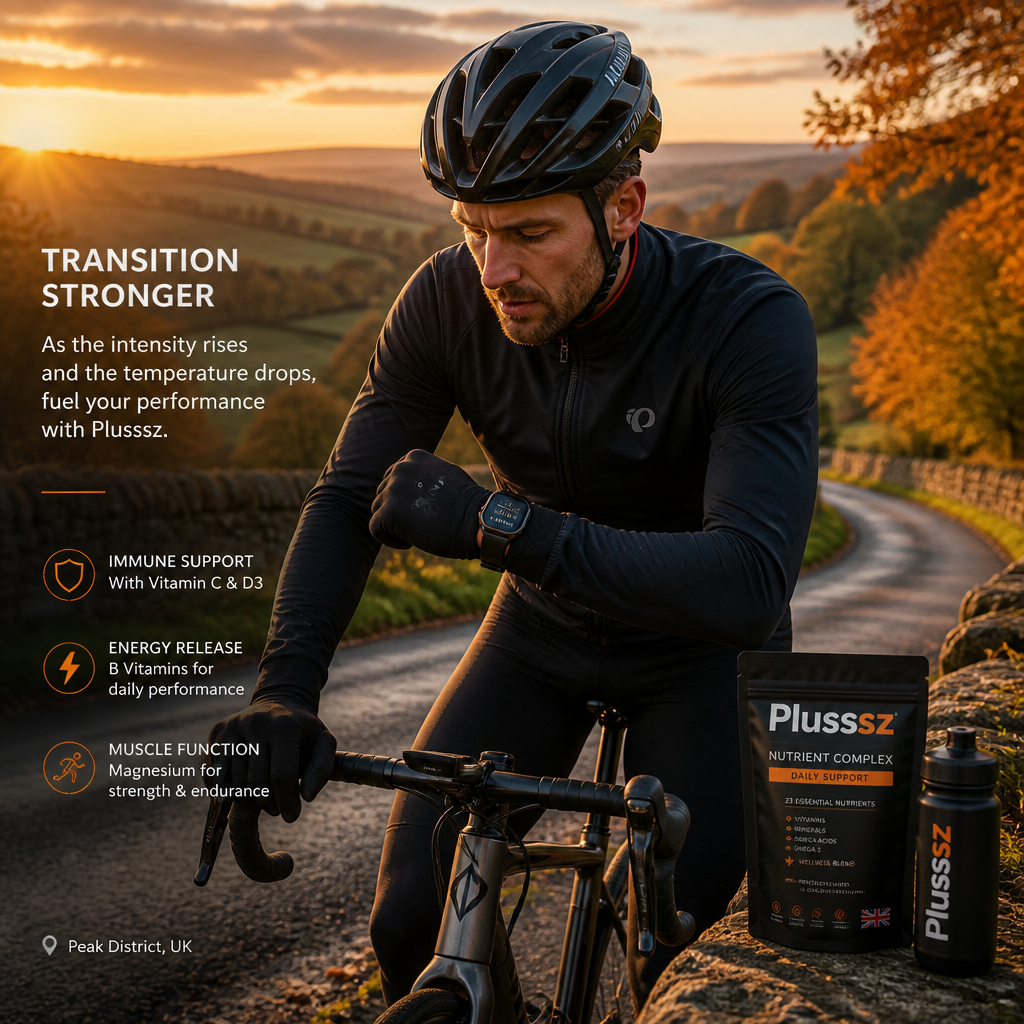
Reviewing your supplement routine at the seasonal transition is basic periodisation, applied to nutrition. Your training block changes. Your caloric expenditure may shift. Your sun exposure drops sharply. Your immune system comes under more pressure as the days shorten and indoor environments become more common. A supplement stack that you set up in May and have not revisited is probably not optimally matched to what your body needs heading into October.
Start with what you know has changed. Sun exposure: down. This means vitamin D3 needs to be present and dosed adequately. Immune pressure: up. This means B vitamins, zinc, and antioxidants carry more weight in autumn. Recovery time: often longer in cold, damp conditions. This means magnesium and B12 warrant attention. Work through your current product label with those filters in mind. If it is a generic formula not designed for active adults, it is probably under-specced in the areas that matter most for this season.
The source form of a mineral determines how much of it your body actually absorbs and uses. Magnesium bisglycinate, for instance, is more bioavailable than magnesium oxide. When a multivitamin lists higher-quality mineral forms, that reflects a genuine formulation decision that affects real-world outcomes. A product designed with improved nutrient assimilability in mind is doing something fundamentally different from a cheaper formula that looks similar on the label. This distinction matters more in autumn and winter, when your body is running with more nutritional demands and less nutritional slack.
Active women heading into autumn have different requirements than active men. A formula designed for women should include higher iron (to address higher average losses), folate in an active form, and iodine. A formula for men should prioritise zinc and selenium for hormonal support. A formula for active seniors should increase vitamin D3, B12, and calcium relative to a standard adult product. These are not cosmetic differences. They reflect genuinely different physiological requirements. If you are currently using a generic, one-size-fits-all product, the autumn review is the right time to move to something formulated for who you actually are. The Plusssz multivitamin range offers separate formulations for women, men, seniors, and sports-focused individuals, which is the correct approach to this problem.
Not every approach to autumn hydration and nutrition support is equally effective. The table below compares three common approaches active UK adults take at this time of year, along with their practical strengths and limitations.
Approach |
What It Gets Right |
Where It Falls Short |
|---|---|---|
Water-only hydration with a generic supermarket multivitamin |
Low cost, easy to maintain as a habit, covers basic micronutrient gaps to some extent |
No electrolyte replacement for session losses; generic formulas often under-dosed for active adults; no vitamin D3 at autumn-relevant levels; relies on thirst, which is suppressed in cold weather |
Sports-focused electrolyte drink only (no multivitamin) |
Addresses acute session hydration and electrolyte losses well; good for performance during training |
Does not address chronic micronutrient insufficiencies; no vitamin D support through autumn and winter; leaves recovery nutrition gaps untouched beyond the training window |
Paired electrolyte hydration product plus demographic-specific multivitamin (the Plusssz approach) |
Covers both acute session needs and chronic micronutrient support; formulations targeted to actual demographic requirements; no added sugar in electrolyte product; improved assimilability in vitamin complex |
Requires slightly more organisation and consistency than a single-product approach; higher quality comes at higher cost than budget alternatives |
The water-only approach is the default for most active people in the UK, and it explains a significant portion of the performance plateaus and sluggish recovery cycles that show up in autumn training logs. The electrolyte-only approach is better but leaves the chronic micronutrient side unaddressed. The paired approach, where hydration and micronutrient support are both deliberately managed with products designed for the purpose, is the most complete response to what the body actually needs across a full autumn training block.
An action plan is only useful if it is specific. Generic advice about eating more vegetables and staying hydrated does not help you change anything. What follows is a structured approach to translating your September review into actual autumn habits.
Run the pre and post weigh-in method on your two hardest sessions of the week. Note the fluid loss figures. Check your current electrolyte product for sodium, potassium, and magnesium content, and compare those figures against what you are actually losing. If the product you are using is a carbohydrate drink with added sugar and minimal electrolyte content, it is not primarily a hydration product. Treat it as fuel and add a dedicated electrolyte product alongside it. The Plusssz electrolyte range is formulated without added sugar, which gives you clean hydration support without the unnecessary caloric load.
Read the label on your current multivitamin. Check for vitamin D3 (not D2). Check for magnesium in a bioavailable form. Check whether the product was designed for active adults or for a general population. If it fails more than one of these checks, replace it. Also check your consistency. A multivitamin taken four days out of seven delivers roughly half the benefit of one taken daily. The autumn review is the right moment to set a fixed daily habit, ideally taken with a meal that includes some dietary fat, since fat-soluble vitamins including D3 absorb significantly better in the presence of dietary fat.
Cold air suppresses the thirst response. This is not a minor physiological quirk. It is a reliable mechanism that causes consistent under-hydration in autumn and winter training. The fix is to drink on a schedule, not on thirst. Set a per-session habit: consume your electrolyte drink 15 minutes before every session over 30 minutes, then sip at regular intervals during the session regardless of whether you feel thirsty. Front-load your fluid intake during the day. Do not leave hydration entirely to the training window.
Pro tip: In genuinely cold conditions, cold electrolyte drinks are unappealing and unappealing drinks do not get consumed. A warm electrolyte drink in an insulated bottle solves more autumn hydration problems than any product reformulation. Check whether your electrolyte product dissolves well in warm water without changing its mineral profile, and use that option during the colder months rather than abandoning electrolyte intake altogether.
Post-exercise core temperature drops faster when you are training outdoors in cool conditions. This means you cool down quickly, which can make the idea of eating feel less urgent than it does after a summer session. In practice, the recovery nutrition window still matters. A combination of protein and carbohydrate within the hour after training, alongside your multivitamin, covers both the acute session demands and the longer-term nutritional support your body needs to adapt and recover. Do not let the cooler temperature trick you into skipping this step.
The combination that works consistently: electrolyte drink pre-training, continued electrolyte sipping during training, then a balanced meal with your multivitamin within an hour of finishing. This covers both the acute session demands and the longer-term nutritional requirements without requiring a complex supplement protocol that fails to survive contact with a busy week.
Yes, and the reason is specific to cooler conditions rather than despite them. Research comparing exercise in warm and cool environments found that while total sweat volume decreases in cooler conditions, the sodium concentration in that sweat is actually higher. You are losing a smaller amount of a more concentrated fluid. Electrolyte replacement, particularly sodium, potassium, and magnesium, remains essential for sessions over 60 minutes regardless of temperature.
September is the right time to start, or to confirm your supplement includes vitamin D3 at a relevant dose. In the UK, UV radiation is only strong enough for the body to produce vitamin D between April and September. From October onward, sunlight cannot meaningfully contribute to your vitamin D levels no matter how much time you spend outdoors. The NHS recommends 10 micrograms of vitamin D daily for adults in the UK during autumn and winter, and active adults training through these months should treat this as a minimum rather than a ceiling.
Check three things. First, is vitamin D3 (not D2) present at a dose relevant to UK conditions? Second, is magnesium provided in a bioavailable form such as bisglycinate rather than oxide? Third, was the product designed for a general population or specifically for active individuals? A general-population formula will be under-specced in the areas active adults need most, including B vitamins for energy metabolism, zinc for immune and hormonal function, and higher vitamin D3 for muscle and bone support. If your product fails on any of these, it is worth switching to a formula built for how you actually live and train.
Many products marketed as hydration or sports drinks are primarily carbohydrate delivery vehicles with a small amount of sodium added. A genuine electrolyte supplement is formulated specifically to replace the minerals lost through sweat, including sodium, potassium, and magnesium, in amounts that actually match sweat losses. The distinction matters because using a carbohydrate drink as your sole hydration strategy means you are getting fuel delivery, not electrolyte replacement. For sessions where you are not carbohydrate-depleted but are still sweating, a no-added-sugar electrolyte product is the more appropriate choice.
These two product categories operate on completely different timescales, so their timing should be managed separately. Electrolytes are acutely time-sensitive: consume them 15 to 20 minutes before sessions under 60 minutes, or sip throughout sessions lasting longer than an hour. Multivitamins are a cumulative, chronic intervention that work over weeks and months, not within a single session. Take your multivitamin with a meal that contains some dietary fat to support absorption of fat-soluble vitamins including D3 and A. Taking it post-training with your recovery meal is a practical habit that works well for most active people.
Seasonally is the right rhythm for most active people in the UK, and the two most important transition points are September going into autumn, and April going into spring. September matters because vitamin D synthesis stops, training environments shift indoors or become cold and wet, and immune demands increase. April matters because sun exposure returns and training intensity often ramps up. A mid-summer check-in on hydration during peak heat weeks is also worthwhile. The key principle is that a supplement routine set once and left untouched treats your body as static when it is clearly not.
Seasonal autumn produce, root vegetables, squash, leafy greens, and cruciferous vegetables, is genuinely valuable and should form the basis of an autumn nutrition approach. Autumn's harvest does provide a range of micronutrients that support an active lifestyle. However, food sources cannot reliably cover vitamin D during UK autumn and winter regardless of dietary quality, because very few foods contain meaningful amounts of it. Fatty fish and eggs contribute, but not at the doses that active adults need when sunlight is unavailable. Supplementation is not a substitute for food quality; it addresses the specific gaps that food cannot realistically fill at this time of year.
If this recap has prompted you to rethink your autumn nutrition and hydration habits, we would love to hear what changes you are planning to make or what has worked well for you in previous years.