Most active people in the UK get the supplement conversation backwards. They pick up a multivitamin or an electrolyte tablet and treat it as a shortcut, expecting it to compensate for a diet built around convenience. That approach does not work, and it wastes money. A balanced diet and supplements work together as a system, not as substitutes for each other. If the food foundation is wrong, even the best supplement formulation underperforms. This guide sets out a practical method for building a diet that supports your training, then shows you exactly where targeted supplementation fills the gaps that food alone cannot reliably close for active individuals in the UK.
Key Insight |
Explanation |
|---|---|
Supplements fill gaps, they do not replace food |
No supplement provides the full matrix of fibre, antioxidants, and co-factors found in whole food. Build diet quality first, then identify specific gaps. |
Electrolyte needs increase sharply with training volume |
Sweat losses of sodium, potassium, and magnesium are real and measurable. A standard diet rarely replaces these at the rate active individuals lose them. |
Vitamin D is a near-universal gap in the UK |
Limited sunlight from October to April means most UK adults, active or not, fall below optimal vitamin D levels without supplementation. |
Food-first does not mean supplement-never |
The food-first principle means optimising diet before adding supplements, not ruling supplements out. For active individuals, certain micronutrients become genuinely hard to obtain from food alone. |
Multivitamin timing affects absorption |
Fat-soluble vitamins (A, D, E, K) absorb better with a meal that contains dietary fat. Taking a multivitamin on an empty stomach is a common and avoidable mistake. |
No-added-sugar formulas matter for daily use |
If you use electrolytes or multivitamins daily over months, hidden sugar content adds up. Choosing no-added-sugar formulations keeps this a non-issue. |
Demographic-specific formulas outperform generic ones |
Nutrient needs differ between men, women, seniors, and younger active adults. A formula built for your profile delivers more relevant micronutrient ratios than a one-size-fits-all product. |
The British Dietetic Association is direct on this point: there is no supplement that provides the same nutritional benefits as a healthy balanced diet. Whole food delivers vitamins and minerals alongside fibre, phytonutrients, and a range of co-factors that interact in ways a supplement cannot replicate in a capsule or tablet. That is not a reason to dismiss supplements. It is a reason to understand what they are actually for.
Sports nutrition experts describe the right order of priorities as a "food first" approach. That means: eat a varied, nutrient-dense diet as the foundation, identify where genuine gaps exist given your training load and lifestyle, and then use supplements to address those specific gaps with precision. Supplements used this way do meaningful work. Supplements used as a substitute for poor eating habits do very little.
The main reasons active people benefit from supplementation in practice are three-fold. First, correcting or preventing micronutrient deficiencies that impair performance or recovery. Second, providing convenient nutrient delivery at times when eating a full meal is impractical, such as immediately after a training session. Third, replacing minerals lost through sweat at rates that a normal diet does not keep pace with during periods of high training volume.
Supplements are only a small part of a nutrition programme for training. The foundation is a varied, high-quality diet that meets energy and macronutrient needs first.
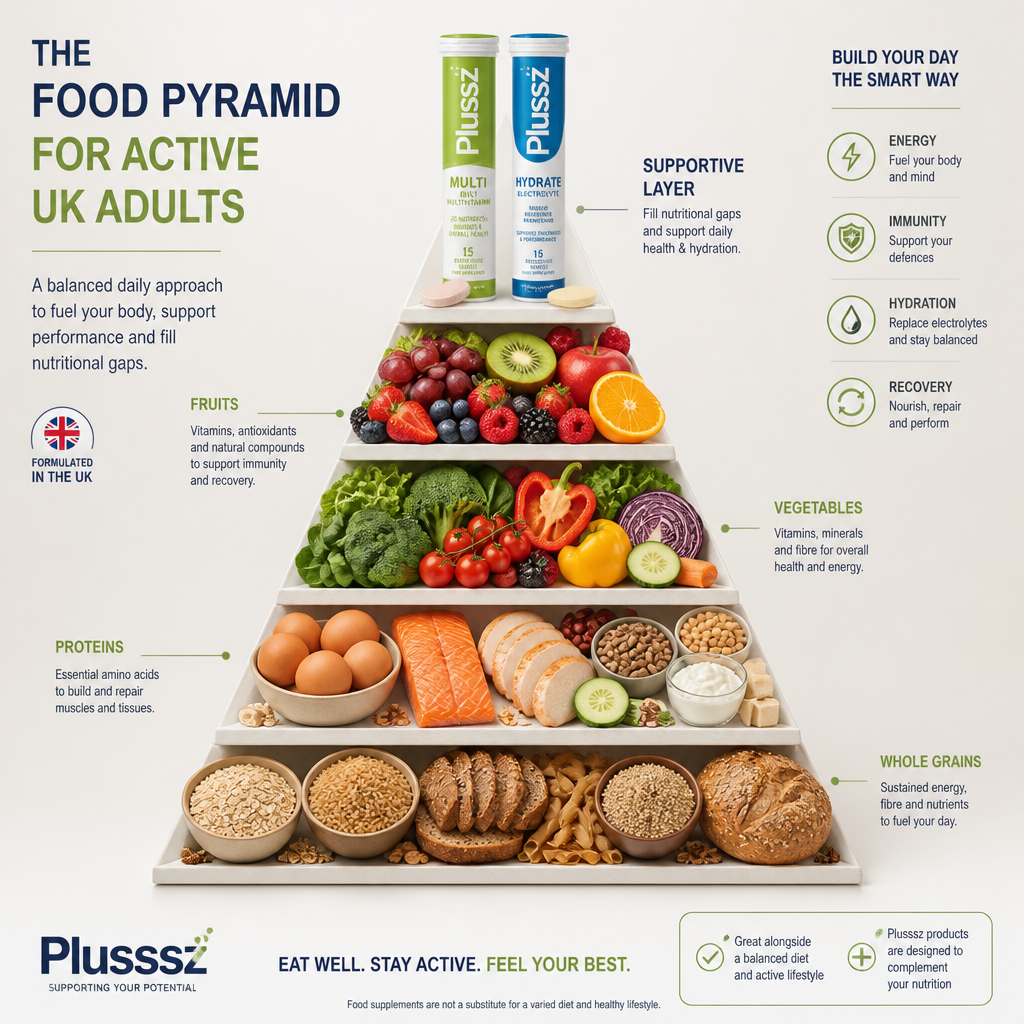
Before looking at any supplement, examine what the diet actually contains. Most active people in the UK are broadly aware of what healthy eating looks like but fall short in two or three specific areas that compound over time. Getting these right makes supplementation far more targeted and cost-effective.


Protein is the area where active people most frequently either over-invest in supplements or under-eat through food. Research from the International Society of Sports Nutrition suggests that consuming a high-quality protein dose distributed evenly across meals, roughly every three to four hours, is associated with better muscle protein synthesis outcomes than eating the same total amount in fewer sittings. This is something you can achieve almost entirely through food. Half a chicken breast or a small tin of tuna provides approximately the same protein content as a standard protein supplement serving.
Practical protein sources to anchor meals around include eggs, Greek yoghurt, legumes, oily fish, lean meat, and dairy. Variety across these categories also provides a broader micronutrient profile than relying heavily on any single source.
Carbohydrates are the primary fuel source for moderate to high intensity exercise. The relevant point for diet and supplement strategy is that quality carbohydrate sources, such as oats, sweet potatoes, brown rice, and fruit, carry B vitamins, magnesium, and potassium alongside the energy. Choosing these over refined options means your carbohydrate intake is doing double duty: fuelling performance and contributing to your micronutrient baseline.
The British Dietetic Association recommends aiming for a variety of vegetables and fruit, targeting at least five portions per day. In practice, active people who eat well on protein and carbohydrates often still fall short here, particularly on vegetables. This matters because plant foods provide antioxidants that support recovery from exercise-induced oxidative stress, potassium that works alongside sodium in fluid balance, and fibre that supports gut health and consistent energy.
Pro tip: Before reviewing which supplements to add, audit your last three days of eating. If your vegetable intake is low, your fruit intake is minimal, and your protein sources are repetitive, fix those first. You will see more performance benefit from improving food quality than from adding supplements to a weak dietary base.
Acknowledging that food comes first does not mean food covers everything. For people training regularly in the UK, there are consistent and predictable gaps where diet alone is unlikely to maintain optimal levels.
The UK's latitude and climate mean that from approximately October through to April, sunlight is insufficient to trigger adequate vitamin D synthesis through the skin, regardless of how much time you spend outdoors. The British Dietetic Association explicitly recommends that all UK adults consider a vitamin D supplement during winter months. For active individuals, this matters beyond bone health: vitamin D plays roles in muscle function and immune regulation, both of which affect training continuity.
Research on electrolyte intake has consistently shown that a significant proportion of adults do not reach recommended dietary levels for magnesium. For active people, this is compounded by sweat losses. Magnesium is involved in hundreds of enzymatic processes including energy production and muscle contraction. It is present in leafy greens, nuts, seeds, and wholegrains, but in amounts that are difficult to achieve reliably while also maintaining a training schedule that creates additional loss through sweat.
Active individuals following plant-based diets face a genuine B12 gap, as this vitamin is found almost exclusively in animal products. Women who train intensively also face elevated iron requirements relative to a standard diet. These are not theoretical risks. They are documented gaps that affect performance, recovery, and long-term health when left unaddressed.
The most common mistake with diet and multivitamin use is doubling up unknowingly. If you eat a fortified breakfast cereal, drink fortified plant milk, and then take a multivitamin, you may be consuming several times the recommended intake of certain vitamins. This is not beneficial and, for fat-soluble vitamins, can be counterproductive. Check the nutrient profile of your regular foods before selecting a multivitamin formulation.
The second common mistake is taking a multivitamin on an empty stomach. Fat-soluble vitamins, specifically A, D, E, and K, require dietary fat for absorption. Taking them without food means a portion of what you swallowed passes through without being absorbed. Take your multivitamin with a meal that contains some fat, such as breakfast with eggs, or a meal with oily fish, nuts, or avocado.
The right multivitamin for an active person is not the cheapest option on the shelf, nor is it the most expensive. It is the one whose nutrient profile matches your actual dietary gaps and your demographic. A woman in her thirties who trains five days a week has different micronutrient priorities than a man in his fifties doing three sessions per week. Formulations designed for your specific profile deliver more of what you need and less of what you already get from food.
Plusssz multivitamin complexes are built around this logic, with distinct formulations for different demographics, no added sugar, and nutrient ratios that reflect the elevated requirements of an active lifestyle rather than sedentary reference values.
Pro tip: Read the label of your multivitamin against the label of any fortified foods you eat regularly, particularly breakfast cereals and plant-based milk alternatives. Identify which nutrients appear in both and at what combined levels. This takes ten minutes and prevents the most common form of unintentional over-supplementation.
Water alone does not rehydrate you effectively after intense exercise. When you sweat, you lose not just fluid but sodium, potassium, magnesium, and chloride. Replacing fluid without replacing these minerals dilutes the electrolyte concentration in your blood and can actually delay the return to proper hydration status. This is why electrolyte supplementation is a genuinely different category from multivitamins, and why active people need to think about both separately.
Sodium is the electrolyte that appears most abundantly in a typical UK diet, largely through processed foods and added salt. Potassium is found in bananas, potatoes, leafy greens, and legumes. Magnesium appears in wholegrains, nuts, and seeds. A person eating a well-structured diet with plenty of whole foods will have a reasonable baseline of all three. The problem is that exercise-induced sweat loss can outpace dietary replenishment, particularly during long sessions, in warm weather, or when training frequency is high.
The threshold where food alone stops being sufficient for electrolyte replacement varies by individual and session intensity. As a working guide, sessions exceeding sixty minutes, particularly those involving sustained effort in warm conditions, create sweat losses that a standard diet is unlikely to replace fast enough to support recovery and the next session. This is where a well-formulated electrolyte supplement earns its place, not as a replacement for food, but as a precision top-up timed around training.
A credible electrolyte formulation should contain sodium, potassium, and magnesium in meaningful doses. Products that list these minerals but include them at levels too low to be physiologically relevant offer little beyond the branding. Look at the per-serving quantities and compare them against known sweat loss ranges before assuming a product will do the job.
Plusssz electrolyte hydration products are formulated without added sugar and with a complete mineral profile specifically for active adults, with separate formulations calibrated for men, women, and older active individuals rather than applying a single generic blend across all demographics.
Nutrient timing is not a marginal consideration for active individuals. The International Society of Sports Nutrition's research on this area confirms that the timing of energy and protein intake around exercise can measurably affect muscle protein synthesis, recovery, and body composition outcomes. Getting this right from food and supplements together produces better results than either alone.
In the period between thirty minutes and two hours after training, consuming fifteen to twenty-five grams of high-quality protein alongside some carbohydrate supports the recovery process. This can come from food, from a protein supplement if eating a full meal is impractical, or from a combination. The key point is that this window exists and that missing it repeatedly over weeks of training creates a cumulative recovery deficit.
Electrolyte supplementation has its own timing logic. Taking electrolytes thirty to sixty minutes before a session helps pre-load hydration status. During sessions lasting longer than sixty minutes, continuing electrolyte intake maintains performance. In the first thirty minutes after a session, replacing what was lost is a priority before plain water rehydration is likely to be fully effective.
For daily supplementation with a multivitamin, consistency matters more than perfect timing, but taking it with a meal that contains fat is non-negotiable for fat-soluble vitamin absorption. If your training schedule means you often skip breakfast or eat very light meals, structure one main meal that includes some fat around the time you take your multivitamin, and make that pairing a habit.
Not all supplement strategies are equal. The table below compares three common approaches active people take to diet and supplementation, illustrating what each achieves in practice.
Approach |
What It Looks Like |
Practical Outcome |
|---|---|---|
Diet Only, No Supplements |
Relies entirely on food for all nutrients, including electrolytes and micronutrients. No supplements used. |
Works adequately for moderately active people with excellent dietary variety, but leaves known gaps such as vitamin D in UK winters and electrolyte losses during intense training unaddressed. Recovery and performance can suffer during high-volume training blocks. |
Generic Supplements, Basic Diet |
Uses a budget multivitamin and a mainstream sports drink with a diet that is inconsistent in quality. Supplements chosen for price rather than formulation relevance. |
High risk of doubling up on some nutrients (especially in fortified foods), under-addressing real gaps, and consuming unnecessary added sugar from sports drinks. Poor value and limited performance benefit. |
Food-First with Targeted, No-Sugar Supplements |
Strong dietary foundation covering macronutrients and food-derived micronutrients. Demographic-specific multivitamin taken with a fatty meal. No-added-sugar electrolytes timed around training. |
Addresses predictable diet gaps (vitamin D, magnesium, sweat-loss electrolytes) without doubling up, without unnecessary sugar intake, and without taking supplements the diet already covers. Best cost-to-benefit ratio for active individuals. |
For most people who are active, a well-varied diet covers the majority of nutritional needs. However, specific gaps are common and predictable for UK-based active individuals. Vitamin D is reliably insufficient from October to April due to limited sunlight. Magnesium and electrolytes are depleted through sweat faster than diet replaces them during high-training periods. A targeted supplement for these specific gaps is a rational addition even when the general diet is good. The goal is precision, not routine pill-taking.
Yes, and for most active people these two products serve entirely different functions. A multivitamin addresses your daily baseline micronutrient requirements across vitamins and minerals. An electrolyte supplement addresses acute fluid and mineral replacement during and around training sessions. They complement each other rather than overlap, provided you are not also consuming large amounts of fortified foods that already cover your multivitamin's contents.
Take it with a meal that contains dietary fat. Fat-soluble vitamins (A, D, E, K) require fat to be absorbed properly. Breakfast is a natural anchor point for most people, particularly if it includes eggs, dairy, nut butter, or avocado. Consistency matters more than the specific time of day, so attach the habit to a meal you eat reliably every day.
The most reliable method is a three-day food diary reviewed against standard nutrient reference values for your activity level. In practice, the most predictable gaps for active UK adults are: vitamin D in winter, magnesium (particularly with high training volume), and electrolytes around intense sessions. If you follow a plant-based diet, B12 and potentially iodine are additional gaps to address. These four or five areas cover the majority of diet-supplement mismatches in this demographic without requiring a blood panel for every individual.
For hydration and mineral replacement purposes, yes. The electrolyte minerals, sodium, potassium, and magnesium, do the functional work. Sugar in conventional sports drinks serves as a carbohydrate fuel source during prolonged endurance events, which is a separate function from hydration. For most training sessions and for daily active lifestyle use, a no-added-sugar electrolyte formulation provides the mineral replacement you need without the sugar load that accumulates when you are using a product daily over months.
Choose a demographic-specific formulation where one is available and relevant to you. Nutrient needs genuinely differ between men, women, seniors, and younger active adults. Women of reproductive age have different iron and folate considerations. Older active adults face different calcium, vitamin D, and B12 absorption dynamics. A formula calibrated to your profile delivers more of the nutrients you specifically require and avoids over-supplementing nutrients that are already well-covered by your diet and life stage.
Yes, and this is a real risk with fat-soluble vitamins in particular. Unlike water-soluble vitamins, fat-soluble vitamins (A, D, E, K) accumulate in the body and can reach harmful levels with sustained over-supplementation. The most common scenario is taking a multivitamin while also eating heavily fortified foods, which can push certain nutrients above the recommended upper limit over time. Always check the combined intake from both food and supplements, and do not take more than the recommended dose of any single supplement unless advised by a healthcare professional.
If you are currently working on building a diet and supplement routine that fits your training, we would like to know what has worked for you and what has been harder to get right than expected.