If you train regularly and still feel drained by midweek, the problem may not be your programme or your sleep. It may be that your body is running short of the micronutrients it needs to convert food into usable fuel. A quality B vitamin complex UK formula addresses exactly this gap. B vitamins do not supply energy directly, but without them your metabolic machinery stalls. For anyone chasing performance, better recovery, or just consistent daily energy, understanding what B vitamins actually do is more useful than any marketing claim on a label.
Key Insight |
Explanation |
|---|---|
B vitamins are cofactors, not fuel |
They do not provide calories, but they enable the enzymatic reactions that release energy from carbohydrates, fats, and protein. |
Active individuals deplete B vitamins faster |
Hard training raises ATP demand, protein turnover, and sweat loss, all of which increase daily B vitamin requirements compared to sedentary people. |
B12 and folate drive red blood cell production |
Without adequate B12 and B9, red blood cell quality drops, reducing oxygen delivery to working muscles and cutting endurance capacity. |
Water solubility means daily replenishment matters |
With the exception of B12, B vitamins cannot be stored in the body in large amounts, so gaps in intake show up quickly in energy levels. |
Deficiency impairs performance before it triggers obvious symptoms |
Sub-optimal B vitamin status causes fatigue and slower recovery well before a clinical deficiency shows up on a blood test. |
Vegans and vegetarians face the highest B12 risk |
Vitamin B12 is found almost exclusively in animal products, making supplementation close to essential for plant-based athletes. |
A broad-spectrum B complex outperforms isolated B vitamins for most people |
All eight B vitamins work interdependently. Supplementing one in isolation can mask or worsen imbalances in others. |
A B vitamin complex is not a single compound but a group of eight chemically distinct water-soluble vitamins that share a common role in cellular metabolism. Those eight are B1 (thiamine), B2 (riboflavin), B3 (niacin), B5 (pantothenic acid), B6 (pyridoxine), B7 (biotin), B9 (folate or folic acid), and B12 (cobalamin). They are grouped together because they are frequently found in the same foods and because they cooperate in overlapping metabolic pathways.
The water-soluble nature of B vitamins is one of the most important things to understand about them. Unlike fat-soluble vitamins such as A, D, E, and K, most B vitamins cannot be stored in large quantities in body tissue, which means regular dietary intake is not optional. For anyone training hard or living an active life, this creates a meaningful and ongoing nutritional obligation.
A common mistake is treating a B vitamin complex as a nice-to-have add-on rather than a foundational part of a supplement strategy. Think of it as infrastructure, not performance enhancement. You cannot build consistent output on top of micronutrient gaps.
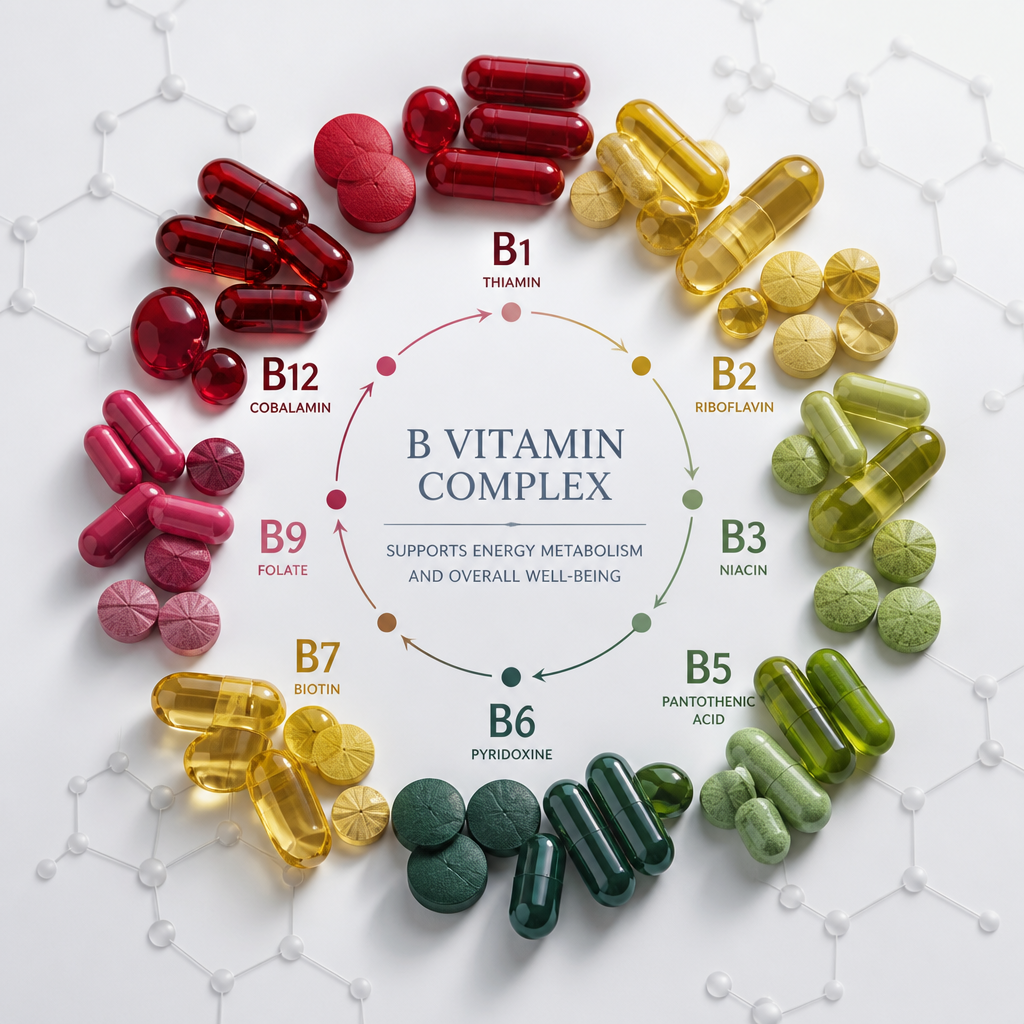
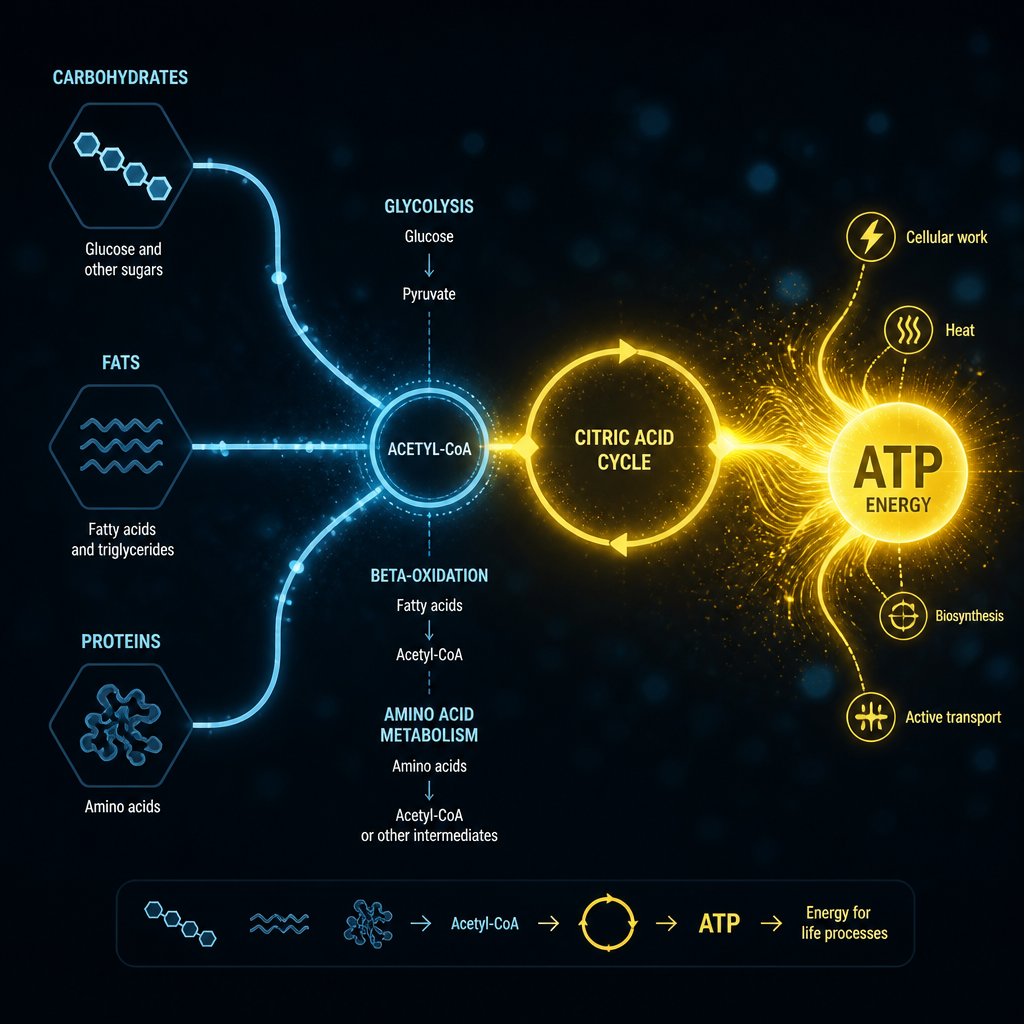
The phrase "B vitamins for energy" is used so loosely that it has almost lost meaning. Here is what it actually refers to. B vitamins act as coenzymes, meaning they bind to enzymes and allow those enzymes to carry out metabolic reactions that would otherwise be too slow or impossible. Remove the coenzyme and the reaction rate drops. In energy terms, this means the rate at which your cells can produce ATP, the molecule your muscles actually run on, is directly limited by B vitamin availability.
Thiamine (B1) is central to the conversion of pyruvate to acetyl-CoA, the critical handoff point between glycolysis and the citric acid cycle. Without adequate thiamine, this step slows and carbohydrate-derived energy backs up. Riboflavin (B2) forms part of two key coenzymes, flavin adenine dinucleotide (FAD) and flavin mononucleotide (FMN), which act as electron carriers in oxidative phosphorylation. Niacin (B3) forms NAD+ and NADH, probably the most widely involved coenzymes in human metabolism, participating in dozens of redox reactions throughout energy production. High niacin intake, however, is not straightforwardly good for performance. Research has shown that excessive niacin supplementation can actually impair exercise performance, which is one reason why balanced, properly dosed formulations matter more than mega-dose approaches.
Vitamin B6 (pyridoxine) plays a key role in amino acid metabolism and glycogenolysis, making it especially relevant for strength and power athletes whose training elevates protein turnover. B9 (folate) and B12 (cobalamin) are required for the formation of healthy red blood cells, which determines how efficiently oxygen reaches working muscles. A shortfall in either leads to a form of anaemia characterised by larger but fewer red blood cells, directly translating into reduced endurance capacity and persistent tiredness. For endurance athletes, B12 status is not a peripheral concern; it sits at the core of sustainable aerobic performance.
"B vitamins play a crucial role in maintaining fundamental cellular functions and various essential metabolic pathways in the body. Although they do not directly provide energy, each B vitamin acts as a cofactor in energy metabolism processes."
Pro tip: If you experience energy dips mid-session despite solid nutrition and sleep, consider whether your B vitamin intake has kept pace with your training volume. Increasing training load without adjusting micronutrient support is one of the most overlooked causes of unexplained fatigue in active people.
The relationship between B vitamins and sport is more nuanced than most supplement marketing suggests, and that nuance is worth knowing. Studies examining B vitamin supplementation in athletes have found that correcting a deficiency reliably improves performance markers, but that loading up on B vitamins when status is already adequate does not produce additional gains. This is the distinction between eliminating a limiting factor and trying to push past a ceiling that does not exist.
Hard training genuinely raises B vitamin requirements through several parallel mechanisms. Higher energy production demands more B1, B2, B3, and B5 because ATP synthesis requires these cofactors at every step. Elevated protein metabolism during strength training increases the need for B6. Endurance training raises the demand for B9 and B12 to support the accelerated red blood cell turnover that sustained aerobic work requires. On top of all this, B vitamins are water-soluble and are lost through sweat during prolonged or high-heat training sessions. The combination of higher demand and higher losses makes sub-optimal B vitamin status a predictable risk for anyone training seriously.
In practice, many athletes attribute persistent fatigue, reduced endurance, and slower recovery to doing too much work. Sometimes that diagnosis is correct. But a significant proportion of cases are driven by underlying nutritional imbalances, particularly B12 and folate shortfalls, that respond directly to corrected intake. The symptoms overlap so closely with overtraining that the root cause is missed. If your performance decline is accompanied by breathlessness that feels disproportionate to effort, that is a signal worth investigating from a nutritional angle before cutting training load.
Pro tip: Athletes following plant-based diets should treat B12 supplementation as non-negotiable rather than optional. B12 occurs almost exclusively in animal products, and even a well-constructed vegan diet cannot reliably meet the elevated needs of regular training through food alone.

Several groups face meaningfully elevated risk of B vitamin shortfalls, and these categories overlap heavily with the audience that is most likely to be thinking about performance nutrition.
Vegans and vegetarians are at the highest risk for B12 deficiency because the vitamin is found almost exclusively in animal-derived foods. People over 50 absorb B12 less efficiently even when dietary intake is adequate, because the stomach produces less intrinsic factor with age. Women of childbearing age in the UK face particular risk around folate (B9), with data suggesting a substantial proportion have intake levels below recommended thresholds. Athletes and active individuals of all descriptions face higher B vitamin turnover due to the mechanisms described above.
A less-discussed but important risk factor is high training volume combined with restricted calorie intake, common in weight-class sports, aesthetic sports, and among people trying to lose fat while maintaining performance. Eating less food means fewer total B vitamins from diet, while the training demands keep B vitamin requirements elevated. This combination creates a compressing gap that a quality B complex supplement is well-placed to close.
A varied whole-food diet is the right starting point for B vitamin intake. Good dietary sources include meat, fish, eggs, dairy, fortified cereals, whole grains, legumes, dark leafy vegetables, nuts, and seeds. Most of the eight B vitamins are distributed across this food range, though B12 is the notable exception, with reliable dietary sources being almost entirely animal-based.
The realistic question for active people is not whether food or supplements are better in principle. It is whether your actual daily diet, accounting for training volume, calorie budget, food preferences, and time constraints, is consistently delivering all eight B vitamins in quantities that match your needs. For many active individuals, the honest answer is that it does on some days but not reliably on all days.
When a B complex supplement is the sensible choice
Supplementation makes practical sense when any of the following apply: dietary variety is limited by time, preference, or budget; training volume is high; dietary pattern excludes major food groups; or testing has identified a specific shortfall. A broad-spectrum B complex formula, such as the magnesium and B-complex formulation in the Plusssz range, provides all eight B vitamins in a single convenient dose and is designed to complement an active diet rather than replace it. The effervescent tablet format used in several Plusssz products also supports better absorption compared to standard compressed tablets, since the nutrients are already dissolved when consumed.
Not all B complex products on the market are equivalent. Understanding what differentiates them helps you choose one that will actually support your goals rather than just look good on a label.
Approach |
Best For |
Key Limitation |
|---|---|---|
Isolated single B vitamins (e.g., B12 only) |
Confirmed deficiency in one specific vitamin, identified by testing |
Does not address the interdependency of the B vitamin group; can mask or worsen other imbalances |
Standard B complex tablet |
General maintenance of B vitamin status across the full group of eight |
Absorption can be lower in compressed tablet form; slower dissolution |
B complex combined with electrolytes and minerals (e.g., magnesium forte + B complex) |
Active individuals and athletes who need to address both micronutrient status and hydration-related mineral losses in a single step |
Contains additional active ingredients; check individual tolerance for each component |
For active individuals who are also managing hydration around training, there is a strong case for choosing a product that combines B vitamins with electrolytes or minerals rather than treating each as a separate purchase. Magnesium, for instance, works alongside B vitamins in energy metabolism and is commonly depleted through sweat. A combined formulation means fewer products to manage and a lower risk of missing a dose when your routine is disrupted.
When evaluating any B complex supplement for sport, check that the formula covers all eight B vitamins rather than just the headline ones like B12 and B6. Confirm the product carries no added sugar if you are managing total carbohydrate intake. And look at the form the vitamins are presented in: bioavailability varies across different vitamin forms, and a well-formulated product will select forms with demonstrated absorption rates rather than the cheapest available raw material.
Pro tip: Combine your B complex with a meal rather than taking it on an empty stomach. B vitamins are absorbed alongside other macronutrients, and food intake stimulates the digestive processes that support their uptake.
B vitamins do not provide energy in the way that carbohydrates or fats do. They act as coenzymes that enable your cells to extract energy from the macronutrients you eat. If your B vitamin status is adequate, taking more will not produce a noticeable energy increase. If you have a shortfall, correcting it will. The distinction matters because it sets realistic expectations for what supplementation can and cannot do.
UK dietary reference values set the recommended intake for B12 at around 1.5 micrograms per day for adults, but this figure was established for the general population under normal conditions. Active individuals, vegans, vegetarians, and people over 50 may require more to maintain optimal functional status, particularly given the role B12 plays in red blood cell production and nerve function. If you have any reason to suspect your intake is low, a blood test for active B12 is more informative than a standard serum B12 test and is worth requesting from your GP.
Yes, and for active individuals it often makes sense to do so. B vitamins and electrolytes address different but complementary aspects of performance: B vitamins support the biochemical machinery of energy metabolism, while electrolytes manage fluid balance, muscle contraction, and nerve signalling during and after exercise. Products that combine both, like the Plusssz Magnesium Forte and B-Complex formulation, are designed specifically for this purpose.
Because B vitamins are water-soluble, excess amounts are generally excreted rather than accumulating in tissue, which makes toxicity from food or a standard complex supplement unlikely. However, taking very high doses of individual B vitamins as single supplements, particularly B3 (niacin) and B6, has been associated with side effects including impaired exercise performance at high niacin doses and nerve-related issues with prolonged very high B6 intake. A balanced B complex at reasonable doses avoids these risks.
Energy drinks use B vitamins on their labels partly because the claim "contributes to normal energy-yielding metabolism" is permitted under food labelling regulations when B vitamins are present. The actual energy effect in those drinks comes from caffeine and sugar, not from the B vitamins. If you are B vitamin sufficient, the B vitamins in an energy drink will not add anything beyond what your existing intake already covers.
There is no single most important B vitamin for endurance, but B12 and folate (B9) have the most direct and well-documented impact on endurance capacity through their role in red blood cell formation and oxygen delivery. B1, B2, and B3 are also central to aerobic energy production. In practice, the weakest link in your B vitamin intake is the one that matters most, which is why a full-spectrum complex is more useful than focusing on one or two vitamins in isolation.
This depends entirely on your starting status. If you are significantly deficient, many people report improved energy and reduced fatigue within two to four weeks of correcting intake. If your status was already broadly adequate, you are unlikely to notice a subjective difference at all, though your metabolic function is still being supported. Testing before and after is the only reliable way to assess change objectively.
If you use a B vitamin complex as part of your training or daily nutrition routine, we would love to hear what difference it has made for your energy and recovery, share your experience in the comments below.