You drink water throughout your run, your ride, or your session at the gym, and yet you still hit that wall. Muscles cramp. Focus blurs. Your legs feel like concrete. The problem is not always that you drank too little water. It is that water alone cannot replace what sweat actually takes from your body. According to dietitian information published by Johns Hopkins Medicine, athletes can lose up to 2 quarts of fluid per hour during activity, and endurance athletes can lose up to 3 quarts per hour, along with significant amounts of sodium. That loss is why electrolyte supplements UK athletes trust have become a serious part of performance nutrition, not just a marketing gimmick. This guide explains exactly what is happening in your body, and what to do about it.
Key Insight |
Explanation |
|---|---|
Water does not replace electrolytes |
Sweat contains sodium, chloride, potassium, and magnesium. Plain water replaces volume but not these minerals, leaving your cells unable to function properly. |
Sodium is the priority electrolyte for athletes |
Sodium and chloride are the minerals lost in the greatest quantities through sweat and are most directly linked to muscle cramps and performance drops. |
Dehydration affects performance before you feel thirsty |
By the time thirst registers, athletic performance, flexibility, endurance, and mood are already being affected. Proactive hydration is non-negotiable. |
Electrolytes support more than muscles |
Magnesium alone acts as a cofactor in over 300 enzymatic reactions, including those tied to energy production. This is not just about cramps. |
Timing matters as much as quantity |
Hydrating only before or after exercise is a common mistake. Electrolyte intake during prolonged activity is where most athletes fall short. |
No added sugar matters for daily use |
Many mainstream sports drinks deliver electrolytes with a heavy sugar load. For training sessions shorter than 90 minutes, that sugar is unnecessary and counterproductive. |
Electrolyte needs change with conditions |
Heat, humidity, and session intensity all increase sweat rate. A formula that works in winter may underdeliver on a hot UK summer training day. |
Most people understand hydration as a simple input-output equation: you sweat, so you drink water. That model is too simple, and for athletes it can actually cause problems. When you sweat, you are not losing pure water. You are losing a fluid that contains sodium, chloride, potassium, magnesium, and calcium. Replacing the volume without replacing the minerals dilutes your blood plasma, which disrupts the electrical signalling your nerves and muscles depend on.
A common mistake is drinking large amounts of plain water during a long training session and wondering why cramps or mental fog arrive anyway. The water arrived. The electrolytes did not. Your cells use sodium and potassium gradients to fire muscle contractions and transmit nerve impulses. Without those gradients being maintained, performance degrades in ways that feel identical to simple fatigue but do not respond to rest.
This is not a niche concern for elite athletes. It applies to anyone doing sustained activity for more than an hour, training in warm conditions, or sweating heavily regardless of pace. The solution is not complicated, but it does require you to stop treating water as a complete hydration strategy.
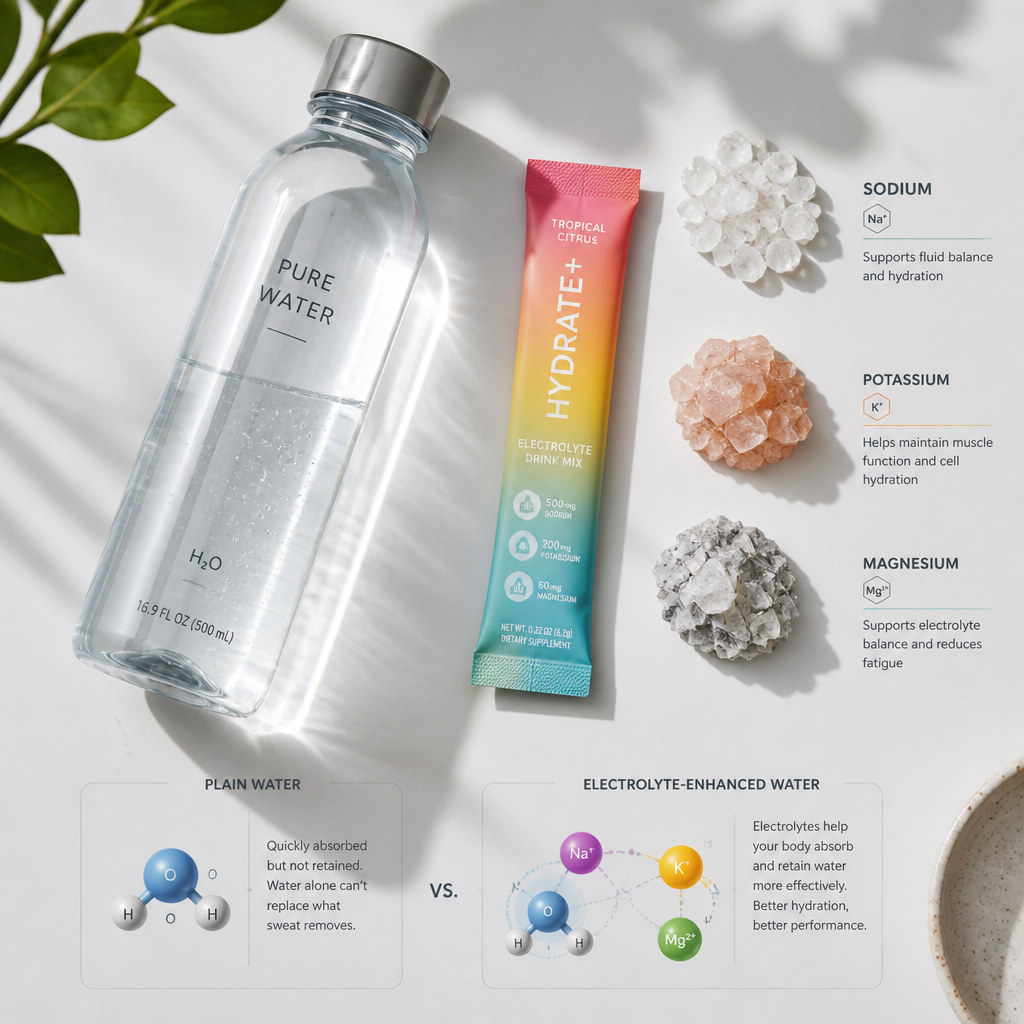

Electrolytes are minerals that carry an electrical charge when dissolved in bodily fluids. That charge is functional, not incidental. It enables the transmission of electrical signals that make your heartbeat, your muscles contract, and your neurons fire. Without the right concentrations of these charged particles, none of those systems work at full capacity.
Sodium and chloride regulate fluid balance and blood pressure. They are the electrolytes lost in the greatest quantities through sweat, which is why they are the most important to replace during exercise. Potassium counterbalances sodium at the cellular level, keeping the electrical gradient across cell membranes intact. Magnesium is involved in over 300 enzymatic reactions, including those directly tied to energy production and protein synthesis. Calcium supports muscle contractions and bone health. Phosphate and bicarbonate round out the picture, supporting energy metabolism and acid-base balance.
Your body works hard to keep electrolyte concentrations within very narrow ranges. The kidneys, hormones, and cellular transport systems all participate in this regulation. The problem is that intense physical activity throws the balance off faster than these systems can compensate, particularly when fluid and electrolyte intake during exercise is inadequate.
The effects are broader than most athletes expect. Water cushions joints, so dehydration reduces flexibility and speed. Proper hydration is essential for heart muscle function, so endurance drops when you are running low. Your lungs need body fluids to moisten inhaled air for efficient oxygen absorption, so breathing efficiency falls. And your brain needs water to function, which is why dehydration affects mood, concentration, and decision-making during competition, not just physical output.
Hydration during a game, tournament or workout, not just before and after, can fall below the radar of an athlete and their trainer, but performance depends on it.
That observation, published by Johns Hopkins Medicine, captures precisely where most recreational and club-level athletes in the UK lose hydration ground. They prepare well before a session and recover well after it. The middle section, where the electrolyte loss is actually happening, gets neglected.
Pro tip: If you are doing any session longer than 60 minutes, start your electrolyte intake at the 30-minute mark rather than waiting until you feel thirsty or tired. By the time those signals arrive, your performance has already started to slip.
Knowing the physiology is useful. Recognising it in your own body during training is more useful. These are the signals that indicate your electrolyte balance is off, not just your hydration volume.
Cramping is the most widely recognised symptom, but it is frequently misattributed. The reflex is to drink more water. The correct response is to replace sodium, potassium, and magnesium. Muscle cramping during exercise is a classic sign that electrolyte gradients across muscle cell membranes have been disrupted. Plain water makes the dilution worse, not better.
Your brain is roughly 75% water, and it is extremely sensitive to changes in electrolyte concentration. Athletes who notice unusual irritability, poor decision-making in competition, or a feeling of mental distance during sessions are often experiencing the cognitive effects of electrolyte imbalance rather than simple tiredness. This is particularly relevant in team sports and disciplines where tactical thinking matters as much as physical output.
If you are sleeping enough but still feel inexplicably flat during training, electrolyte status is worth examining before you start blaming your training load. Magnesium deficiency in particular is associated with impaired energy production at the cellular level. Athletes training frequently and sweating heavily are among the groups most likely to run chronically low on magnesium.
Pro tip: Track your sweat rate by weighing yourself before and after a known-duration session in a known temperature. Each kilogram of body weight lost represents roughly one litre of fluid, and that fluid contained electrolytes. This simple check tells you whether your current hydration strategy is keeping pace with your actual losses.
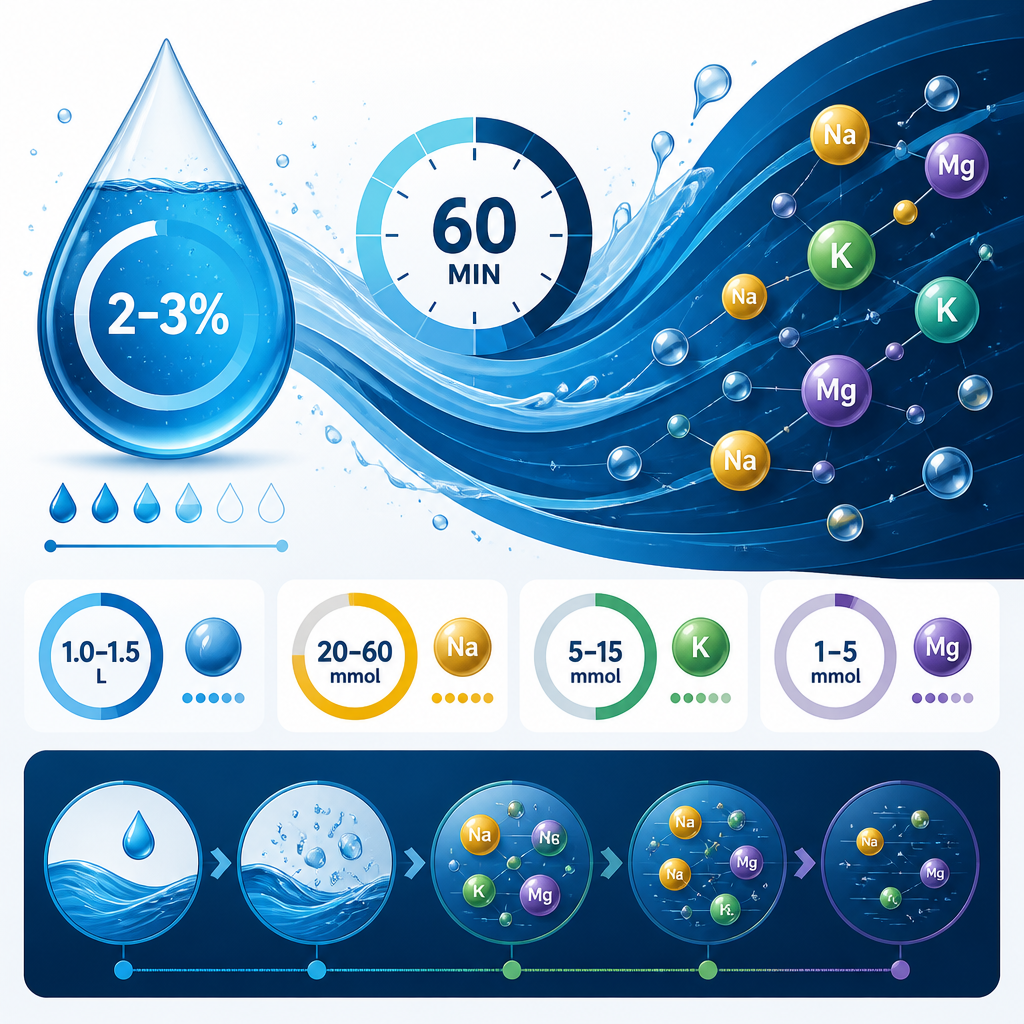
This is a sports hydration guide for practical use, not abstract theory. Here is how to structure your electrolyte and fluid intake around a training session or event.
Drink enough fluid to ensure you begin activity in a well-hydrated state. A useful indicator is urine colour: pale yellow is the target. If you are training first thing in the morning, you are almost certainly starting in a mildly dehydrated state after overnight fluid losses. A small electrolyte serving before your session is more useful here than a large volume of plain water, which will simply pass through without being retained efficiently.
For sessions under 60 minutes at moderate intensity, water is generally sufficient. For sessions over 60 minutes, in hot or humid conditions, or at high intensity, electrolyte intake during the session is necessary. Small, regular amounts are more effective than a large intake at once. The goal is to maintain electrolyte concentrations, not to catch up after they have already dropped.
Post-session recovery hydration should replace both fluid and electrolytes. This is when sodium becomes especially useful again, because sodium in your recovery drink or food helps your body retain the fluid you are consuming, rather than excreting it rapidly. Athletes who drink large amounts of plain water post-session but skip sodium often find they are in the bathroom repeatedly without actually rehydrating at a cellular level.
Not all hydration strategies are equal, and the differences matter when you are training consistently. The table below compares the three most common approaches UK athletes use.
Approach |
What It Delivers |
Where It Falls Short |
|---|---|---|
Plain water only |
Replaces fluid volume lost through sweat. Effective for short, low-intensity sessions under 60 minutes. |
Does not replace sodium, potassium, magnesium, or chloride. Can dilute blood sodium during prolonged intake without electrolytes. |
High-sugar sports drinks |
Provides electrolytes and carbohydrates in a single product. Useful for endurance events over 90 minutes where energy replacement is also a goal. |
Unnecessary sugar load for shorter sessions. Can cause GI discomfort. Not suitable for daily training hydration without adding to total sugar intake. |
No-added-sugar electrolyte supplements |
Delivers the electrolyte profile needed for performance without the sugar. Suitable for daily training use, morning sessions, and athletes managing body composition. |
Does not supply carbohydrate energy for very long events. Must be combined with appropriate fuelling strategy for races or events over 2 hours. |
In practice, the answer for most active people is not one approach for all situations. A no-added-sugar electrolyte supplement covers the majority of daily training needs. For a race or event extending beyond 90 minutes, pairing it with a carbohydrate source makes sense. The mistake is defaulting to high-sugar drinks for every session when most sessions do not require that carbohydrate load.
Plusssz Electrolytes SPORT is designed specifically for the scenario described throughout this guide: active individuals who need a clean, effective electrolyte formula they can use consistently without the sugar load that makes many mainstream options unsuitable for daily training. The formulation is built around the minerals that matter most for athletic performance, with no added sugar and an emphasis on nutrient assimilability, meaning the minerals in the formula are in forms your body can actually absorb and use, not just present on a label.
Where competitors like Science in Sport, High Five, and ORS Hydration focus primarily on carbohydrate-electrolyte ratios suited to race-day fuelling, Plusssz takes a different angle. The focus is on the athlete who trains regularly, possibly daily, and needs electrolyte support that works for a Tuesday morning gym session just as well as a Saturday long run. That daily-use case is where a no-added-sugar formulation genuinely differentiates itself.
For Plusssz customers who have been recommended the product by a training partner or teammate, the key thing to understand is this: you are not buying a product to fix dehydration after it happens. You are building a hydration habit that keeps electrolyte balance stable across your training week, so that cumulative deficits do not compound into the fatigue and performance dips that get misread as overtraining or insufficient sleep.
Pro tip: If a friend recommended Plusssz to you, ask them when they use it in relation to their sessions. The timing protocol matters as much as the product itself. Most experienced users take it before and during sessions rather than treating it as a post-workout recovery drink alone.
Yes. Electrolyte excess is possible, particularly with sodium and potassium, and it can cause issues including elevated blood pressure and cardiac irregularities in extreme cases. However, for the vast majority of active people using a correctly dosed supplement like Plusssz Electrolytes SPORT in line with the product guidance, this is not a realistic risk. Problems with electrolyte excess are far more commonly associated with extremely high-dose supplements taken outside of any training context, not with standard sports hydration products used as directed.
For sedentary individuals eating a balanced diet, food can supply adequate electrolytes. For athletes training at moderate to high intensity, particularly in warm conditions, the losses through sweat exceed what food reliably replaces within a training day. Whole foods do not come with a consistent, measurable electrolyte dose, which makes them harder to calibrate around training demands. Supplementation fills that gap with precision.
Generally, a reduced dose on rest days is appropriate if you are sweating at all, living in a warm climate, or doing light active recovery. If your rest day is genuinely sedentary and your diet is balanced, food-sourced electrolytes are likely sufficient. The bigger mistake is skipping electrolytes entirely on easy training days, where lighter sweat losses still accumulate if you are not replacing them.
UK summer training, especially July and August when temperatures and humidity both rise, significantly increases sweat rate even at the same effort level. Your electrolyte needs in those conditions are meaningfully higher than in a cold January session at the same pace. Many athletes are surprised to find their usual hydration strategy stops working in summer, when in fact it was only ever matched to cooler conditions. Adjusting electrolyte intake to match season and conditions is a practical necessity, not a fine-tuning detail.
The clearest difference is the absence of added sugar and the focus on the mineral profile rather than carbohydrate delivery. Standard sports drinks are optimised for endurance race fuelling, where carbohydrate energy is a priority. Plusssz Electrolytes SPORT is optimised for the broader training week, covering daily sessions where electrolyte replacement is the goal and sugar loading is unnecessary. The formulation also emphasises nutrient assimilability, meaning the minerals are in forms selected for effective absorption, not simply present as the cheapest available source of each mineral.
For sessions lasting more than 60 minutes, start at the 30-minute mark rather than waiting until you feel thirsty or notice performance dipping. For sessions in heat or at high intensity, that window shrinks further. The goal is to maintain electrolyte balance throughout the session, not to restore it after it has already declined. Once your performance or mood starts to drop because of electrolyte imbalance, you are already behind and it takes time to recover that ground.
Have you noticed a difference in your training when you switched from plain water to an electrolyte supplement? Share your experience in the comments, because real-world feedback from active people is what helps others make smarter decisions about their hydration.