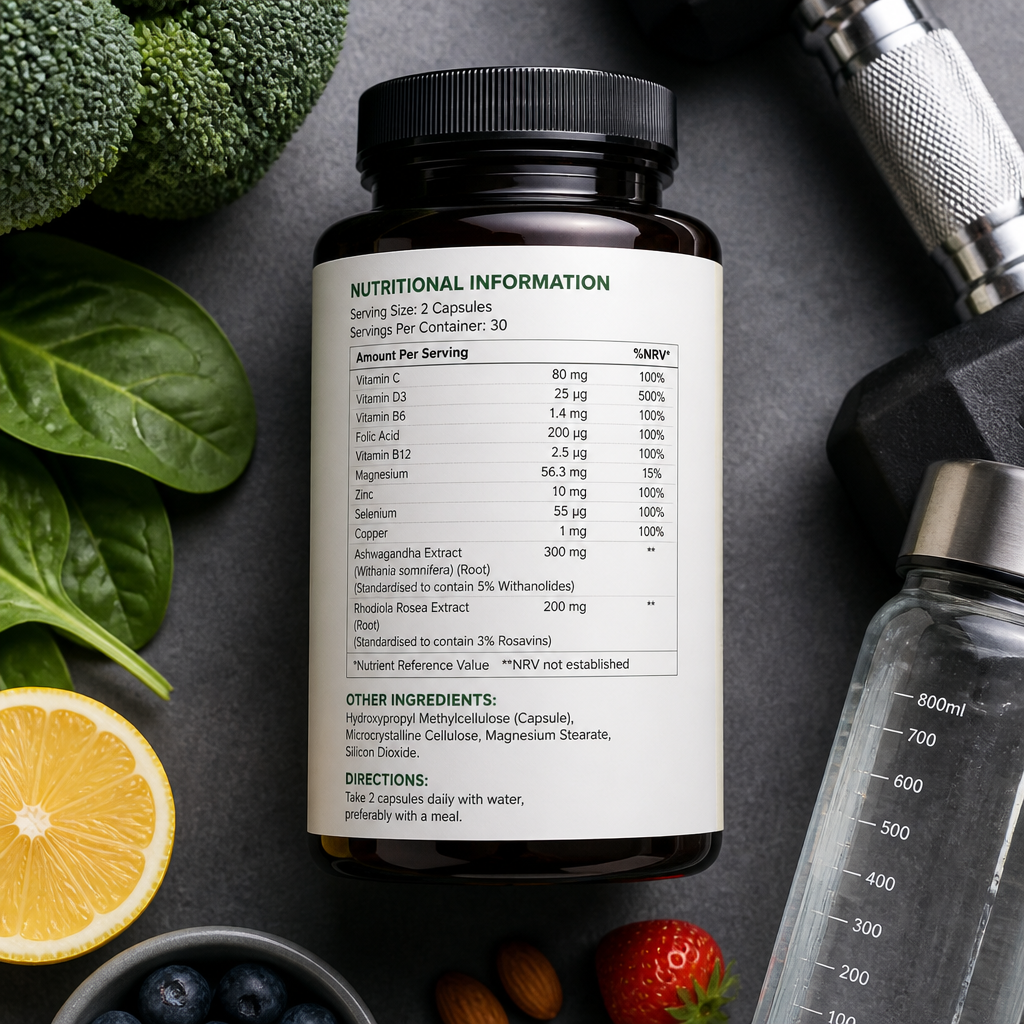
Pick up almost any multivitamin or electrolyte supplement and you will see a column of percentages on the back panel. "Vitamin C 80mg - 100%." "Vitamin D 5µg - 100%." Most people read that and assume the job is done: one tablet, full coverage, nothing to worry about. That assumption is wrong, and it costs active people real performance and recovery. Understanding the 100% daily vitamins meaning on a UK supplement label is not a trivial label-reading exercise. It is the difference between choosing a supplement that actually supports your training and choosing one that merely looks impressive on paper.
NRV stands for Nutrient Reference Value. It is the daily reference intake amount for a given vitamin or mineral, set for food labelling purposes across the UK and EU. When a supplement label shows "100% NRV" next to a nutrient, it means one serving of that product provides the full reference amount for that nutrient, relative to what is considered sufficient for an average healthy adult.
The percentage is calculated simply. If the NRV for vitamin C is 80mg, and your supplement contains 80mg of vitamin C per serving, it shows 100% NRV. A product with 40mg shows 50% NRV. A product with 160mg shows 200% NRV. The maths is straightforward. The interpretation is where people go wrong.
NRVs are a labelling benchmark, not a personalised prescription. They are population-level reference figures designed to ensure the average healthy adult avoids deficiency, not figures calculated to optimise performance, support heavy training loads, or account for any individual's specific circumstances. That distinction matters enormously if you are active, older, pregnant, or eating a restricted diet.
Pro tip: Before comparing two supplement products by their % NRV figures, always check the serving size. A product showing 200% NRV for vitamin B12 per "serving" of four capsules is not the same as one showing 200% NRV per single capsule. Serving size manipulation is one of the most common ways a label looks more impressive than the product actually is.

If you are old enough to remember "RDA" on supplement packets, you already know NRV. The term RDA (Recommended Daily Allowance) was replaced by NRV (Nutrient Reference Value) in December 2014 under European Regulation 1169/2011, which is retained in UK law following Brexit. The values themselves did not change. NRV is a straight terminology swap. Any label still showing "RDA" is simply older stock or a brand that has not updated its packaging.
The NRV figures that appear on UK supplement labels are defined in Annex XIII of EU Regulation 1169/2011. For reference, some of the commonly seen NRVs for adults include: vitamin C at 80mg, vitamin D at 5µg, vitamin B12 at 2.5µg, iron at 14mg, magnesium at 375mg, and vitamin A at 800µg. These are fixed values for labelling purposes.
Understanding how to read supplement labels correctly in the UK starts with knowing these reference figures. When a product displays "500% NRV" for vitamin B12, it is not claiming to give you five times what you need. It is saying it provides five times the labelling reference value, which for B12 is quite low relative to the amounts many practitioners recommend for active adults or those with absorption issues.
Pro tip: The NRV for vitamin D is 5µg (200 IU). NHS guidance suggests UK adults consider a daily supplement of 10µg (400 IU) throughout autumn and winter. A supplement providing "100% NRV" of vitamin D is, in that context, providing half the amount the NHS actually recommends for seasonal supplementation. Always cross-reference NRV figures with current public health guidance for the specific nutrient.
This is where most label-reading goes wrong. People see 100% and stop reading. Here are five things the percentage figure will never tell you, no matter how carefully you look at it.
NRV is a population average. A 55kg sedentary person and a 90kg athlete training five days a week have meaningfully different micronutrient requirements. The NRV captures none of that variation. For active individuals, requirements for certain nutrients, including magnesium, B vitamins involved in energy metabolism, and antioxidant vitamins, are routinely higher than the reference value implies.
Seeing 200%, 400%, or even higher NRV for certain nutrients is not inherently cause for concern. The figure that sets a safety boundary is the Tolerable Upper Intake Level (UL), assessed by the European Food Safety Authority (EFSA). For water-soluble vitamins like vitamin C and most B vitamins, excess is excreted rather than accumulated. The NRV and the upper limit are completely separate concepts that answer different questions.
100% NRV of magnesium as magnesium oxide and 100% NRV of magnesium as magnesium citrate are not equivalent in practice. The form of a nutrient affects how much your body can actually absorb and use. A supplement can list an impressive NRV percentage while using a poorly absorbed form that delivers a fraction of the functional benefit. The label percentage tells you nothing about the quality of the ingredient.
Your total intake of a nutrient comes from food and supplements combined. If your diet already provides substantial amounts of certain vitamins, you may not need a supplement to hit 100% NRV at all. Conversely, if your diet is restrictive, 100% NRV from a supplement may still leave you short when you factor in absorption differences.
A percentage figure means nothing without the serving size that generates it. This is consistently one of the most important things to check. The label must state what quantity of the product corresponds to the nutritional information shown. A common mistake is assuming that the per-serving figure applies to one capsule, when the product actually requires two or three capsules to deliver that amount.
The NRV is a population-level labelling benchmark for an average adult. It is not a calculation of what any individual needs, which varies with diet, circumstances, and stage of life. Reference values are deliberately framed as reference points rather than prescriptions.
Knowing the limits of NRV percentages, the practical question is: what should you actually look at on a supplement label? There are three things that carry more informational weight than the % NRV column alone.
The actual quantity of a nutrient, in milligrams or micrograms per serving, is more informative than its percentage. Compare the amount directly against current recommendations for your demographic, not just the NRV benchmark. For example, knowing a product contains 10µg of vitamin D is more useful than knowing it provides 200% NRV, because 10µg is the level widely recommended for autumn and winter supplementation in the UK.
Where the label discloses the form of an ingredient, it matters. For minerals especially, the compound form significantly affects absorption. Magnesium citrate or glycinate is better absorbed than magnesium oxide. Zinc bisglycinate is better absorbed than zinc oxide. A product designed for active individuals should, ideally, specify the forms used. If the label simply says "magnesium" with no form listed, that is a legitimate question to ask the brand.
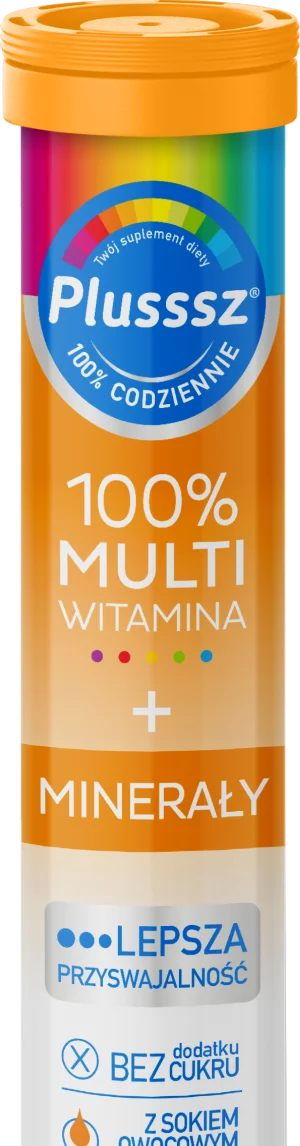
A multivitamin formulated specifically for active adults will have been dosed and balanced differently from a general-population product, even if both products use the same ingredient list. The ratios between nutrients, the forms used, and the serving size will all differ. Supplements designed with sports nutrition in mind, including the Plusssz range of multivitamin complexes, account for the different micronutrient demands of exercise, including energy metabolism support and electrolyte integration, in ways a standard label percentage does not capture.

The NRV system was designed for the general population, and that design choice has real consequences for anyone who trains regularly. Exercise increases the body's demand for several micronutrients through specific, well-understood mechanisms.
Sweat losses during exercise deplete electrolytes including sodium, potassium, magnesium, and chloride. Those acute losses are not reflected in the NRV at all, because the NRV is a resting-state reference figure. This is precisely why an electrolyte supplement is a separate, complementary product to a multivitamin rather than a replacement for one. Products like the Plusssz electrolyte hydration range address the acute replacement need that a multivitamin label percentage cannot capture.
B vitamins involved in energy metabolism, including B1 (thiamin), B2 (riboflavin), B3 (niacin), B6, and B12, are consumed at higher rates when energy turnover is elevated. Active individuals training multiple times per week have a genuine case for intakes above the NRV for these nutrients, not because the NRV is dangerous to exceed, but because the reference point was not set with high training loads in mind.
Antioxidant vitamins, including vitamin C and vitamin E, are involved in managing the increased oxidative stress that accompanies exercise. However, there is a nuance here: excessive antioxidant supplementation at very high doses can blunt training adaptations. A multivitamin providing 100% to 150% NRV of these nutrients is a supportive range. A product providing 500% NRV of vitamin C daily, in contrast, is in territory where the evidence becomes more mixed.
The practical implication for active people is this: use the NRV percentage as a floor, not a ceiling, for understanding what a supplement delivers. Then assess whether the formulation has been calibrated for the demands of regular exercise rather than for the needs of a sedentary reference adult.
Not all supplement labels present information in equally useful ways. The table below compares three approaches you will encounter, from the most common to the most transparent.
Label Approach |
What It Shows |
What It Hides or Omits |
|---|---|---|
% NRV Only |
Percentage of reference value per serving. Looks simple and reassuring at a glance. |
Absolute amounts, nutrient forms, serving size context. Can make a low-dose product appear complete. |
Amount + % NRV |
Absolute quantity (e.g., 80mg) alongside the NRV percentage. Allows comparison with independent guidelines. |
Still omits nutrient form. Does not disclose whether the dose is appropriate for the target demographic. |
Amount + Form + % NRV + Demographic Targeting |
Full picture: how much, in what form, relative to reference, and for whom the product is designed. Enables informed decisions. |
Nothing material. This is the standard an active consumer should expect from a product positioned as performance-focused. |
The third approach is the benchmark to hold supplement brands to. It is also, not coincidentally, the approach used by specialist supplements designed for active adults rather than general-market products chasing mass-market shelf space. If a brand cannot or will not tell you the form of the minerals in their product, that omission is itself informative.
Yes, effectively. NRV replaced RDA on UK and EU supplement labels in December 2014 following European Regulation 1169/2011. The numerical values are identical. Only the terminology changed. If you see "100% RDA" on an older label, it means exactly the same thing as "100% NRV" on a current one.
No. NRV figures are set as reference points to prevent deficiency in the context of an otherwise adequate diet. A supplement providing 100% NRV of a nutrient is not designed to be the sole source of that nutrient in isolation from food. Total daily intake from food and supplements combined is what matters. Treating a multivitamin as a dietary replacement rather than a complement to a balanced diet is a misuse of what the product is designed to do.
Because the NRV for some nutrients, particularly water-soluble vitamins like B12 and vitamin C, is set at a relatively conservative level. For B12, the NRV is 2.5µg, but many practitioner-formulated supplements provide much higher amounts, partly because absorption of B12 is less efficient from supplements than from food, and partly because deficiency risks in certain populations (older adults, vegans) are well-documented. High percentages for water-soluble vitamins are not inherently dangerous because excess is excreted. For fat-soluble vitamins like A and D, the safety picture is different and upper limits matter more.
For some nutrients, yes. B vitamins involved in energy metabolism, magnesium, and vitamin D are among the nutrients where active adults routinely benefit from intakes above the NRV reference value. The key is that the higher dose should be in a form that is well absorbed and within established safety limits. Look for products formulated with active adults as the specific target demographic, not general-population formulas that happen to be marketed toward gym users. Plusssz multivitamin complexes, for example, are designed with the micronutrient demands of an active lifestyle in mind, which means the formulation choices go beyond simply meeting the NRV floor.
For most nutrients in most circumstances, no. The NRV is not a maximum. The relevant safety boundary is the Tolerable Upper Intake Level (UL), which is set separately by the European Food Safety Authority. For water-soluble vitamins, exceeding 100% NRV by a significant margin is generally safe. For fat-soluble vitamins (A, D, E, K), and for some minerals like iron and zinc, it is worth checking the UL before long-term use at very high percentages. When in doubt, look for a product where the formulation rationale is clearly explained.
Not all electrolytes have established NRVs under the current labelling system. Sodium, potassium, chloride, and magnesium do have NRV reference values, which is why you will see percentage figures for them on electrolyte products. However, the relevant benchmark for an electrolyte supplement used around exercise is not just the daily reference value but the acute replacement need during and after a training session. A product like a Plusssz electrolyte hydration formula is addressing sweat-loss replacement, which operates on a different scale to a daily micronutrient reference. This is why electrolyte supplements and multivitamins serve complementary rather than competing purposes for active individuals.
Have you ever been confused by the numbers on your supplement label, or discovered that a product you were using was not actually formulated for your level of activity? Share your experience in the comments.