If you train regularly, eat a balanced diet, and still feel like your energy tanks by midday, B vitamins are almost certainly part of the conversation you need to have. B vitamins energy metabolism is not a vague wellness concept. It is a specific, well-understood biochemical process: without an adequate supply of all eight B vitamins, your body simply cannot convert the carbohydrates, fats, and proteins you eat into the usable energy your muscles and brain demand. For active individuals who push their bodies hard and expect results, that gap matters enormously. This guide covers what each B vitamin actually does, why deficiency is more common than most people assume, and how smart supplementation fits into a performance-focused lifestyle.
Key Insight |
Explanation |
|---|---|
B vitamins are coenzymes, not energy sources |
They do not provide calories. They activate the enzymes that extract energy from the food you eat. Without them, that process stalls regardless of how well you eat. |
All eight B vitamins are water-soluble |
With the partial exception of B12, they are not stored in the body, meaning daily intake through food or supplements is necessary for consistent performance. |
Deficiency does not require a poor diet |
Active individuals, older adults, vegans, and people with high physiological stress are all at elevated risk even when eating reasonably well. |
B3 (Niacin) and B2 (Riboflavin) are central to fat and protein metabolism |
For anyone training with body composition goals, these two are especially important. Low B2 and B3 slow the conversion of dietary fat and protein into usable fuel. |
B vitamins work as a system, not individually |
Taking only B12 while ignoring B1 or B6 creates imbalances. A well-formulated B-complex supplement covers all eight in meaningful doses. |
Concentration and mood are directly affected |
B vitamins support neurotransmitter synthesis and nervous system function. Brain fog and low motivation are often early signs of suboptimal B status, not just tiredness. |
Electrolyte supplementation and B vitamins complement each other |
Hydration supports nutrient transport, and B vitamins support the metabolic pathways that make hydration effective. Combining both is the logical choice for active individuals. |
Vitamin B is not a single compound. It is a family of eight distinct water-soluble nutrients that share enough functional overlap in cellular metabolism to be classified together. The eight members are B1 (Thiamine), B2 (Riboflavin), B3 (Niacin), B5 (Pantothenic Acid), B6 (Pyridoxine), B7 (Biotin), B9 (Folate), and B12 (Cobalamin).
Because they are water-soluble, most B vitamins are not stored in the body in meaningful quantities. You use what you need, and you excrete the rest. This means consistent daily intake is not optional if you want to maintain peak metabolic function. The one partial exception is B12, which the liver can store in limited amounts, but even that reserve gets depleted over time if intake drops.
What unites them beyond their solubility is their role as coenzymes. Enzymes are the proteins that drive virtually every chemical reaction in the body, including the reactions that break down food into ATP, the actual currency of cellular energy. Coenzymes act as the switch that turns those enzymes on. B vitamins are among the most important coenzymes in that system.
B vitamins are not fuel themselves. They are the mechanism that allows fuel to be used. A car with a full tank but a broken ignition does not move. Neither does your metabolism without adequate B vitamins.
The process of converting food into energy runs through several interconnected biochemical pathways. B vitamins are embedded at critical points in all of them. Understanding where they sit helps explain why a deficiency in even one B vitamin can have outsized effects on how you feel and perform.
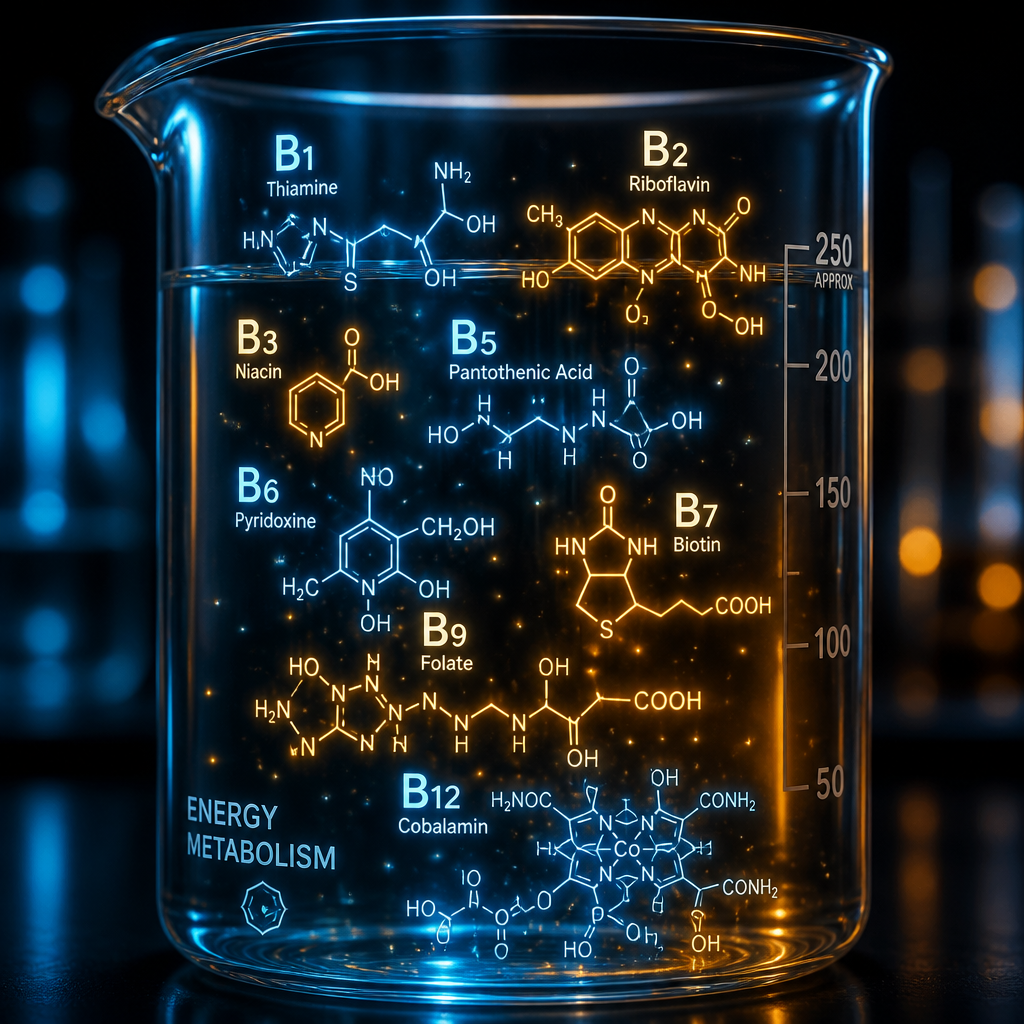

When you eat carbohydrates, they are broken down into glucose. Glucose enters glycolysis, the first stage of energy extraction. B1 (Thiamine) is essential at this stage, acting as a coenzyme for pyruvate dehydrogenase, the enzyme that moves glucose metabolism forward into the citric acid cycle. Without adequate B1, this handoff stalls, and energy production from carbohydrates becomes inefficient. For endurance athletes relying on carbohydrate as their primary fuel, B1 is non-negotiable.
The citric acid cycle (also called the Krebs cycle) is where the bulk of ATP is generated. B2 (Riboflavin) and B3 (Niacin) are central here. They form NAD+ and FAD, the electron carriers that shuttle energy through the cycle and into the electron transport chain where ATP is finally produced. B5 (Pantothenic Acid) is required to form Coenzyme A, which is essentially the molecule that feeds fuel into the cycle in the first place.
B vitamins do not only matter for carbohydrate metabolism. When you deplete glycogen during prolonged exercise, your body shifts toward fat oxidation and, to a lesser extent, protein catabolism. Both of these processes require B vitamins. B2 and B3 support fatty acid oxidation. B6 (Pyridoxine) is directly involved in amino acid metabolism, which matters both for protein synthesis and for gluconeogenesis, the process of making glucose from non-carbohydrate sources during extended training sessions.
Pro tip: If your training sessions extend beyond 60 to 90 minutes, your demand for B vitamins increases significantly because your body is pulling energy from multiple fuel sources simultaneously. This is exactly when a well-formulated multivitamin complex with complete B-vitamin coverage earns its place in your routine.
Each of the eight B vitamins has a distinct primary role. Grouping them together in a supplement makes sense from a formulation standpoint, but understanding what each one does allows you to identify gaps in your own diet and flag early signs of insufficiency before they affect performance.
Thiamine activates the enzyme systems that move glucose through the early stages of energy production. It also supports nervous system function. Early signs of low B1 include fatigue, irritability, and reduced mental sharpness, particularly noticeable during or after exercise. Found in whole grains, legumes, and pork.
Riboflavin supports the metabolism of fats, proteins, and carbohydrates, and also supports the health of the eyes, skin, and nervous system. It forms part of the FAD coenzyme that drives the electron transport chain. Deficiency is more common than appreciated, particularly in individuals who avoid dairy and meat.
B3 is required to produce NAD+, one of the most important electron carriers in the body. Without sufficient NAD+, the citric acid cycle slows and ATP output drops. Niacin also plays a role in DNA repair. Found in poultry, fish, peanuts, and whole grains.
B5 is required to synthesise Coenzyme A, which is indispensable for the citric acid cycle. It is also involved in synthesising steroid hormones and metabolising cholesterol. Deficiency is uncommon but possible in highly restrictive diets.
B6 is involved in over 100 enzyme reactions, most of which relate to amino acid metabolism. It is also required for the synthesis of neurotransmitters including serotonin and dopamine. For active individuals, B6 supports both protein utilisation from diet and mood regulation.
Biotin acts as a coenzyme for carboxylase enzymes involved in fatty acid synthesis and gluconeogenesis. It also plays a known role in blood sugar regulation. Biotin is often marketed primarily for hair and nail health, which is accurate but undersells its metabolic importance.
Folate is critical for DNA synthesis and cell division, making it particularly important during periods of rapid tissue repair, which includes recovery from intense training. It also contributes to red blood cell formation, which directly affects oxygen delivery to working muscles.
B12 supports red blood cell formation, neurological function, and DNA synthesis. It is the one B vitamin that the liver stores in meaningful amounts, but that reserve can take years to deplete, which is why B12 deficiency sometimes goes undetected for a long time. Vegans and older adults are most at risk. Deficiency symptoms include fatigue, weakness, and neurological symptoms including numbness and difficulty concentrating.
Pro tip: If you follow a plant-based diet and train regularly, B12 is the one B vitamin where supplementation is genuinely critical rather than optional. Food sources of B12 are almost exclusively animal-derived, and no plant food provides it in a reliable, bioavailable form without fortification.
A B vitamin deficiency does not require a terrible diet. Several groups face elevated risk simply due to how their bodies process or access these nutrients, and many of them overlap with the active, health-conscious individuals who are most likely to be reading this.
Physical training increases the body's demand for energy, which increases the demand for the coenzymes that drive energy production. Sweat also carries water-soluble nutrients out of the body. This combination means that active individuals have a higher daily requirement for B vitamins than sedentary individuals, yet they are often not accounting for this in their supplement strategy.
Absorption of several B vitamins, particularly B12 and B6, declines with age due to changes in digestive function. Seniors who are also physically active face a compounding challenge: higher demand and lower absorption efficiency at the same time. A targeted supplement formulated for older adults is not a luxury in this context. It is a practical solution.
Beyond B12, plant-based eaters may also have lower intake of B2 (riboflavin, found primarily in dairy and meat) and B3 (niacin, found in poultry and fish). If your diet excludes animal products and you are training regularly, a comprehensive B-complex supplement is a straightforward and well-justified choice.
Folate (B9) requirements increase during pregnancy. B6 plays a role in hormonal regulation across the menstrual cycle. Women who train intensively and may also be managing hormonal fluctuations benefit from ensuring their B vitamin intake is comprehensive and consistent.
The UK supplement market is crowded, and the quality gap between products is significant. When evaluating a B-complex supplement UK offering, the label tells you most of what you need to know, if you know how to read it.
A genuine B-complex must include all eight B vitamins. Products that only list B6, B12, and biotin are cutting corners. The omission of B1, B2, B3, and B5 means the metabolic pathways those vitamins support are left unaddressed. Always check the full ingredient list before buying.
The chemical form of a vitamin determines how readily the body absorbs and uses it. For B12, methylcobalamin is generally considered more bioavailable than cyanocobalamin. For B9, methylfolate is preferred over folic acid for individuals with common MTHFR gene variants that limit folic acid conversion. A supplement that emphasises improved nutrient assimilability, as Plusssz UK's multivitamin complexes do, is addressing this directly. This is not marketing language. It is a meaningful formulation decision.
Some B-complex products, particularly gummies and effervescent formats popular with broader consumer audiences, contain significant amounts of added sugar. For active individuals managing their nutrition carefully, this is a problem. Look for products with clear, minimal ingredient lists where the active nutrients are not buried under sweeteners, artificial colours, or unnecessary binders.
Plusssz UK's approach is built around active individuals who take their nutrition seriously. The multivitamin formulations in their range are designed with no added sugar and a focus on bioavailability, which aligns directly with what the evidence supports for B vitamin supplementation. Their products are worth considering as part of a broader strategy that includes electrolyte hydration, particularly for individuals who train intensively and want a coherent, evidence-aligned supplement stack rather than a random collection of single-nutrient pills. You can explore their multivitamin range directly.
Not all supplement formats deliver B vitamins equally. The format you choose affects absorption, convenience, and whether the product stays free of added sugar. Here is a practical comparison of the three most common formats available in the UK market.
Format |
Absorption and Bioavailability |
Practical Considerations for Active Individuals |
|---|---|---|
Capsule or Tablet (no added sugar) |
Good bioavailability when quality forms are used (e.g., methylcobalamin for B12, methylfolate for B9). Consistent dosing with each serving. |
Easy to take pre- or post-workout. No caloric load. Simple to stack with electrolyte products. Best choice when formulated with active nutrient forms. |
Effervescent Tablet |
Fast dissolution may aid absorption speed. However, many effervescent products contain added sugar or sweeteners that active individuals may want to avoid. |
Convenient for hydration-focused routines when the formula is sugar-free. Check labels carefully. Can complement electrolyte drinks when formulated appropriately. |
Gummy Supplement |
Variable absorption. Often uses lower-quality vitamin forms for palatability. Dose per gummy is frequently lower than capsule equivalents. |
Usually contains added sugar. Not the preferred format for serious athletes or health-conscious consumers tracking their nutrition. Better suited to general wellness markets. |
The connection between B vitamins and physical energy gets most of the attention, but the cognitive effects are equally significant and often more immediately noticeable in daily life. Vitamins for energy and concentration is a phrase that markets a real phenomenon: B vitamin insufficiency affects the brain before it visibly affects the body.
B6 is directly required for the synthesis of serotonin, dopamine, and GABA. These neurotransmitters govern mood, motivation, and the ability to sustain focus. When B6 levels are suboptimal, this synthesis slows. The result is not dramatic neurological disease; it is the low-grade flatness, reduced motivation, and difficulty concentrating that many active people write off as overtraining or poor sleep.
B12 is essential for maintaining the myelin sheath that surrounds nerve fibres. Myelin determines how quickly and accurately nerve signals travel. When B12 is insufficient, nerve conduction slows. In practical terms, this affects reaction time, coordination, and mental sharpness during and after exercise. These are exactly the qualities that separate good performances from great ones.
Both B9 (Folate) and B12 are required for red blood cell formation. Red blood cells carry oxygen to the brain and working muscles. When red blood cell production is impaired, cognitive performance and physical endurance suffer together. This is a pathway where B vitamin status connects directly to VO2 max and sustained aerobic output.
The practical implication is straightforward: if you are supplementing for performance and you are not covering your B vitamins, you are leaving a clear gap open. Whether you are training for a sportive, preparing for a 10K, or simply trying to maintain sharp focus through a demanding workday, B vitamins sit at the intersection of physical and cognitive performance in a way that no other single nutrient group does.
Pairing a complete B-complex supplement with a well-designed electrolyte hydration product, such as those in the Plusssz UK electrolyte range, addresses both the metabolic and hydration dimensions of performance. These are not competing strategies. They are complementary ones.
B vitamins do not provide energy in the caloric sense. What they do is enable the enzymes that extract energy from your food to function properly. If your B vitamin status is adequate, you will not feel a sudden boost from taking more. But if your levels are suboptimal, restoring them removes a real metabolic bottleneck. The effect is genuine but it works by removing a deficit, not by adding a stimulant.
Possibly, but the margin for error is smaller than most people think. Physical training increases the metabolic demand for B vitamins. Sweat losses further reduce water-soluble nutrient levels. If your diet is varied and includes animal products, legumes, and whole grains, you may cover your baseline needs. But consistently hitting optimal levels for active individuals from diet alone is difficult, and the consequences of falling short are real enough to make a quality supplement worth including.
A well-formulated B-complex covers all eight B vitamins in balanced doses. Taking individual B vitamins separately risks creating imbalances. For example, high-dose B6 supplementation without adequate B2 can cause problems because B2 is needed to convert B6 into its active form. B vitamins work as a system, and supplementing them as a system is the more intelligent approach for most people.
Most B vitamins have wide safety margins because they are water-soluble and the body excretes excess amounts. However, B3 (Niacin) at very high doses can cause flushing and, in sustained high doses, liver stress. Very high doses of B6 over extended periods have been associated with peripheral nerve symptoms. Standard B-complex supplements are formulated well within safe ranges. Megadosing individual B vitamins without clinical guidance is where problems arise.
This depends on your starting point. If you are significantly deficient, noticeable changes in energy and mental clarity can emerge within a few weeks of consistent supplementation. If your baseline B vitamin status is already reasonable, the effects will be subtler and more about sustaining performance over time than producing a dramatic change. Consistency matters more than timing in this context.
Yes, in a practical sense. Electrolytes support cellular hydration and nutrient transport. B vitamins drive the metabolic pathways that convert nutrients into energy. Neither one covers what the other does, which is exactly why combining an electrolyte hydration product with a comprehensive multivitamin complex makes more sense than choosing between them. For active individuals, this combination addresses both the transport and the conversion sides of the performance equation.
Have you noticed a difference in your energy or concentration when changing your B vitamin intake? Share your experience in the comments, we would genuinely like to hear what has worked for you.