Most men buying a men's multivitamin UK shoppers find on the shelf are paying for a generic one-size-fits-all formula designed around average sedentary adults. If you train regularly, play sport, or simply push hard at work and in the gym, your micronutrient demands are meaningfully higher than the NHS reference nutrient intakes suggest. Research published by the British Nutrition Foundation confirms that physical activity increases the turnover of several vitamins and minerals, yet the supplement market largely ignores this. This guide cuts through the noise and tells you exactly which nutrients matter, why they matter for active men specifically, and what to look for when choosing a formula that actually delivers.
Key Insight |
Explanation |
|---|---|
Magnesium is almost always under-dosed |
Most budget multivitamins provide less than 25% of the recommended intake for active men, who lose significant magnesium through sweat during training. |
Vitamin D3 matters more than D2 |
D3 (cholecalciferol) raises serum 25(OH)D levels roughly 87% more effectively than D2 according to a meta-analysis in the American Journal of Clinical Nutrition. |
Zinc supports testosterone metabolism |
Zinc is a cofactor in testosterone synthesis. Active men who train intensely are particularly prone to zinc depletion through sweat losses. |
B-vitamin complex is non-negotiable for energy |
B1, B2, B3, B5, B6, and B12 are all involved in ATP production. A deficiency in any one of them creates a bottleneck in energy metabolism. |
Iron is often wrong for men |
Unlike formulas designed for women, a well-designed men's multivitamin should contain minimal or no iron unless a deficiency has been confirmed via blood test. |
Bioavailability form matters enormously |
Magnesium oxide has roughly 4% absorption. Magnesium citrate or bisglycinate absorbs at rates above 30%. The same compound, wildly different results. |
Electrolytes and multivitamins serve different functions |
Multivitamins cover micronutrient gaps. Electrolytes manage acute hydration and fluid balance during and after exercise. Active men benefit from both, not one or the other. |
The NHS reference nutrient intakes (RNIs) were designed around average population health, not athletic performance or high-activity lifestyles. For sedentary adults, those figures work reasonably well. For men who train several times per week, they fall short in at least five key areas.
Physical activity accelerates the turnover of water-soluble vitamins, particularly the B-complex group. Every time your body converts glycogen to ATP during a training session, it burns through B vitamins as coenzymes. Sweat losses add another layer, depleting minerals like magnesium, zinc, and sodium at rates that diet alone rarely replaces.
A common mistake active men make is assuming that eating a high-calorie diet to support training automatically covers their micronutrient needs. In practice, calorie-dense training diets are often rich in protein and carbohydrates but surprisingly poor in micronutrient density, particularly for vitamin D, magnesium, and zinc. The data consistently shows this across multiple UK dietary surveys.


The difference between a generic multivitamin and one built for vitamins for active men is not just marketing. It comes down to the specific nutrients included, the forms used for absorption, and whether the formula accounts for sweat-related losses that sedentary individuals simply do not experience.
Not every vitamin and mineral on a supplement label is equally important for an active man. The following are the non-negotiables, backed by the strongest evidence for performance, recovery, and long-term health.
Vitamin D3 supports testosterone production, immune function, bone density, and muscle protein synthesis. Public Health England data shows that approximately 1 in 5 UK adults has low vitamin D levels, and that figure worsens during winter months. Active men training indoors are particularly at risk.
The key detail most formulas miss is pairing D3 with K2 (specifically MK-7). Vitamin K2 helps direct the calcium that vitamin D helps absorb into bones rather than arterial walls. Without K2, high-dose D3 supplementation can have unintended consequences for cardiovascular health over time.
Magnesium is involved in over 300 enzymatic reactions including muscle contraction, nerve function, and protein synthesis. Active men lose magnesium through sweat, and the UK National Diet and Nutrition Survey consistently identifies magnesium as one of the minerals most likely to fall below recommended intake in adult males.
The form matters critically here. Magnesium oxide, which appears in most cheap multivitamins, has an absorption rate of roughly 4%. Magnesium citrate or bisglycinate absorbs at 30% or above. Any best multivitamin for men sport should be using chelated or citrate forms, not oxide.
Zinc is a cofactor in testosterone synthesis and plays a direct role in immune cell production. Men engaged in regular high-intensity training are particularly susceptible to zinc depletion because significant quantities are lost through sweat. A 2018 review in the journal Nutrients confirmed that zinc supplementation in athletes with low baseline levels measurably improved testosterone markers.
B vitamins do not give you energy directly. What they do is enable your mitochondria to convert food into ATP efficiently. Without adequate B1 (thiamine), B2 (riboflavin), B3 (niacin), B5 (pantothenic acid), B6, and B12, energy production at a cellular level becomes inefficient regardless of how much you eat. Active men training at high volume need this entire chain functioning well.
Pro tip: Look for methylcobalamin rather than cyanocobalamin for B12. Methylcobalamin is the biologically active form your body uses directly, without needing to convert it first.
Vitamin C is required for collagen synthesis, which means it directly supports tendon, ligament, and connective tissue repair after training. It also functions as an antioxidant, helping to reduce exercise-induced oxidative stress. Active men need more vitamin C than sedentary adults, and the UK average intake is already borderline adequate even without the additional demands of sport.
The supplement market is full of formulas that look impressive on the label but fail in the detail. In practice, three specific errors appear repeatedly across mainstream UK multivitamins sold to men.
Iron supplementation makes sense for women of childbearing age due to menstrual losses. For most men, supplemental iron is not only unnecessary but potentially harmful. Excess iron generates free radicals and has been associated with increased oxidative stress. A quality men's formulation should contain little to no iron unless the buyer has a confirmed clinical deficiency.
The NHS suggests 300mg of magnesium daily for adult men. Many multivitamins include 50-75mg, and in the oxide form that absorbs poorly. This is window dressing, not meaningful supplementation. An active man with training-related sweat losses may need closer to 350-400mg and in a high-bioavailability form.
A significant proportion of the population carries MTHFR gene variants that reduce their ability to convert synthetic folic acid into the active form the body uses. Methylfolate (5-MTHF) bypasses this conversion step entirely. Premium formulas use methylfolate. Budget formulas use folic acid because it is cheaper.
"The difference between a supplement that works and one that looks good on paper often comes down to the precise molecular form of each ingredient, not the headline dose." - Dr. Rhonda Patrick, biochemist and researcher in micronutrient science
Not all delivery formats are equal for active men. The format affects absorption speed, convenience during training schedules, and what additional ingredients can be included. Here is a direct comparison of the three most common formats available in the UK market.
Format |
Absorption Speed |
Best Suited For |
|---|---|---|
Standard tablet or capsule |
Moderate (30-60 minutes gastric breakdown required) |
Daily baseline supplementation taken with meals, suits most active men |
Effervescent powder or drink |
Fast (nutrients already dissolved, absorbed within 15-30 minutes) |
Pre- or post-training use, convenient for men who already use hydration products |
Softgel capsule |
Moderate to fast (lipid shell aids fat-soluble vitamin absorption, particularly D3 and K2) |
Formulas heavy in fat-soluble vitamins A, D, E, K where absorption with dietary fat matters |
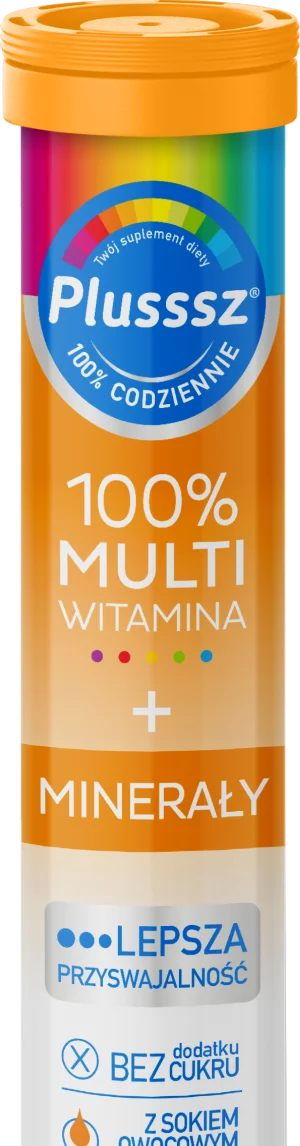
The effervescent format is particularly relevant for active men who are already using electrolyte hydration products like those from Plusssz. Combining a dissolved multivitamin with a hydration drink means fewer separate products and the convenience of taking both before or after training in a single serving ritual.
Pro tip: Fat-soluble vitamins (A, D, E, K) absorb significantly better when taken with a meal containing dietary fat. Taking a softgel multivitamin with your post-workout meal that includes healthy fats will meaningfully improve absorption compared to taking it on an empty stomach.
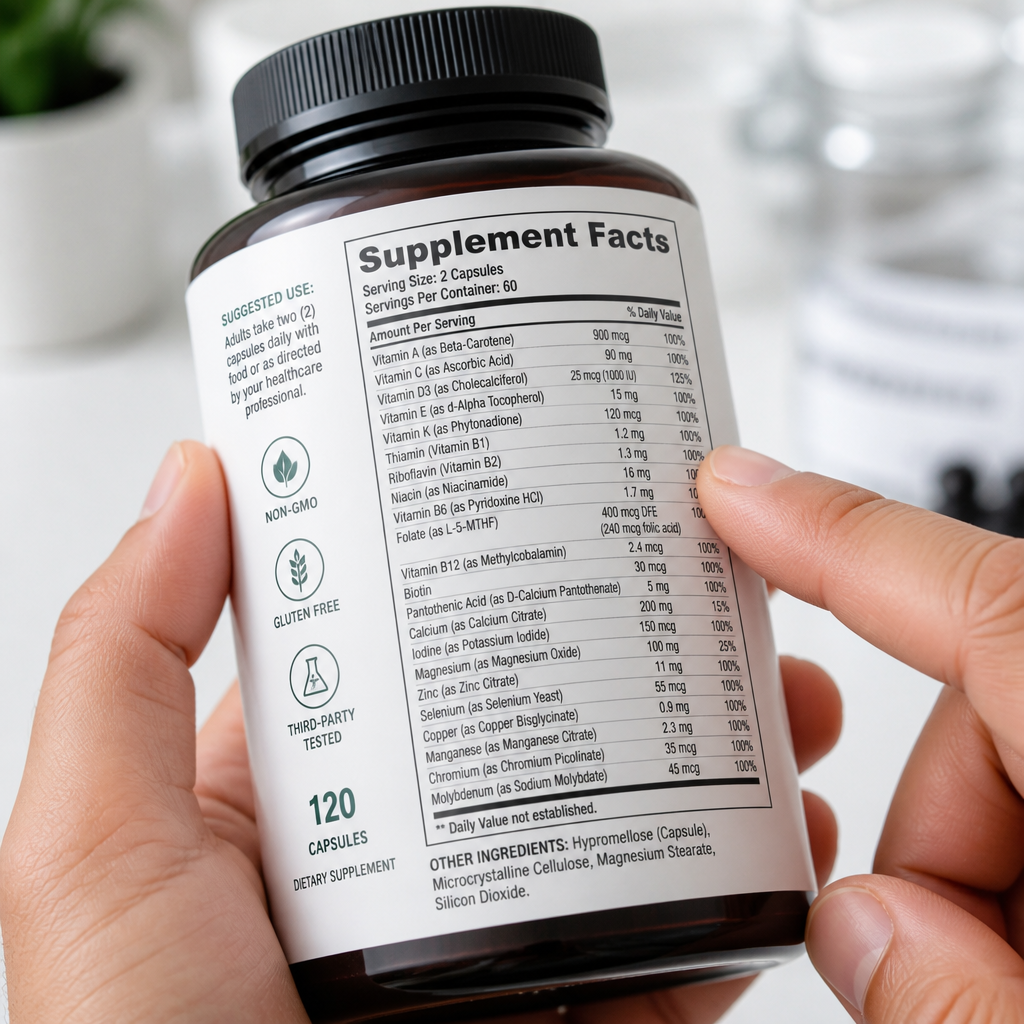
Label literacy is the most underrated skill in supplement buying. Most men look at the headline ingredients list without checking the forms, doses, or whether those doses represent anything meaningful relative to their actual needs.
Before you look at the dose, check the form. Magnesium oxide versus magnesium bisglycinate. Cyanocobalamin versus methylcobalamin. Folic acid versus methylfolate. Vitamin D2 versus D3. These distinctions determine whether a supplement actually works, not the dose printed in bold.
The Nutrient Reference Value (NRV) on UK labels is a baseline for the average sedentary adult. For active men, particularly for magnesium, zinc, B vitamins, and vitamin D, you often need to exceed 100% NRV to see meaningful benefit. A formula providing 25% NRV of magnesium in oxide form is functionally useless for a man training five times per week.
Some manufacturers list a proprietary blend with a total weight but no breakdown of individual ingredient doses. This makes it impossible to evaluate whether any single component is present at a therapeutically relevant level. Transparent labeling is a minimum standard worth insisting on.
A common confusion among active men is treating electrolytes and multivitamins as interchangeable. They are not. They serve fundamentally different functions and neither replaces the other.
Multivitamins address chronic micronutrient gaps. They cover vitamins, trace minerals, and cofactors that build up or deplete over weeks and months. Their benefits are long-term and cumulative.
Electrolytes, specifically sodium, potassium, magnesium, and chloride, manage acute fluid balance and hydration status during and after exercise. When you sweat heavily during a training session or match, you lose electrolytes at a rate that water alone cannot replace. Rehydrating with water without electrolytes can actually dilute serum sodium, worsening performance and recovery rather than improving it.
The data consistently shows that active men performing more than 60 minutes of moderate to intense exercise benefit from electrolyte supplementation during and after the session, independent of whether they are taking a daily multivitamin. Brands like Plusssz have built specifically around this gap, offering no-added-sugar electrolyte formulas designed for exactly this use case, distinct from their multivitamin complex range.
Think of it this way. Your multivitamin handles the baseline. Your electrolyte product handles the session. Together they address both chronic deficiency and acute hydration in a way that neither product does alone.
Prioritise the forms of key ingredients over the number of ingredients listed. Look for vitamin D3 (not D2), magnesium as citrate or bisglycinate (not oxide), methylcobalamin for B12, and zinc in a chelated form. Also confirm the formula contains no or minimal iron, since most active men do not need supplemental iron and excess can cause harm.
For most active men, a well-formulated daily multivitamin covers baseline micronutrient needs. However, high-volume training significantly increases sweat losses of magnesium and zinc specifically. If you are training at high intensity five or more days per week, it is worth considering a separate electrolyte product on training days to replace what sweat depletes acutely, in addition to your multivitamin.
Yes, and for active men this is actually the recommended approach. Your multivitamin covers chronic micronutrient gaps across vitamins, trace minerals, and cofactors. Your electrolyte product handles acute hydration and fluid balance during and after training. They work on different timescales and do not compete with each other when used as directed.
Iron supplementation is appropriate for women of childbearing age who lose iron through menstruation. For most men, dietary iron intake from red meat and fortified foods is sufficient, and supplemental iron adds oxidative stress without benefit. Unless a GP has confirmed iron deficiency through a blood test, men should choose a formula with minimal or no iron.
Water-soluble B vitamins can show noticeable effects on energy metabolism within one to two weeks in men who were genuinely deficient. Vitamin D3 takes four to eight weeks to meaningfully raise serum 25(OH)D levels. Magnesium effects on sleep quality and muscle recovery are often reported within two to four weeks. Do not expect overnight changes, but do expect measurable improvements within a full supplement cycle of eight to twelve weeks.
Yes, in meaningful ways. Sport-oriented formulas typically contain higher doses of B vitamins to support energy metabolism, higher magnesium to account for sweat losses, antioxidants like vitamin C and E to manage exercise-induced oxidative stress, and often vitamin D3 at doses above the standard NRV. They also tend to avoid iron and prioritise high-bioavailability ingredient forms over cheap alternatives.
If you have tried a men's multivitamin specifically designed for an active lifestyle, share what worked and what did not. Real-world feedback from people who actually train helps cut through the marketing noise better than any label claim.