Most active people take their supplements whenever they remember, which usually means inconsistently. A random supplement schedule is barely better than no schedule at all, because timing directly affects absorption, energy output, and recovery. Research published by the British Nutrition Foundation confirms that nutrient bioavailability can shift significantly depending on when and how supplements are consumed. If you follow a supplement schedule for an active lifestyle UK, you stop leaving performance gains on the table. This guide maps out a realistic week, day by day, so you can build a routine that actually sticks.
Key Insight |
Explanation |
|---|---|
Take fat-soluble vitamins with food |
Vitamins A, D, E, and K require dietary fat to absorb properly. Always pair them with a meal containing some fat, not a fasted pre-workout drink. |
Electrolytes work best before sweat begins |
Pre-loading with electrolytes 20 to 30 minutes before exercise produces better hydration outcomes than trying to catch up mid-session. |
Morning is the optimal window for most multivitamins |
Taking a multivitamin at breakfast aligns with the body's natural nutrient uptake rhythm and reduces the risk of nausea on an empty stomach. |
Consistency beats perfection every single week |
Missing one dose matters far less than skipping three days in a row. A fixed daily anchor, like breakfast or post-training, builds habit faster than flexible reminders. |
No-added-sugar electrolyte formulas support daily use |
Products like those from Plusssz UK that contain no added sugar can be used on both training days and rest days without contributing to excess calorie or sugar load. |
Rest days still require electrolyte support |
Low-intensity movement, heat, and even stress cause fluid and mineral loss. Skipping electrolytes entirely on rest days is a common error that slows recovery. |
Separating iron and calcium improves absorption of both |
Calcium competes with iron for absorption. If your multivitamin is high in calcium, avoid taking it alongside a high-dairy meal or a calcium-only supplement. |
The supplement industry spends most of its marketing budget on what is inside the capsule or sachet. Very little attention goes to when you actually take it. That is a missed opportunity, because a well-timed supplement plan can produce noticeably different results compared to random dosing, even with identical products.
In practice, the body operates on circadian rhythms that influence digestion, hormone secretion, and cellular repair. Magnesium taken in the evening supports muscle relaxation during sleep. B vitamins taken in the morning support energy metabolism during active hours. These are not marginal differences, they are the foundation of a smart supplement schedule for an active lifestyle in the UK.
"Optimal nutrient timing is not about being obsessive. It is about stacking small advantages so that your body has what it needs, when it needs it." - Dr. Asker Jeukendrup, sports nutritionist and researcher at the University of Birmingham
The data consistently shows that active individuals who follow structured supplement timing report better energy consistency, faster recovery, and fewer mid-afternoon energy crashes than those who supplement without a schedule. Building the structure does not take long, but it does require mapping your week honestly.
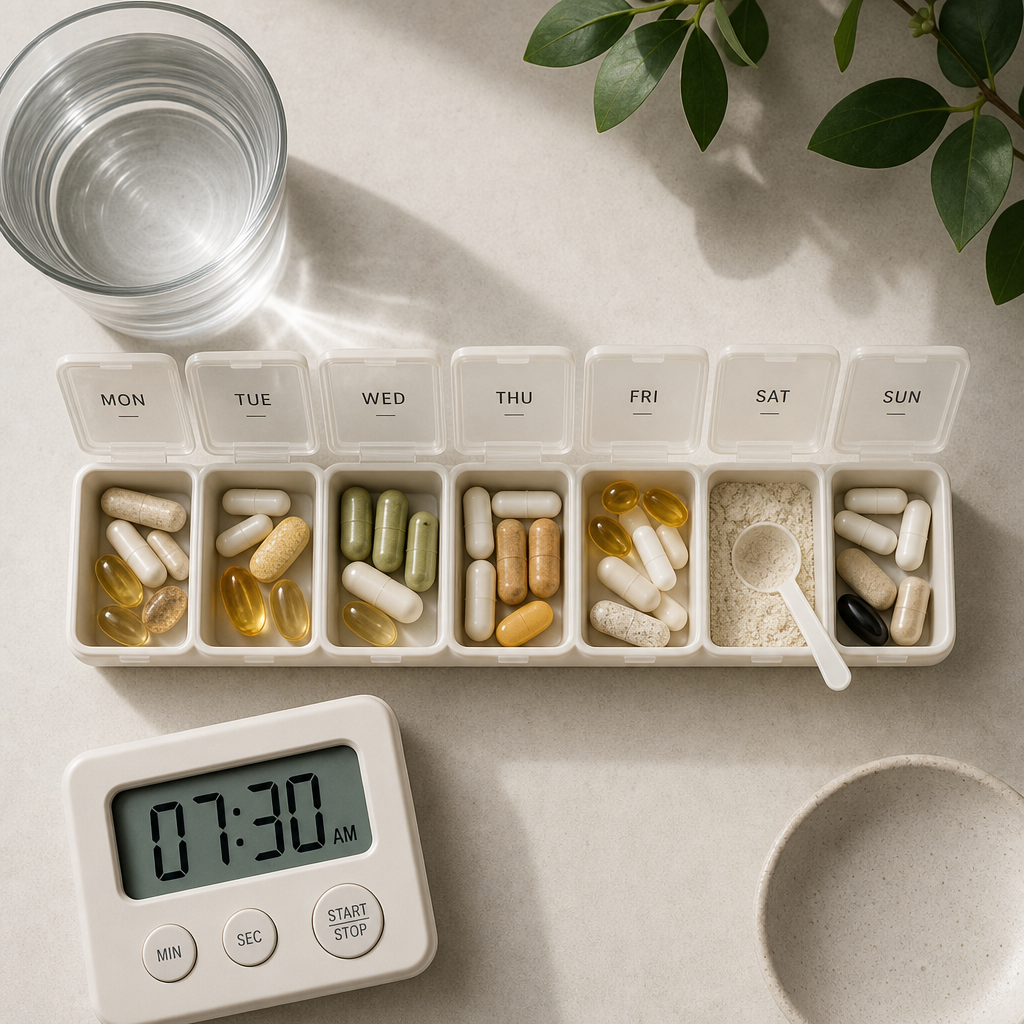

The most common question active people ask is when to take a multivitamin. The honest answer is: with your first substantial meal of the day, almost always breakfast or a post-morning-training meal. There are two reasons this works better than any other window.
Vitamins A, D, E, and K are fat-soluble. Without fat in your stomach at the time of ingestion, a meaningful portion of those vitamins passes through without being absorbed. A typical British breakfast with eggs, avocado, or even a small amount of whole milk provides enough fat to support absorption. A black coffee and a multivitamin on an empty stomach does not.
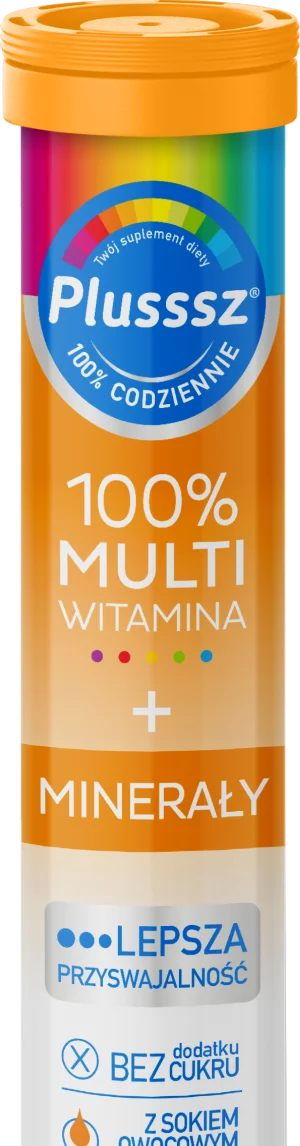
Plusssz UK formulates its multivitamin complexes with improved nutrient assimilability in mind, meaning the bioavailability is optimised at the formulation level. Pairing that with a fat-containing meal amplifies the benefit further.
B vitamins, particularly B6 and B12, can be mildly stimulating. A common mistake is taking a full-spectrum multivitamin in the evening and then wondering why sleep feels lighter than usual. Morning dosing eliminates that variable entirely.
Pro tip: Keep your multivitamin next to your kettle or coffee machine. Visual cues are the single most reliable way to build a supplement habit without relying on phone reminders that are easy to dismiss.
Electrolytes are not just a during-exercise product. The most effective electrolyte timing guide splits usage across three windows: pre-exercise, intra-exercise, and post-exercise recovery. Each window has a distinct physiological purpose.
Starting a session already in mild dehydration, which studies suggest affects up to 40 percent of people who train in the morning, impairs both power output and cognitive focus from the first minute. Drinking an electrolyte solution 20 to 30 minutes before training pre-loads sodium, potassium, and magnesium levels so the body can regulate fluid balance effectively as sweat begins.
Plusssz UK's no-added-sugar electrolyte products are well-suited to this window because they deliver the mineral payload without a glucose spike that could disrupt energy levels mid-session.
For sessions under 45 minutes, plain water is often sufficient. For longer training blocks, including endurance runs, cycling, circuits, or competitive sport, continuing electrolyte intake every 20 to 30 minutes maintains plasma osmolality and delays fatigue onset. This is the window where brands like Science in Sport and High Five primarily focus their marketing, but the pre and post windows are just as important for whole-week performance.
The post-exercise window is critical for fluid and mineral restoration. Sweat loss during a moderate one-hour gym session in the UK averages between 0.5 and 1.5 litres depending on intensity and individual sweat rate. Replacing only water without electrolytes can dilute remaining blood sodium, which paradoxically increases the sensation of thirst without actually restoring hydration status.
Pro tip: Weigh yourself before and after training. Each 0.5 kg of weight lost represents roughly 500 ml of fluid lost. Use that figure to calibrate how much electrolyte solution you need post-session, rather than guessing.
Here is a practical template for a typical active week. This is designed for someone training four to five times per week with a mix of strength and cardio sessions. Adjust the intensity markers to match your own programme.
Morning: Take multivitamin with breakfast including fat. Drink an electrolyte sachet 25 minutes before your session. Continue with water or a second electrolyte drink during training if it exceeds 50 minutes. Post-training: one electrolyte sachet within the hour following your session, alongside a protein-rich meal.
Morning: Multivitamin with breakfast as normal. One electrolyte drink mid-morning or before your lighter session. No post-training electrolyte dose is necessary if the session was under 30 minutes at low intensity, but staying hydrated with mineral water supports the recovery process.
Rest days are not supplement-free days. Continue your multivitamin at breakfast. A half-dose electrolyte drink in the afternoon supports recovery from Monday and Tuesday while keeping sodium and potassium levels stable. Dehydration does not take rest days.
Mirror Monday's protocol. Pre-load with electrolytes 25 minutes before your session. For HIIT or interval-based work, sweat loss is typically higher per minute than steady-state cardio, so prioritise post-session electrolyte replacement. Pair your multivitamin with a breakfast that includes eggs or nut butter for fat-soluble vitamin support.
Same as Monday and Thursday for electrolytes. If you play a team sport on Friday evenings, take your electrolyte dose with dinner rather than immediately before bed to avoid disrupting sleep with a large fluid intake late at night.
Weekend training often varies in timing and type. The rule is simple: match electrolyte use to sweat rate and session duration. Keep the morning multivitamin consistent regardless of whether you train. Weekend consistency with the multivitamin is where most people fall down, because routine is disrupted by social commitments and different meal times.

Not every approach to scheduling supplements is equally effective. Below is a direct comparison of the three most common strategies active people use, based on real-world outcomes rather than ideal-conditions lab results.
Approach |
How It Works |
Verdict for Active People |
|---|---|---|
Ad-hoc dosing (take when remembered) |
No fixed time or food pairing. Supplements taken opportunistically throughout the day or week. |
Lowest effectiveness. Absorption is inconsistent, habit formation is poor, and deficiencies accumulate silently over weeks. |
Fixed morning anchor routine |
Multivitamin taken every morning with breakfast. Electrolytes timed around training sessions using a consistent pre, intra, post structure. |
Most effective for the majority of active people. Habit is stable, absorption is optimised, and the schedule adapts easily to different training days. |
Training-day-only supplementation |
Electrolytes and multivitamins only consumed on days with planned exercise. Rest days are supplement-free. |
Better than ad-hoc but misses the recovery and baseline maintenance benefits of daily multivitamin use. Adequate for some but not optimal for those training four or more times per week. |
A common mistake is treating supplements as a post-training reward rather than a performance input. The mindset matters. If you only reach for your electrolytes when you feel thirsty or fatigued, you are already behind the curve. Thirst is a late signal, not an early warning.
A second common mistake is stacking too many supplements without understanding how they interact. Calcium and iron compete for the same absorption channels. Taking both at the same time in high doses reduces the uptake of each. Plusssz UK's gender-specific formulations for women and men are designed to address these interaction risks at the formulation stage, but timing still plays a role.
A third mistake is ignoring the UK climate. British winters involve indoor heating that dehydrates the body, reduced sunlight that affects vitamin D synthesis, and lower activity-driven thirst signals. Active individuals in the UK often underestimate their electrolyte and vitamin D needs during the colder months compared to summer training blocks.
Finally, people switch supplements too quickly. If you start a new electrolyte or multivitamin product and do not feel a difference within three days, that is normal. Fat-soluble vitamins take weeks to build adequate tissue levels. Electrolyte benefits are more immediate, but the cumulative effect of consistent daily use over four to six weeks is substantially greater than sporadic use over the same period.
A rigid supplement schedule that does not flex for real life is one that gets abandoned. The goal is a framework that holds up across a varied week, not a military-grade protocol that collapses the moment your alarm fails or your Tuesday session moves to Thursday.
On days with two training sessions or extended endurance work over 90 minutes, increase your electrolyte intake proportionally. A second pre-training electrolyte dose before your afternoon or evening session is appropriate. Do not double your multivitamin dose; fat-soluble vitamins accumulate and exceeding recommended doses carries risk over time.
Keep the multivitamin going. During illness, immune function places extra demands on vitamin C, zinc, and B vitamins. These are also the days when people are most likely to skip supplements, which is the opposite of what the body needs. A no-sugar electrolyte drink also supports fluid retention during fever or gastric illness without adding unnecessary sugar that can worsen gut discomfort.
Electrolytes offered by Plusssz UK, are straightforward to pack and do not require refrigeration. This makes them significantly more practical for active people who travel to events, races, or competitions than ready-to-drink formats. Taking your weekly supply in a small travel pouch removes the friction that causes people to skip supplements when away from their normal environment.
Pro tip: Prepare a supplement travel kit at the start of each week, not the morning of your trip. Pre-portioning removes one more decision from a morning that is already busy with logistics.
Yes, in most cases they can be taken together without significant interaction. However, if your multivitamin contains high doses of calcium and your electrolyte formula also contains calcium or magnesium, spacing them by two hours improves the absorption of both. Plusssz UK's formulations are designed with complementary mineral profiles, so stacking them on the same morning is generally fine. When in doubt, take the multivitamin with breakfast and the pre-training electrolyte 20 minutes before your session.
Yes. Electrolyte needs do not disappear on rest days. Passive fluid loss through respiration, low-grade movement, stress hormones, and heated indoor environments continues regardless of exercise. A maintenance dose of around half a standard serving on rest days keeps baseline mineral levels stable and supports the recovery process from previous training. Skipping electrolytes entirely on rest days is one of the most common errors in an active person's weekly supplement plan.
Missing one day has no meaningful physiological impact. Fat-soluble vitamins are stored in tissue, and water-soluble vitamins turn over relatively slowly in active individuals with a reasonably balanced diet. The risk is not one missed dose but the pattern of missing doses, which erodes the baseline nutrient levels that a supplement schedule is designed to maintain. Simply resume the next morning with your regular dose. Do not double up.
The timing principles are identical, but the formulation requirements differ. Women of reproductive age have higher iron needs and different B vitamin demands at certain points in their cycle. Men may benefit from higher zinc and vitamin D dosing in support of testosterone and muscle function. Plusssz UK offers gender-specific multivitamin complexes for exactly this reason. The when is universal; the what should be matched to your demographic and physiology.
Electrolyte benefits, particularly improved hydration and reduced cramping during training, are often noticeable within one to two weeks of consistent use. Multivitamin benefits are slower to appear because they work at the cellular and systemic level. Most active people report clearer energy consistency, better sleep quality, and improved recovery after four to six weeks of daily adherence. Blood markers of nutrient status, such as serum vitamin D and ferritin, take six to twelve weeks to reflect meaningful change from a new supplementation routine.
The timing structure is the same, but seniors require particular attention to vitamin D, B12, and magnesium. Absorption of B12 decreases with age due to reduced gastric acid production, which means a higher dose or a more bioavailable form is often warranted. Vitamin D synthesis in skin declines with age, making supplementation even more important in the UK's limited sunlight environment. Plusssz UK offers formulations designed specifically for seniors that address these elevated needs without requiring a complex multi-product protocol.
What does your current supplement routine look like, and where does it tend to break down? Share your experience so others in the community can learn from what has and has not worked for you.