Most people shopping for hydration support in the UK are choosing between two categories that look similar on the shelf but are fundamentally different in the body. The electrolytes vs sports drinks UK debate is not really a debate at all once you read the label. Traditional sports drinks like Lucozade Sport and Powerade are built around sugar and colour, with electrolytes added almost as an afterthought. A genuine electrolyte supplement is built around the minerals first, with everything else either supporting absorption or simply absent. If you are training regularly, managing your health, or just trying to stay properly hydrated, the ingredients list is the only number that tells you the truth.
Key Insight |
Explanation |
|---|---|
Sugar is not an electrolyte |
Most commercial sports drinks contain 20-30g of sugar per 500ml serving. Sugar does not replace sodium, potassium, or magnesium lost in sweat. |
Sodium is the primary electrolyte lost in sweat |
Sweat contains roughly 900mg of sodium per litre. Any hydration product that does not list a meaningful sodium dose is not addressing the core problem. |
Magnesium is the most overlooked electrolyte |
Magnesium supports muscle contraction and nerve function. It is frequently missing or under-dosed in standard sports drinks. |
Clean hydration means no artificial colours, no unnecessary sugars |
Formulas with no added sugar and no synthetic dyes serve hydration without adding metabolic load or interfering with dietary goals. |
Bioavailability determines whether you absorb what you consume |
The form of mineral used matters. Magnesium citrate absorbs better than magnesium oxide. Potassium chloride is far more effective than potassium sulphate. |
Electrolyte supplements serve different use cases than sports drinks |
Sports drinks target glycogen replacement during extended endurance events. Electrolyte supplements target hydration, recovery, and daily mineral balance. |
Reading the label is a skill, not an inconvenience |
Per-serving dose, mineral form, and the presence of fillers are three things the front of any pack will never tell you honestly. |
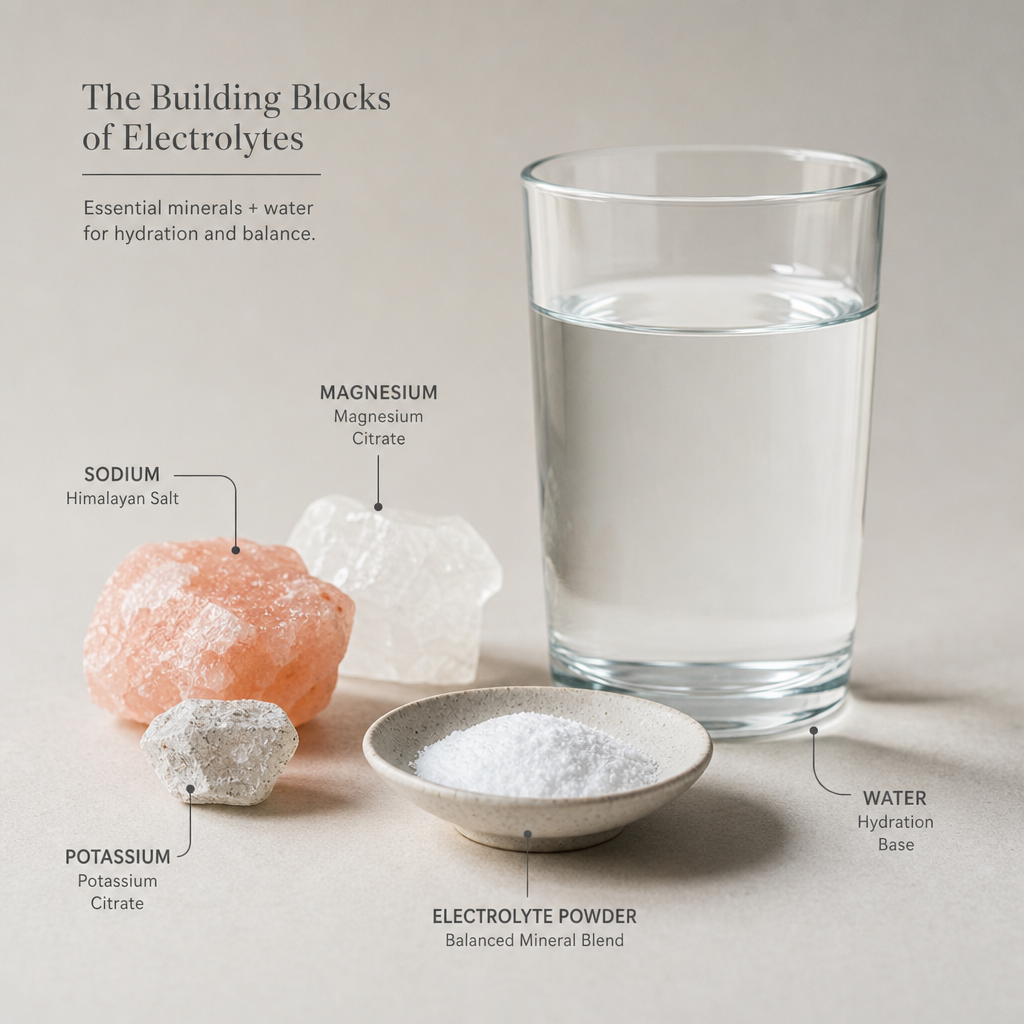
Electrolytes are minerals that carry an electrical charge when dissolved in water. In the human body, the ones that matter most for hydration and physical performance are sodium, potassium, magnesium, and calcium. Each one plays a specific role, and none of them are interchangeable.
Sodium regulates fluid balance between cells and the bloodstream. Without adequate sodium, your body cannot hold onto the water you drink, which is why drinking plain water during intense exercise without any sodium replacement can actually worsen dehydration at the cellular level. Potassium works alongside sodium to regulate blood pressure and muscle contractions. Magnesium is involved in over 300 enzymatic reactions and is directly linked to muscle relaxation and energy production. Calcium supports not just bone density but also the electrical signals that trigger every muscle contraction you make during training.
In practice, most people who feel fatigued, cramped, or mentally foggy after exercise are not simply low on water. They are low on one or more of these minerals. A glass of water does not fix that. An electrolyte product formulated to address that specific deficit does.
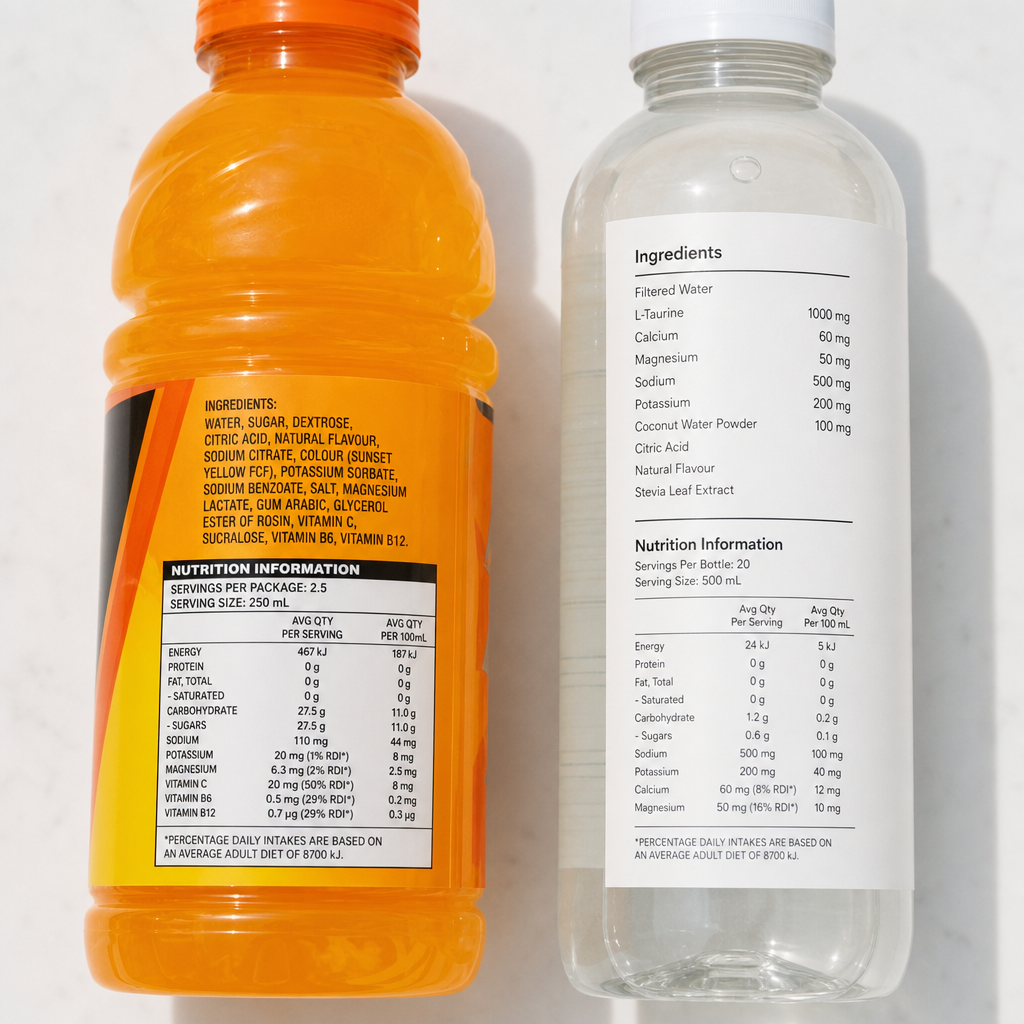

Pick up any major commercial sports drink in a UK supermarket and read the back label. The primary ingredients are almost always water, glucose syrup or sugar, citric acid, and then artificial colours and flavourings. Electrolytes, if listed at all, typically appear near the bottom of the ingredients list, which means they are present in the smallest quantities.
A standard 500ml bottle of a leading sports drink contains between 25g and 33g of sugar. For context, the NHS recommends adults consume no more than 30g of free sugars per day. A single sports drink can consume that entire daily allowance in one sitting. For someone watching their weight, managing blood glucose, or simply not needing the caloric load because they are doing a 45-minute gym session rather than a three-hour endurance race, this is a significant problem.
The sugar exists primarily as a source of quick carbohydrate energy, which is genuinely useful during events lasting longer than 90 minutes at high intensity. For everyone else, it is excess caloric content dressed up as a performance product.
The data consistently shows that sweat losses during moderate exercise can reach 1 to 1.5 litres per hour, carrying with them approximately 900mg to 1,400mg of sodium per litre. A common mistake is assuming that a sports drink with 200mg of sodium per 500ml bottle is providing meaningful replacement. It is not. You would need to drink several bottles to approach actual electrolyte replacement, at which point the sugar intake becomes counterproductive.
"The primary function of oral rehydration is to replace fluid and electrolytes, particularly sodium. Products that prioritise carbohydrate delivery often under-deliver on the electrolyte side of the equation." - Journal of the International Society of Sports Nutrition, hydration guidelines
Pro tip: When comparing any hydration product, look at the sodium per serving first. If it is under 300mg for a product marketed as a serious electrolyte solution, the formula is weighted toward flavour and shelf appeal, not hydration function.
The front of a pack tells you what the marketing team wants you to believe. The back label tells you what is actually inside. Learning to read it properly takes about three minutes and will permanently change how you choose hydration products.
Some products list impressive-looking nutrient amounts, but those figures are per 100g or per two scoops rather than per standard serving. Always convert everything to a single, real-world serving before you compare products side by side. A product listing 500mg of sodium per 100g but recommending a 5g serving is delivering only 25mg per use.
Magnesium oxide is the cheapest and least bioavailable form of magnesium. Magnesium citrate or magnesium malate are absorbed significantly better. Similarly, sodium chloride is effective and straightforward, but some products use sodium bicarbonate as their sodium source, which has different absorption characteristics and can cause digestive discomfort at higher doses.
The form of the mineral tells you whether the manufacturer prioritised formulation science or cost-cutting. A product built around nutrient assimilability, such as the approach taken at Plusssz electrolyte products, will specifically choose forms with established absorption evidence.
A clean hydration supplement should have a short ingredients list where every item serves either a nutritional or a functional purpose. Artificial colours like Brilliant Blue FCF or Tartrazine serve zero nutritional function. Preservatives like sodium benzoate are purely a shelf-life tool. If you cannot explain why an ingredient is there, question whether it should be.
The following table breaks down the three main hydration options available to active people in the UK. This is not a theoretical exercise. These are the actual functional differences that determine whether your hydration strategy supports your goals or simply tastes good.
Category |
Typical Electrolyte Supplement (e.g. Plusssz) |
Commercial Sports Drink (e.g. Lucozade Sport, Powerade) |
Plain Water |
|---|---|---|---|
Sodium per serving |
400-1,000mg, clearly labelled |
100-250mg per 500ml bottle |
0mg |
Sugar content |
Zero added sugar in quality formulas |
25-33g per 500ml bottle |
0g |
Mineral variety |
Sodium, potassium, magnesium, calcium, often trace minerals |
Sodium and potassium, minimal doses |
Trace amounts only, varies by source |
Artificial additives |
None in clean formulas |
Colours, preservatives, artificial flavours common |
None |
Best use case |
Training, recovery, daily hydration, heat, travel |
Long endurance events requiring rapid carbohydrate and fluid replacement |
Baseline hydration in low-intensity conditions |
Suitable for sugar-free diets |
Yes, in no-added-sugar formulas |
Only in low-sugar variants, which typically contain artificial sweeteners |
Yes |
The comparison above makes clear that commercial sports drinks occupy a narrow use case. They are appropriate for endurance athletes burning through glycogen stores over extended durations. For the gym-goer, the weekend cyclist, the active professional, or anyone simply trying to stay well hydrated without consuming unnecessary sugar, a dedicated electrolyte supplement is the more rational choice.
The answer depends almost entirely on exercise duration, intensity, and individual goals, not on which product has better branding or a more aggressive marketing campaign.
If you are competing in an event lasting more than 90 minutes at sustained high intensity, such as a half-marathon, a long cycling sportive, or a triathlon, the carbohydrate component of a sports drink has a legitimate physiological role. Your glycogen stores will be depleted, and rapid glucose delivery through a liquid format can meaningfully support continued performance. This is the context these products were originally designed for.
For any session under 90 minutes, for strength training, for daily hydration support, for recovery between sessions, for older adults managing mineral status, or for anyone on a low-sugar or ketogenic diet, a clean electrolyte supplement is the more appropriate tool. You get the minerals without the metabolic cost of the sugar.
Plusssz formulates specifically for this broader active population, including targeted options for seniors who often have greater challenges with mineral absorption, and for women and men whose micronutrient needs differ meaningfully. The multivitamin and electrolyte range at Plusssz reflects exactly this kind of demographic specificity rather than a one-size-fits-all approach.
Pro tip: If someone you know recommended a specific electrolyte product to you, ask them specifically what they were using it for and at what point in their training. The context matters. A product that works brilliantly for recovery after an early-morning run may not be the right choice for a 65-year-old managing magnesium levels for sleep quality.
The phrase clean hydration supplement has become common enough in the UK market that it risks losing meaning. It needs a working definition that can be tested against a label.
Clean hydration means the product delivers minerals in bioavailable forms, contains no added sugar, uses no artificial colours or synthetic flavourings, and does not include fillers or proprietary blends that obscure individual ingredient doses. Every ingredient on the label should have a clear, verifiable purpose.
Artificial colours such as Sunset Yellow and Tartrazine have been linked to adverse reactions in sensitive individuals, and the European Food Safety Authority requires warning labels on products containing certain azo dyes. Consuming these compounds daily in a product you are using for health and performance reasons is a contradiction. If the formula is clean, those concerns simply do not exist.
Beyond additives, the no-added-sugar formulation directly affects whether a product is usable across a range of dietary approaches. Someone following a low-carbohydrate diet cannot routinely use a 30g-sugar sports drink without disrupting their dietary framework. A sugar-free electrolyte product removes that barrier entirely.
The UK supplement market has grown substantially, and not every product claiming to be the best electrolyte supplement UK consumers can buy is actually worth the price. Competitors like Science in Sport, High Five, and ORS Hydration all occupy space in this market, and each has strengths in specific contexts. The question is whether their formulas are built around your actual needs or around manufacturing economics.
Science in Sport products are well-regarded in the endurance community and their electrolyte range is designed primarily for carbohydrate co-delivery during prolonged events. The formulas contain maltodextrin, which serves a purpose in long-duration sport but adds unnecessary carbohydrate load for anyone not in that specific use case.
High Five Zero is the sugar-free entry in the High Five range and is a reasonable option for lower-intensity use. However, it relies on artificial sweeteners including acesulfame potassium, which some individuals prefer to avoid. The electrolyte doses are moderate rather than therapeutic.
ORS Hydration is built on the oral rehydration salts model, which prioritises sodium and glucose co-transport for rapid fluid absorption. It is effective in clinical rehydration contexts but the glucose content makes it less suitable as a daily clean hydration product.
The differentiating factor for Plusssz in this landscape is the combination of meaningful mineral doses, no added sugar, high bioavailability forms, and formulations built for different demographics rather than a single athlete archetype. For someone referred by a friend who trains regularly or is managing their health actively, those distinctions translate directly into whether the product works for you specifically or just works in general.
No. Sports drinks are primarily carbohydrate delivery vehicles with electrolytes added in small amounts. Electrolyte supplements are formulated specifically to replace minerals lost through sweat and daily physiological processes, without the sugar load. They serve overlapping but distinct purposes, and the ingredients list tells you which category a product actually belongs to regardless of how it is marketed.
For meaningful hydration support, look for at least 400mg of sodium per serving. Research into sweat composition consistently shows losses of 900mg to 1,400mg of sodium per litre of sweat, so a product with 100-200mg per serving is unlikely to make a material difference during moderate to vigorous exercise. Higher-sodium formulas are particularly relevant for those who train in warm conditions or who sweat heavily.
Yes, and for many people daily use is more beneficial than using electrolytes only around training. Magnesium is particularly relevant here, as UK dietary surveys suggest a significant portion of the adult population does not reach recommended daily intake through diet alone. Daily electrolyte supplementation supports baseline mineral status, which influences sleep quality, energy levels, and muscle function, not just athletic performance.
Electrolyte supplements focus specifically on the minerals lost in sweat and involved in fluid balance: sodium, potassium, magnesium, and calcium primarily. Multivitamins cover a broader range of vitamins and minerals including fat-soluble vitamins like D and K, B vitamins, and trace elements. Some formulas, including those in the Plusssz range, combine both functions to address hydration and general micronutrient status together.
For reducing sugar intake, yes. But artificial sweeteners introduce a different set of considerations. Some individuals experience digestive sensitivity to sweeteners like acesulfame potassium and sucralose. More importantly, switching from sugar to sweeteners does not improve the electrolyte dose, which remains the fundamental limitation of most commercial sports drinks. A clean electrolyte supplement with no sweeteners and no sugar removes both concerns simultaneously.
The mineral losses are broadly similar because sweat composition does not change significantly based on exercise type. However, the volume of sweat, and therefore the total electrolyte deficit, tends to be higher in prolonged endurance activity than in a typical gym session. Strength training does create specific demand for magnesium given its role in muscle contraction and recovery. So while the minerals needed are the same, the dosing priorities may shift depending on your primary training modality.
If you have recently switched from a commercial sports drink to a dedicated electrolyte supplement, we would like to know what difference you noticed in how you felt during and after training.