Most supplement routines fail within three weeks. Not because the products are wrong, but because the timing, sequencing, and consistency are all over the place. If you are active, training regularly, or simply trying to perform better each day, a daily supplement routine UK built around real physiology will outperform any random stack of capsules taken at breakfast. This guide gives you a practical, no-fluff framework based on what actually works for people who move, sweat, and want to recover properly.
Key Insight |
Explanation |
|---|---|
Timing matters more than quantity |
Taking the right supplement at the wrong time reduces its effectiveness significantly. Fat-soluble vitamins need food; electrolytes work best pre or intra-workout. |
Electrolytes are not just for marathon runners |
Anyone training for 45 minutes or more in a warm environment loses meaningful sodium and potassium. Replenishment improves performance and reduces cramping. |
No-added-sugar formulas matter for daily use |
Regular sugar-laden electrolyte drinks add unnecessary calories and cause blood sugar spikes, which undermine a balanced daily routine. |
Multivitamins fill gaps, not replace food |
A quality multivitamin covers micronutrient shortfalls common in active individuals but cannot substitute a varied diet. It is a safety net, not a shortcut. |
Consistency beats perfection |
Taking a well-chosen supplement daily for 12 weeks produces measurably better results than an elaborate protocol followed sporadically. |
Demographic-specific formulas improve assimilability |
Women, men, seniors, and athletes have different micronutrient demands. A targeted formula accounts for these differences rather than offering one-size-fits-all dosing. |
Hydration and vitamins work synergistically |
Several B vitamins and vitamin C are water-soluble and are transported more efficiently when paired with adequate hydration and electrolytes. |
The most common reason a supplement routine collapses is poor sequencing. People buy five products, take all of them at breakfast with coffee, and wonder why they see no results after a month. Coffee inhibits the absorption of iron and certain B vitamins. Taking everything at once overwhelms the gut's transport capacity for nutrients competing for the same receptors.
A common mistake is treating supplements as an afterthought rather than a deliberate part of a daily schedule. The data consistently shows that habit stacking, attaching a supplement to an existing daily action like a morning meal or pre-training drink, increases adherence by a significant margin. According to a 2023 survey published by Statista, approximately 43% of UK adults reported inconsistent supplement use despite purchasing products regularly.
The fix is not more willpower. It is a simpler, better-timed routine with fewer products that do their jobs well.

Before adding any product to your routine, you need an honest picture of what your body actually needs. That means looking at three things: your training load, your diet quality, and any demographic-specific gaps you are likely carrying.
If you train three or more times per week at moderate to high intensity, your electrolyte and B vitamin demands are elevated compared to a sedentary person. Sweat losses during a one-hour moderate session can range from 500ml to over a litre depending on temperature and body size. That fluid carries sodium, potassium, magnesium, and chloride with it.
A practical starting point: track your sweat rate for two weeks by weighing yourself before and after training without drinking during the session. Every kilogram lost is approximately one litre of fluid. This gives you a concrete hydration target to design your multivitamin and electrolyte routine around.
Most active UK adults are low in vitamin D (particularly between October and March), magnesium, and omega-3 fatty acids. The NHS itself recommends vitamin D supplementation for everyone in the UK during autumn and winter months. If your diet is low in oily fish, leafy greens, and whole grains, those gaps are real and measurable.
Pro tip: Keep a simple three-day food log before choosing your multivitamin. Identify which food groups you consistently skip. That shapes which multivitamin formula is actually useful to you rather than just a marketing match.
The morning is the highest-leverage window for foundational supplements. Your gut is empty or lightly loaded, cortisol is naturally elevated to support wakefulness, and you have the mental clarity to be consistent before the day derails your intentions.
Fat-soluble vitamins, specifically A, D, E, and K, require dietary fat for absorption. Take your multivitamin with breakfast rather than on an empty stomach. A meal that includes eggs, avocado, or full-fat yoghurt provides enough fat to drive absorption of these nutrients meaningfully. Taking a fat-soluble vitamin with a dry rice cake and black coffee is largely a waste of a tablet.
Water-soluble vitamins, the B complex and vitamin C, are absorbed efficiently without food but are also flushed out faster. This is why splitting your vitamin C intake between morning and post-training can maintain more stable blood levels across the day.
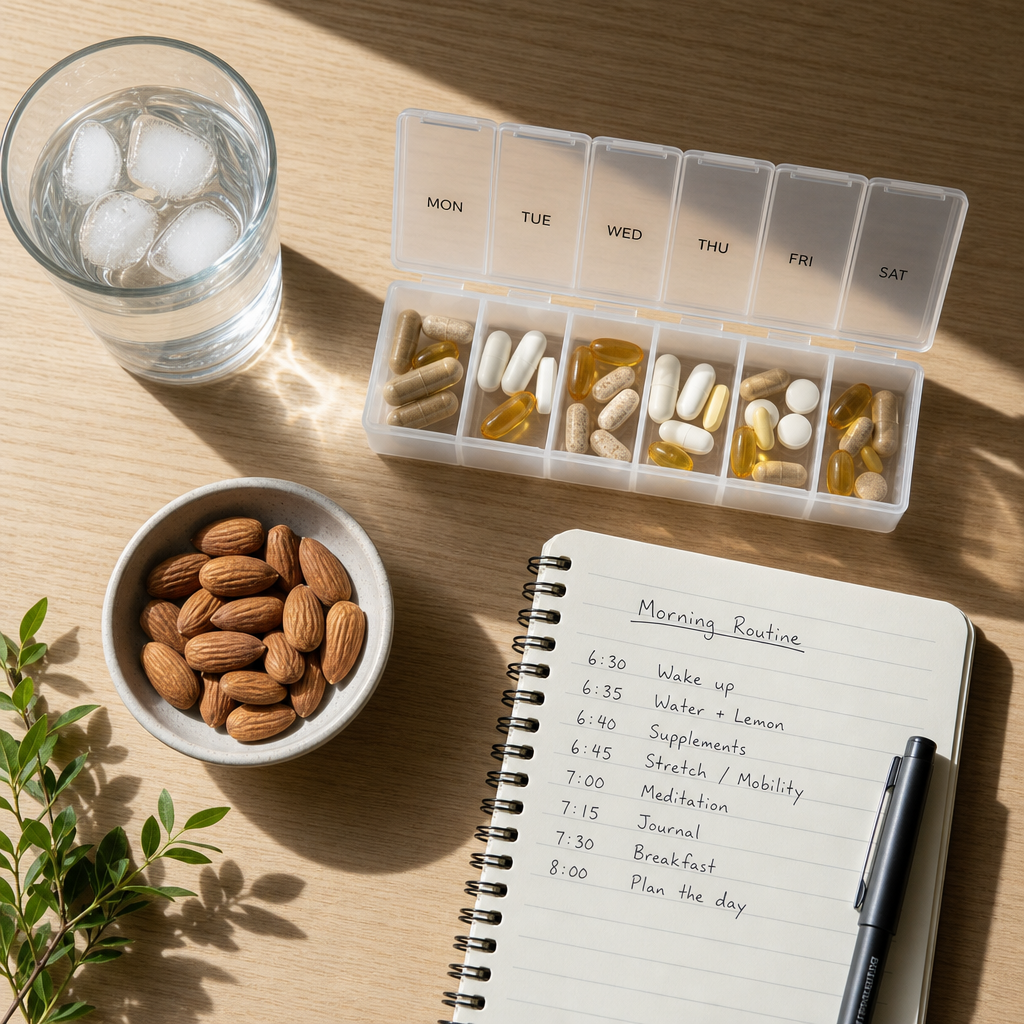
Drinking 400-500ml of water first thing in the morning rehydrates you after overnight fluid loss and acts as a reliable cue to take your morning supplements. For active individuals, adding a no-added-sugar electrolyte product to that morning drink provides a gentle sodium and potassium top-up that supports early energy without the blood sugar spike of a sugary sports drink.
Pro tip: Prepare your morning supplement stack the night before. Place your multivitamin next to the kettle or your water bottle. The physical cue makes a measurable difference to consistency over a 12-week period.
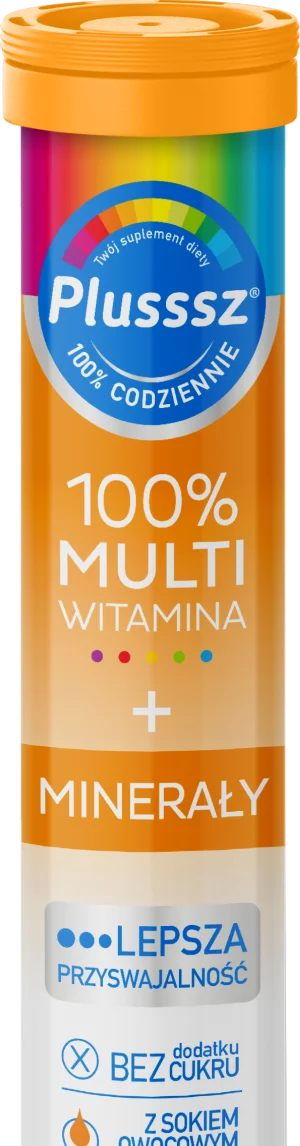
The most effective active lifestyle supplements routine for a UK-based individual combines a targeted multivitamin taken with breakfast and an electrolyte hydration product timed around training. These two product categories address the two most common gaps in an active person's nutrition: micronutrient shortfalls and hydration imbalances.
"Electrolyte depletion during exercise is one of the most underestimated performance inhibitors in recreational sport. Even mild dehydration of 2% body weight impairs cognitive and physical performance measurably." - American College of Sports Medicine Position Stand on Exercise and Fluid Replacement
Generic multivitamins often rely on cheap forms of minerals and vitamins with low bioavailability. Magnesium oxide, for example, is significantly less absorbable than magnesium citrate or glycinate. When evaluating a product, look at the form of each nutrient, not just the headline dose on the label.
For women who are active, iron and folate are frequently under-consumed. For active men over 40, zinc, vitamin D, and magnesium are the most common shortfalls. Seniors engaged in regular exercise need higher B12 (absorption decreases with age) and more vitamin D to support bone density. Plusssz UK formulates specifically for these demographic differences rather than offering a single formula to everyone.
Electrolytes are not only lost during training. Poor diet, alcohol, coffee, and heat all deplete sodium, potassium, and magnesium. A structured routine uses a low-dose electrolyte product in the morning for baseline maintenance and a higher-dose product during or after training sessions lasting longer than 45 minutes.
For sessions under 45 minutes in cool conditions, water alone is typically sufficient. For anything longer, or in warm UK summers, a dedicated electrolyte product with no added sugar keeps you performing without unnecessary calorie loading.

Training timing is where most supplement routines either pay off or fail completely. The principle is simple: match the supplement to the physiological window it supports.
The pre-training window is for priming. Electrolytes taken 30 minutes before a session support early fluid retention and nerve signalling. If you take your multivitamin at breakfast and train mid-morning, you are already benefiting from morning nutrient uptake without doubling up unnecessarily.
For sessions over an hour, sipping an electrolyte drink throughout the session replaces what sweat takes out. The target for most active individuals is 400-800mg of sodium per hour of exercise, depending on sweat rate. Products with no added sugar allow you to meet that target without consuming excess carbohydrates unless you are in a deliberate fuelling protocol for endurance sport.
The 30-minute post-training window is most relevant for protein and carbohydrate timing, which is outside the scope of multivitamin and electrolyte supplementation. However, rehydrating with an electrolyte product immediately post-session accelerates fluid replacement compared to plain water alone, because sodium drives retention of ingested fluids.
Not all approaches to building a supplement routine are equally effective. Below is a practical comparison of three common strategies used by active individuals in the UK.
Approach |
Key Features |
Best Suited For |
|---|---|---|
Generic All-in-One Stack |
Single product covering vitamins, minerals, and electrolytes. Often lower bioavailability forms. Convenient but imprecise. |
Beginners who want simplicity over optimisation. Not ideal for serious athletes or those with specific nutrient gaps. |
Targeted Multivitamin Plus Separate Electrolyte |
Demographic-specific multivitamin taken with breakfast. No-added-sugar electrolyte product timed around training. Two products, deliberate timing. |
Active individuals training 3 or more times per week who want measurable results. This is the approach Plusssz UK is built around. |
Food-First with Single Gap-Filler |
Strong diet base with one targeted supplement covering a confirmed deficiency (e.g. vitamin D only). Minimalist and evidence-grounded. |
People with excellent diet quality and low training loads. Risk is underestimating electrolyte loss and micronutrient gaps that food logs miss. |
In practice, the most frequent errors in supplement routines are not about choosing the wrong products. They are about execution. Understanding where people go wrong saves months of wasted spending and suboptimal results.
Dumping a handful of supplements into your stomach at 7am with no food and a mug of coffee is the fastest way to irritate your gut, impair absorption, and still feel terrible by midday. Calcium and iron, for example, compete for the same absorption channels. Taking them together means one of them loses. Space them by at least two hours if both are part of your routine.
A common mistake is treating electrolytes as exclusively a sports product. Hydration status affects nutrient transport across the entire day, not just during a session. If you are under-hydrated at your desk, your vitamin D and B12 absorption is compromised even if your timing was perfect at breakfast.
Many people stop a supplement routine after four weeks because they do not feel a dramatic difference. The data consistently shows that vitamin D levels take six to eight weeks to measurably shift in blood serum. Magnesium status changes over a similar timeline. Consistency for a minimum of 12 weeks is the threshold for evidence-based assessment of whether a routine is working.
One of the clearest differentiators between brands like Plusssz UK and generic competitors is demographic specificity. A 55-year-old woman doing three yoga and two HIIT sessions per week has fundamentally different micronutrient needs than a 28-year-old male endurance cyclist. Treating them with the same formula is not evidence-based practice.
Active women of reproductive age need adequate iron (losses through menstruation compounded by sweat losses), folate, and calcium. Vitamin D deficiency is widespread in the UK across all demographics, but women over 40 face accelerating bone density concerns that make D3 with K2 a particularly important pairing. The K2 component directs calcium to bones rather than soft tissue.
Men training at high intensity have elevated zinc requirements (zinc is lost in sweat and is critical for testosterone maintenance and immune function). Magnesium glycinate or citrate supports sleep quality and muscle recovery, both of which decline with intense training loads. A multivitamin built for active men should contain meaningful doses of these, not token amounts added for label appeal.
Vitamin B12 absorption decreases with age due to reduced intrinsic factor production in the stomach. Seniors should look for methylcobalamin (the active form of B12) rather than cyanocobalamin, which requires conversion steps the aging gut handles less efficiently. Combined with vitamin D3, magnesium, and electrolyte support, this forms the core of a practical daily supplement routine UK for older active individuals.
The best time to take a multivitamin is with your largest meal of the day, typically breakfast or lunch. This ensures fat-soluble vitamins (A, D, E, K) have sufficient dietary fat for absorption. Taking a multivitamin on an empty stomach can cause nausea and reduces the uptake of several key nutrients.
Yes. Any training session lasting 45 minutes or more, particularly in a warm environment or at high intensity, depletes sodium, potassium, and magnesium through sweat. Even gym sessions, cycling, and team sports create meaningful electrolyte losses. A no-added-sugar electrolyte product is appropriate for most active individuals, not just endurance athletes.
Yes, with some nuance. If your multivitamin contains calcium and your electrolyte product contains iron (some do), it is better to separate them by an hour or two. In most standard pairings, a morning multivitamin with breakfast followed by an electrolyte drink around training time is a clean, non-competing protocol.
Most people notice improved energy and hydration within one to two weeks of consistent electrolyte use. Micronutrient changes, such as improved vitamin D status or corrected magnesium levels, take six to twelve weeks to manifest in measurable ways. Commit to at least 12 weeks before evaluating whether a routine is working for you.
For most active individuals, yes. Products with added sugar are designed for high-intensity endurance events where rapid carbohydrate delivery is the goal. For daily hydration support and routine training, added sugar contributes unnecessary calories and blood sugar volatility without meaningful performance benefit. A no-added-sugar formula fits a balanced daily routine far better.
The most reliable method is a blood panel through your GP covering vitamin D, B12, iron/ferritin, and magnesium. In practice, neon-yellow urine from cheap B vitamins often signals poor bioavailability forms being excreted rather than absorbed. Look for nutrient forms like methylcobalamin, magnesium citrate, and zinc bisglycinate as markers of a higher-quality formulation.
Yes, and this is one area where demographic-specific formulas genuinely add value. Women need more iron and folate; men need more zinc. Post-menopausal women need higher vitamin D and K2. A single formula cannot optimise for both sets of requirements simultaneously. Choosing a multivitamin matched to your sex and activity level is worth the minor additional cost.
If you have built a supplement routine that has made a real difference to your training or daily energy, share what worked for you in the comments. Your experience might be exactly what someone else needs to hear.