You could be spending good money on supplements every month and absorbing less than half of what you actually pay for. Research published in the European Journal of Nutrition suggests that certain synthetic vitamin forms have absorption rates as low as 10-20% compared to their more bioavailable counterparts. That gap is not a minor footnote. It is the difference between a supplement that works and one that mostly goes down the drain. Understanding supplement bioavailability UK is the single most important factor that most buyers completely overlook when choosing what to put in their bodies.
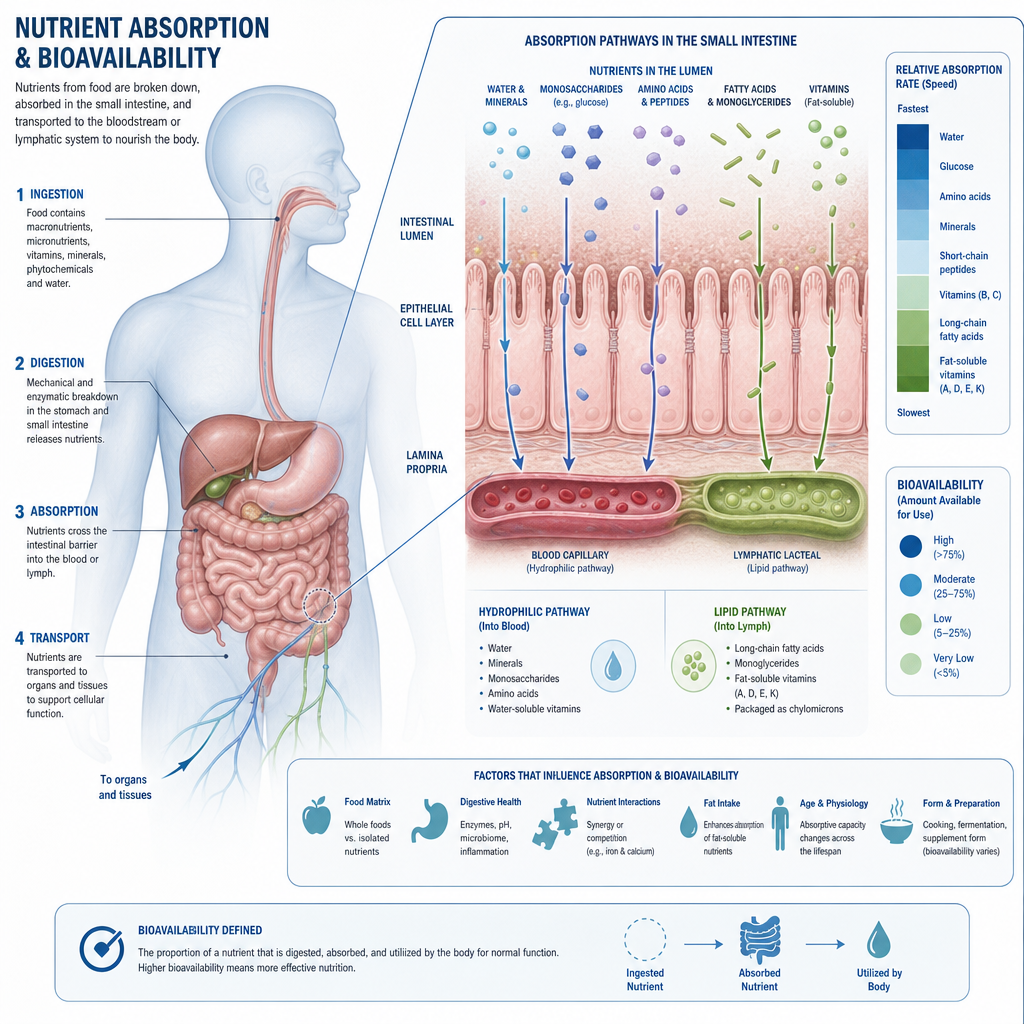
Bioavailability refers to the proportion of a nutrient or active ingredient that actually enters your bloodstream and becomes available for your body to use. It is not about what is listed on the label. It is about what your cells actually receive after digestion, absorption through the intestinal wall, and metabolism by the liver.
A supplement with 500mg of vitamin C printed on the box does not mean your body processes all 500mg. The form of the vitamin, the delivery mechanism, whether you took it with food, and even your gut health all determine the final number. In practice, bioavailability is the real serving size, not the one on the back of the packet.
For active individuals training regularly or managing a demanding lifestyle, this matters enormously. Your body has higher demands for certain micronutrients post-exercise, and if your supplement form is poorly absorbed, you are leaving recovery and performance on the table.
Key Insight |
Explanation |
|---|---|
Form determines absorption |
Magnesium glycinate absorbs significantly better than magnesium oxide. The mineral is the same; the form is not. |
Electrolytes in solution have high bioavailability |
Dissolved electrolyte powders bypass many of the absorption barriers that tablets face, making them highly efficient for hydration support. |
Fat-soluble vitamins need dietary fat |
Vitamins A, D, E, and K require fat in the same meal to be absorbed properly. Taking them on an empty stomach wastes a significant portion. |
Synthetic vs. natural forms differ meaningfully |
Natural vitamin E (d-alpha-tocopherol) is absorbed roughly twice as effectively as the synthetic dl-alpha-tocopherol form. |
Gut health is a multiplier for all nutrient absorption |
Compromised gut lining or dysbiosis reduces absorption across the board, meaning even high-bioavailability supplements underperform in poor gut conditions. |
No added sugar formulas support metabolic efficiency |
Sugar spikes can interfere with mineral absorption pathways, particularly calcium and magnesium. Sugar-free electrolyte formulas avoid this issue entirely. |
Methylated B vitamins are non-negotiable for many people |
Roughly 40-60% of the population carries MTHFR gene variants that impair conversion of synthetic folic acid to its usable form. Methylfolate bypasses this entirely. |
The supplement industry is largely unregulated when it comes to the form of nutrients used. A manufacturer can include a vitamin or mineral in a cheap, poorly absorbed form, hit the label claim for milligrams, and market the product as high-strength. Technically, they are not lying. Practically, they are selling you something that works far less well than it could.
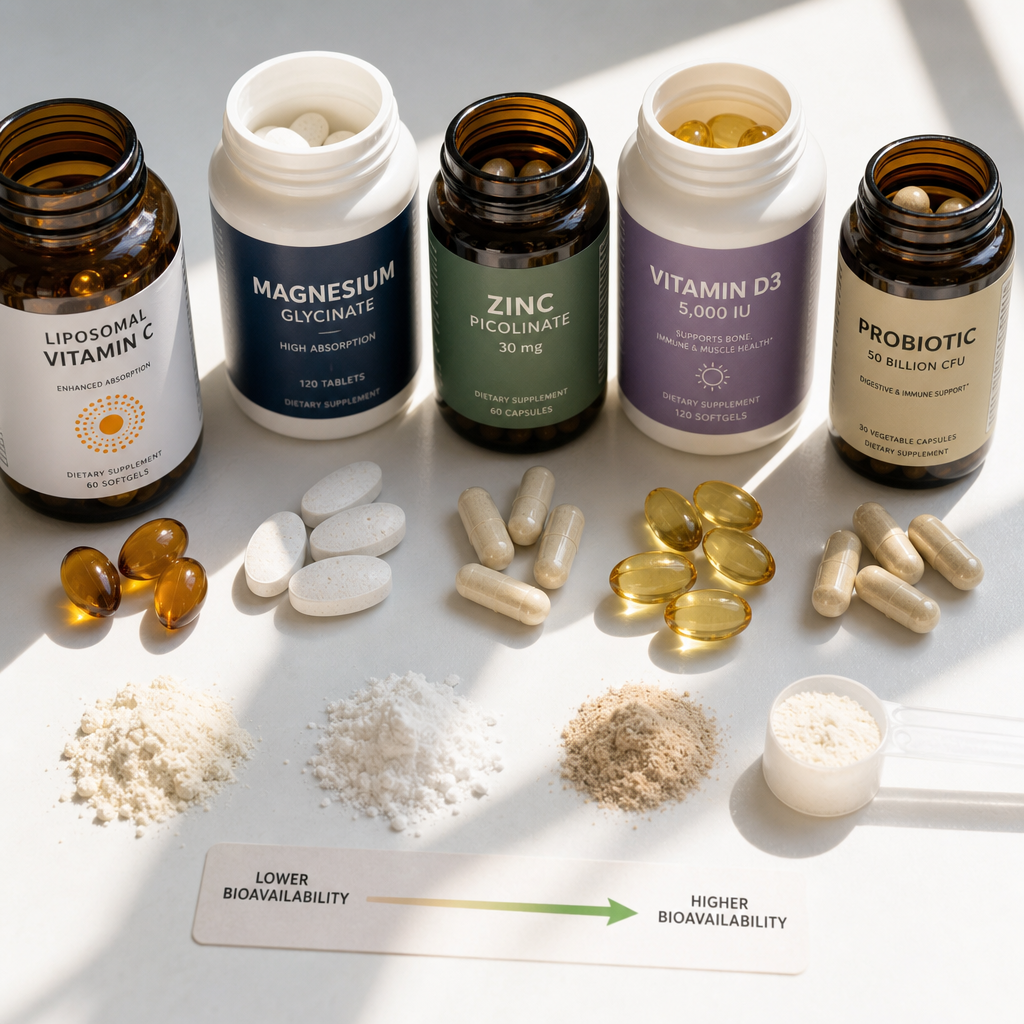
The data consistently shows that the chemical form of a nutrient is the primary driver of how much your body actually absorbs. Zinc picolinate, for example, has demonstrated superior absorption compared to zinc gluconate or zinc sulfate in clinical comparisons. Chelated minerals, where a mineral is bound to an amino acid, consistently outperform their oxide and sulfate counterparts in absorption studies.
Tablets must first break down in the stomach before nutrients are even available for absorption. Depending on the binder and compression used, some tablets pass through the digestive system partially intact. This is more common than supplement brands admit publicly.
Powders dissolved in water, like electrolyte hydration formulas, present nutrients already in solution. Your intestinal cells do not have to work to dissolve the product first. This is a meaningful advantage for absorption speed and efficiency, particularly during or after exercise when rapid nutrient delivery matters.
Pro tip: If you want to do a basic at-home test for a tablet supplement, drop it in a glass of warm water and stir gently. A high-quality tablet should begin breaking apart within 20-30 minutes. If it sits intact for an hour, your stomach acid may not do much better.
Improved nutrient assimilability is a term used to describe formulation choices that actively increase the proportion of a nutrient that your body can actually process and use. It goes beyond simply choosing a better chemical form. It includes co-factor inclusion, delivery format, and timing design.
A well-formulated multivitamin, for instance, will pair vitamin D3 with vitamin K2. This is not marketing. Vitamin K2 directs calcium to bones rather than soft tissue, and D3 without K2 can cause calcium to accumulate in arteries rather than where it is needed. These are co-factors that improve assimilability at a physiological level.
Exercise increases oxidative stress, mineral losses through sweat, and the body's demand for certain B vitamins involved in energy metabolism. If those nutrients are present on a label but absorbed poorly, the gap between what you need and what you get widens exactly when your body is under most demand.
A common mistake is assuming that a higher milligram dose compensates for poor absorption. It does not reliably. Megadosing poorly bioavailable magnesium oxide will mostly give you loose stools before it meaningfully raises your cellular magnesium levels. The right form in a sensible dose consistently outperforms the wrong form in a large dose.
"The bioavailability of a nutrient is arguably more important than the dose on the label. Formulation decisions determine whether a supplement is therapeutic or merely decorative." - Dr. Jeffrey Bland, founding father of functional medicine and author of The Disease Delusion
At Plusssz, the formulation philosophy behind their electrolyte and multivitamin ranges is built specifically around this principle. By prioritising forms with documented superior absorption and combining nutrients with their synergistic co-factors, the goal is to ensure that the nutrients listed on the label are the ones your body actually uses, not the ones that exit your system without effect.
Vitamins absorption is influenced by at least five distinct variables, and most supplement users are only aware of one or two of them. Knowing all five lets you make smarter decisions when choosing and taking your supplements.
Fat-soluble vitamins (A, D, E, K) require dietary fat present in the gut at the time of ingestion for proper absorption through the intestinal lymphatic system. Taking these on an empty stomach, or with a fat-free meal, measurably reduces how much you absorb. Water-soluble vitamins (C and all B vitamins) are generally absorbed more readily but are also not stored in the body, meaning consistent daily intake matters.
Certain nutrients compete for the same transport proteins in the intestinal wall. High-dose zinc supplementation, for example, inhibits copper absorption. Calcium and magnesium compete for absorption at high doses. This is why the ratio of nutrients in a formulation matters as much as the individual amounts.
The gut microbiome synthesises certain B vitamins and vitamin K2, and a diverse, healthy microbiome enhances absorption of many micronutrients. Research from University College London has demonstrated that gut dysbiosis measurably reduces iron and B12 absorption. If you are training hard and eating a restricted diet, your microbiome health is a real variable in how well your supplements work.
The MTHFR polymorphism is the best-documented example. People carrying this variant cannot efficiently convert synthetic folic acid to 5-methyltetrahydrofolate (5-MTHF), the active form the brain and body uses. Supplements using methylfolate bypass this entirely. Similarly, some individuals convert beta-carotene to vitamin A poorly and need preformed retinol instead.
Gastric acid production decreases with age, which directly reduces absorption of vitamin B12, calcium, iron, magnesium, and zinc. Seniors who take the same supplement as a 25-year-old are not necessarily getting the same nutritional result. This is why formulations targeted at older active adults often include higher amounts of these specific nutrients or use forms that require less gastric acid for absorption.
Pro tip: Take fat-soluble vitamins like D3 and K2 with your largest meal of the day, particularly one containing healthy fats such as eggs, olive oil, or avocado. The difference in absorption compared to taking them fasted can be significant, with some studies indicating a 30-50% improvement in serum vitamin D levels when taken with a fat-containing meal.

The table below compares three of the most commonly supplemented minerals across different chemical forms, based on published absorption studies. This is not exhaustive, but it covers the comparisons most relevant to active individuals using multivitamin and electrolyte products.
Nutrient |
Lower Bioavailability Form |
Higher Bioavailability Form |
|---|---|---|
Magnesium |
Magnesium oxide (absorption rate approximately 4%) |
Magnesium glycinate or malate (absorption rate 40-80%) |
Zinc |
Zinc sulfate (adequate but lower tolerance) |
Zinc picolinate or bisglycinate (superior absorption and tolerance) |
Vitamin B12 |
Cyanocobalamin (requires conversion step, poorly absorbed in those with low gastric acid) |
Methylcobalamin (active form, absorbed directly without conversion) |
Folate (B9) |
Folic acid (synthetic, requires MTHFR conversion) |
Methylfolate or 5-MTHF (active form, bypasses genetic barriers) |
Iron |
Ferrous sulfate (higher absorption but significant GI side effects) |
Iron bisglycinate (similar or better absorption with superior GI tolerance) |
The pattern across all of these is consistent. Chelated forms, methylated forms, and active forms consistently outperform cheaper, synthetic, or inorganic forms. When a supplement brand says they use improved forms for better absorption, look for these specific names on the label. Vague claims without listed forms are a red flag.
Electrolytes including sodium, potassium, magnesium, and calcium operate differently from vitamins when it comes to bioavailability. Because they are ionic compounds, they dissociate readily in water and are absorbed through specific ion channels in the intestinal wall. When dissolved in water before consumption, their bioavailability is generally high, often above 90% for sodium and potassium.
This is why electrolyte hydration products in powder form have a genuine functional advantage over trying to get the same minerals from compressed tablets taken separately. The solubility problem has already been solved before the product reaches your gut.
There is a specific reason why sugar-free electrolyte formulas are preferable beyond calorie concerns. High sugar intake elevates insulin, and elevated insulin can increase urinary excretion of magnesium and zinc. For an athlete sweating through a hard training session, that is the last thing you want at the exact moment you are trying to replenish those minerals.
A properly formulated electrolyte product with no added sugar supports the absorption and retention of key minerals rather than working against it. This is not a small detail. For anyone training more than four times per week, the cumulative difference over weeks of supplementation is meaningful.
One nuance worth understanding: small amounts of glucose (not sugar in the traditional sense) do enhance sodium absorption in the gut through the SGLT1 co-transporter. This is the physiological basis of oral rehydration therapy. A well-designed electrolyte formula may include a very small amount of glucose specifically for this purpose, not as sweetener, but as an absorption facilitator. This is different from a product loaded with sugar for palatability reasons. Reading the ingredient breakdown tells you which you are dealing with.
Most people scan the front of a supplement box and move on. The information that actually tells you whether a product is worth buying is on the back, in the ingredient list and the form names used. Here is what to look for.
The label saying "Vitamin B12 200mcg" tells you almost nothing useful. "Vitamin B12 (as methylcobalamin) 200mcg" tells you a great deal. Always look for the parenthetical form name. If a brand does not list the form, assume it is the cheapest available version and price accordingly.
Look for pairings that suggest the formulator understands absorption physiology. D3 alongside K2, iron alongside vitamin C, and zinc with copper in appropriate ratios are all indicators of a formulation designed for actual efficacy rather than just label compliance.
Some tablet binders and fillers actively interfere with nutrient absorption. Calcium carbonate, used as both a nutrient and a filler, competes with iron absorption. If you see calcium carbonate listed alongside iron in a multivitamin, those two nutrients are fighting each other in your gut. High-quality formulations keep these nutrients in separate delivery mechanisms or use alternative forms.
Plusssz UK's approach to formulation, particularly in their multivitamin complexes for women and men, prioritises these precise considerations. The difference between a generic multivitamin and a purpose-built formula for active individuals is largely found in these label details, not in the marketing copy on the front of the box.
Bioavailability is the percentage of a supplement's active ingredient that your body actually absorbs and uses. A supplement may list 500mg of a nutrient, but if the form used has 20% bioavailability, your body receives the equivalent of 100mg. Choosing supplements formulated with high-bioavailability forms is the most direct way to ensure you are actually getting what the label claims.
Yes, and the difference is often significant. The UK supplement market ranges from products using the cheapest available nutrient forms to those using clinically validated, highly bioavailable forms. The price gap between these does not always reflect this. Some mid-priced products use far superior forms compared to expensive mainstream brands. Reading the ingredient form names on the label is more reliable than using price as a proxy for quality.
For electrolytes, the delivery format matters more than the chemical salt used, with one important exception. Magnesium in electrolyte products varies meaningfully by form. Magnesium citrate or malate absorbs considerably better than magnesium oxide. For sodium and potassium, most common forms absorb well when dissolved in water, which is why quality electrolyte powders dissolved before consumption are a highly efficient delivery method.
To a degree, yes. Taking fat-soluble vitamins with a fat-containing meal meaningfully improves their absorption. Taking iron supplements with vitamin C and away from calcium and coffee improves iron uptake. Taking magnesium in the evening on its own rather than in a mixed stack reduces competition with other minerals. These timing adjustments help, but they cannot fully compensate for a supplement using a fundamentally poorly absorbed nutrient form.
The differences are physiologically grounded when done properly. Women of reproductive age have higher iron needs and different demands for folate, particularly methylfolate given its role in hormonal and cellular health. Men's formulas often include higher zinc levels given its role in testosterone metabolism and immune function. Seniors need more B12 in more bioavailable forms due to age-related decline in gastric acid. Demographic-specific formulations are not just marketing if the nutrient forms and ratios reflect genuine physiological differences.
Mainstream sports drinks typically rely on high sugar content for palatability and energy, which is a different functional goal than electrolyte replenishment. For mineral absorption specifically, no added sugar electrolyte formulas are superior because they avoid the insulin-driven urinary excretion of magnesium and zinc that follows high-sugar intake. For pure rehydration and mineral replacement post-exercise, a well-formulated sugar-free electrolyte powder designed for absorption is a more targeted and effective tool than a mainstream sports drink.
Have you switched supplement forms and noticed a difference in how you feel or recover? Share your experience below, because the real-world data from active people is some of the most useful information in this space.