Most UK shoppers spend more time reading a restaurant menu than the label on a supplement they take every day. That is a problem. The UK supplement market is worth over £500 million annually according to the Health Food Manufacturers' Association, and a significant portion of products on shelves contain unnecessary fillers, misleading serving size tricks, and nutrient forms your body absorbs poorly. Knowing how to read a supplement label in the UK is not optional if you care about what you are actually putting in your body. This guide cuts through the jargon and tells you exactly what to look for.
Key Insight |
Explanation |
|---|---|
Serving size is the first number to check |
Manufacturers sometimes use a single tablet as a serving when the recommended dose is three, making nutrient amounts look smaller per portion than they are in practice. |
"No added sugar" is not the same as sugar-free |
Products can carry this claim while still containing naturally occurring sugars from fruit concentrates or maltodextrin. Check the carbohydrate line under the nutrition table. |
Nutrient form matters more than quantity |
Magnesium oxide contains more elemental magnesium by weight than magnesium citrate, but citrate absorbs significantly better. Always check the form listed in brackets after the nutrient name. |
NRV percentages are population averages |
UK Nutrient Reference Values are set for sedentary adults. If you train regularly, your electrolyte and B-vitamin needs are higher than the 100% NRV figure suggests. |
"Proprietary blend" hides individual doses |
If a label lists a blend weight rather than individual ingredient weights, you cannot verify whether active ingredients are present in effective amounts. |
Inactive ingredients can be active problems |
Fillers like titanium dioxide (E171) and artificial colourings are flagged by the Food Standards Agency. These appear in the "other ingredients" section, which many people skip entirely. |
Electrolyte ratios matter for hydration |
Sodium and potassium need to be present together in the right ratio for effective cellular hydration. A supplement listing only sodium is not a complete electrolyte formula. |
Post-Brexit, the UK operates under its own retained food law framework, which means UK supplement labels follow the UK Food Information Regulation rather than EU Regulation 1169/2011, though the two are largely aligned in practice. The key practical difference is that UK products sold after January 2021 must display a UK Conformity Assessed marking for certain health claim categories, and the approved list of permitted nutrition and health claims is now maintained separately by the Food Standards Agency.
If you pick up a product imported from the EU or the US and sold on a UK marketplace, the labelling requirements may not match what UK law mandates. In practice, this means allergen declarations, country of origin statements, and responsible person details may be absent or formatted differently. This is not a theoretical risk. A 2022 Trading Standards review found labelling non-compliance in a notable proportion of food supplements sold via third-party online marketplaces in the UK.
For active individuals buying electrolyte products or multivitamin complexes, the practical implication is straightforward: always buy from brands that explicitly manufacture and label for the UK market. That means the label will use milligrams and micrograms consistently, reference UK NRV rather than US DV percentages, and list a UK-based responsible operator. These are not minor details. They affect how you interpret every number on the label.
Pro tip: If a supplement label lists "% Daily Value" instead of "% NRV", the product was formulated for the US market. US DV figures differ from UK NRV figures for several key nutrients including Vitamin D, folate, and calcium, so the percentages are not directly comparable to what your UK diet and activity level actually require.
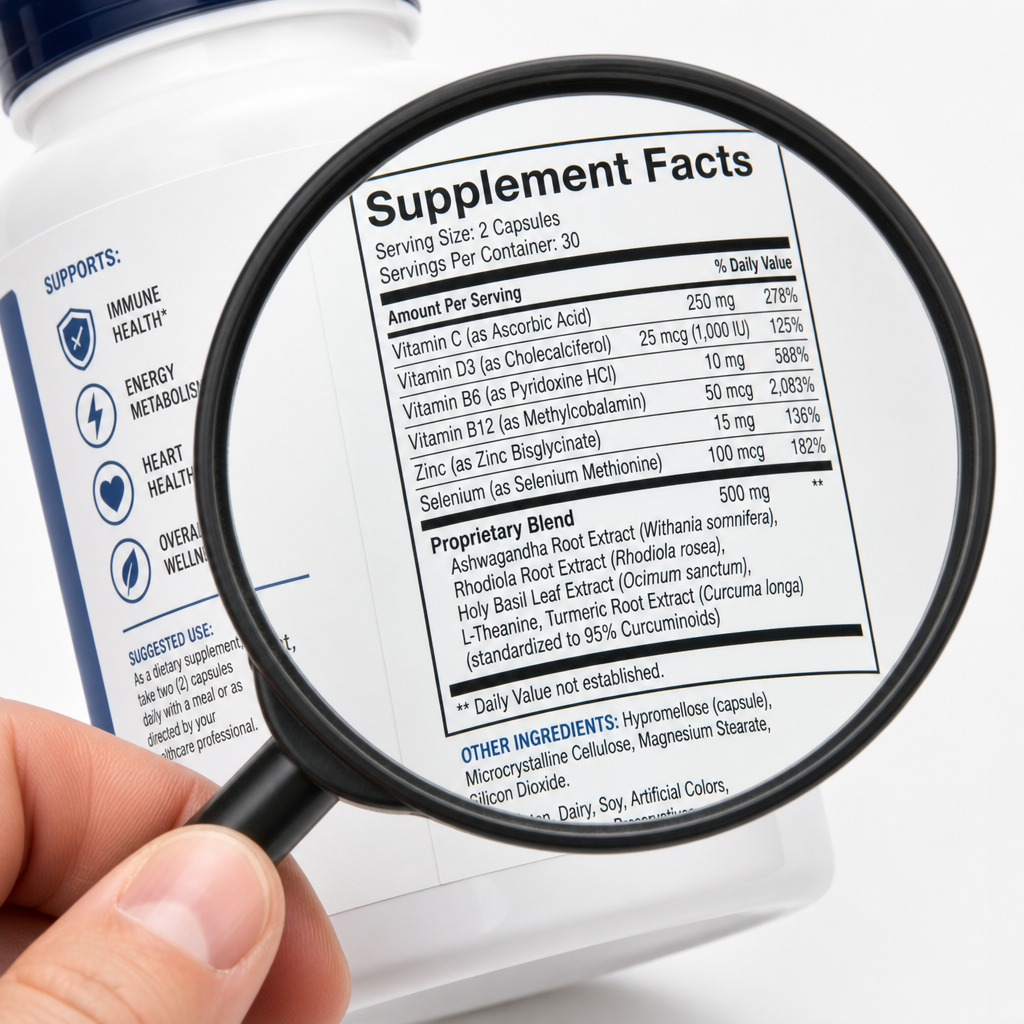

A UK-compliant supplement label has several mandatory components, and knowing where each lives saves you time and prevents you from being misled by the marketing on the front of the pack.
The front of a supplement pack is regulated but it is also where brands spend their creative budget. Claims like "supports energy metabolism" or "contributes to normal immune function" are permitted under UK law only if they appear on the FSA's approved health claims register. However, they are chosen because they test well with consumers, not because they are the most relevant claims for your specific goal.
A common mistake is to make a purchasing decision based on front panel claims alone. The phrase "electrolyte formula" on the front of a product tells you nothing about the actual sodium, potassium, magnesium, and chloride content per serving. That information only appears on the nutrition table on the back or side panel.
UK law requires the nutrition table to display energy, fat, saturates, carbohydrate, sugars, protein, and salt per 100g or 100ml, and optionally per serving. For supplements, the per-serving column is more useful than per 100g because you are not consuming 100g of a product in one sitting. The per-serving column is where you verify whether the amounts listed are actually meaningful.
For electrolyte products specifically, look for sodium, potassium, magnesium, and calcium listed individually with their NRV percentages. If these appear only in a blend with a combined weight, you cannot assess the formula properly. Brands confident in their formulation list each electrolyte separately with its individual amount.
UK ingredients lists are ordered by weight, descending. The first ingredient is present in the largest quantity. For a multivitamin tablet, you would expect vitamin and mineral compounds to appear near the top, with bulking agents and anti-caking agents near the bottom. If a filler like microcrystalline cellulose or dicalcium phosphate appears in the top three ingredients, the tablet contains more filler than active nutrients by weight.
The form of each nutrient is usually listed in brackets immediately after the nutrient name. For example: "Magnesium (as Magnesium Citrate)" or "Vitamin C (as Ascorbic Acid)". This matters because different forms have different bioavailability profiles, and some forms are chosen because they are cheaper to manufacture, not because they absorb better.
The ingredient list on a supplement is where most shoppers give up. Long chemical names and E-numbers are intimidating by design, and some manufacturers use this complexity to obscure low-quality formulations. Here is what you actually need to know about dietary supplement ingredients.
Bioavailability is the percentage of a nutrient your body actually absorbs and uses. Research published in peer-reviewed nutrition journals consistently shows that chelated mineral forms (where a mineral is bound to an amino acid or organic acid) absorb better than inorganic forms. The practical examples worth memorising are these: magnesium citrate outperforms magnesium oxide; zinc picolinate outperforms zinc oxide; and methylcobalamin is the preferred form of B12 for individuals with MTHFR gene variants, which affect a meaningful percentage of the UK population.
For electrolyte supplements used during or after exercise, the sodium source also matters. Sodium chloride (table salt) is the most common and is fine for basic hydration. Sodium citrate is gentler on the stomach at higher doses, which is relevant if you are consuming electrolytes mid-run or during an event rather than just at rest.
Every supplement contains ingredients beyond the active nutrients. These are called excipients, and they include binders, fillers, anti-caking agents, and coating materials. Most are harmless in the doses used. However, a handful are worth flagging. Titanium dioxide (E171) is under ongoing review by the European Food Safety Authority and was suspended in the EU in 2022. The UK FSA is conducting its own review. Until that review concludes, its presence in a supplement is a reasonable reason to consider an alternative product.
Artificial sweeteners like sucralose and acesulfame-K appear frequently in flavoured electrolyte powders and tablets. They are technically permitted and the FSA considers them safe at normal intake levels. However, if you are already consuming sweeteners through other parts of your diet, stacking them via supplements adds to your total intake without nutritional benefit. This is worth checking if you are monitoring your overall sweetener consumption.
Pro tip: The simplest way to assess an ingredients list is to count the items listed before the first additive or excipient. In a high-quality electrolyte formula, you should see four or more active mineral salts listed before you encounter anti-caking agents or carriers. If the first non-active ingredient appears second or third on the list, the product is heavier on filler than formula.
"No added sugar" is one of the most commonly misread claims on supplement labels in the UK, particularly on electrolyte drinks, chewable multivitamins, and gummies. The claim is regulated: under UK food law, a product can only carry this claim if no mono- or disaccharides (simple sugars) have been added during manufacture, and no ingredients added specifically for their sweetening properties contribute sugar to the product.
Here is where the confusion starts. A product labelled no added sugar can still contain carbohydrates that register as sugars on the nutrition table. This happens when the product contains fruit juice concentrates, honey powder, or certain forms of rice syrup that are added for flavour or texture purposes rather than declared as sweeteners. The label is technically correct but the nutrition table may show 4-5g of sugars per serving.
For athletes and active individuals managing carbohydrate intake, this distinction matters. The right way to verify a product's actual sugar content is to ignore the claim on the front and go directly to the sugars row in the nutrition table. If the figure per serving is 0g or less than 0.5g, the product is genuinely low in sugar regardless of what claim appears elsewhere on the label. If the figure is higher, the no added sugar claim tells you only that the sugars came from an ingredient rather than being added directly as sugar.
Plusssz electrolyte formulas are formulated without added sugar and the nutrition table reflects that directly, with per-serving sugar content that confirms the front-of-pack claim rather than contradicting it. That transparency is what clean-label supplementation actually looks like in practice.
"Consumers have a right to accurate and meaningful information about the food and supplements they buy. The nutrition label is the most reliable source of that information, not the front of pack messaging." - Food Standards Agency, Guidance on Nutrition Labelling
UK Nutrient Reference Values (NRVs) are the benchmarks used to calculate the percentages you see on supplement labels. They are set by European Food Safety Authority scientific panels and adopted into UK retained law, representing the intake levels judged sufficient to meet the needs of most healthy adults in the general population.
The problem for active individuals is the phrase "most healthy adults in the general population." NRVs are not set for people exercising four or five times per week. The NRV for magnesium is 375mg. Research consistently indicates that individuals engaging in regular endurance or resistance training have higher magnesium requirements due to losses through sweat and increased muscular demand. The 100% NRV figure on a label is a floor, not a target, for active people.
Use NRV percentages for one specific purpose: assessing whether a supplement is delivering a meaningful dose relative to the baseline requirement. A supplement delivering 5% NRV of a nutrient is essentially decorative. A supplement delivering 100-200% NRV is providing a therapeutically relevant dose for most purposes.
Be cautious about fat-soluble vitamins. Vitamins A, D, E, and K accumulate in body tissue rather than being excreted, so very high NRV percentages for these nutrients (above 200-300%) taken daily over long periods carry a genuine risk of toxicity. For water-soluble vitamins and minerals, your body excretes what it does not need, so high NRV percentages are generally less concerning.
For electrolytes specifically, note that sodium does not have an NRV in the traditional sense. The UK nutrition table expresses sodium as salt equivalent (salt = sodium x 2.5), and the guidance is a maximum intake of 6g of salt per day. This makes electrolyte supplements harder to evaluate on a pure NRV basis, which is why looking at the absolute milligram amount of each electrolyte per serving is more useful than relying on percentage figures alone.
Approach |
What It Involves |
Best For |
|---|---|---|
Front Panel Only |
Making decisions based on claims like "supports energy", "no added sugar", and branding. No reference to the nutrition table or ingredients list. |
Nobody. This approach consistently leads to purchasing decisions based on marketing spend rather than formulation quality. |
Nutrition Table + NRV Check |
Reviewing per-serving nutrient amounts, cross-referencing NRV percentages, and checking the sugars row against any no added sugar claim on the front. |
Most shoppers making everyday purchasing decisions. Covers 80% of what matters for supplement evaluation without requiring specialist knowledge. |
Full Label Audit (Nutrition + Ingredients + Additives) |
Checking nutrient forms in brackets, reviewing the full ingredients list for additive positioning, identifying proprietary blends, and verifying UK regulatory compliance markers. |
Active individuals with specific performance or health goals, people with intolerances, and anyone committing to a supplement long-term. This is the approach worth developing as a habit. |
After reading hundreds of supplement labels, the patterns become obvious. Here are the specific signals that indicate a well-formulated product versus one that prioritises margin over efficacy.
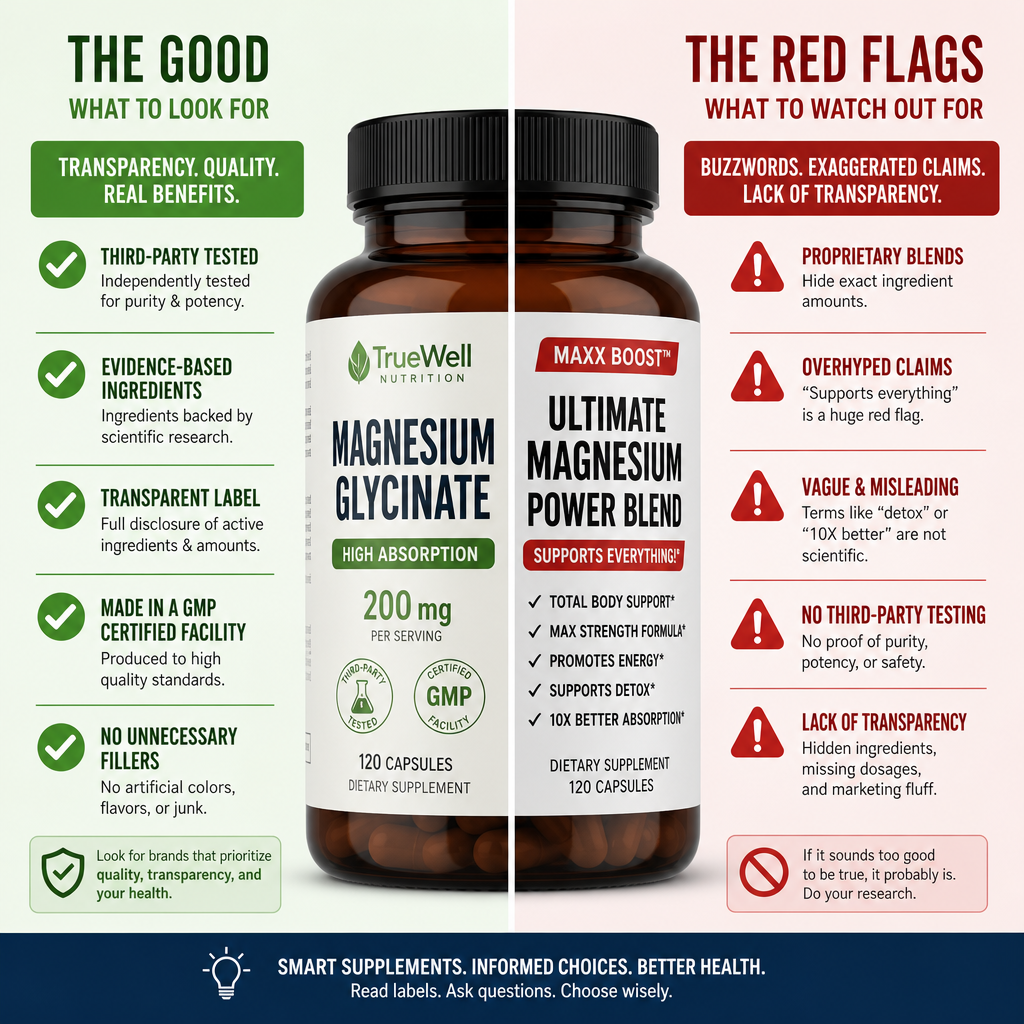
A proprietary blend with a single combined weight is the single biggest red flag on any supplement label. It means the manufacturer is legally hiding individual ingredient doses. The only reason to do this is to prevent buyers from calculating whether effective doses are present. High-quality brands list every active ingredient separately with its individual amount in milligrams or micrograms.
Serving sizes set artificially low is another tactic. If the recommended use is six capsules per day but the nutrition table is based on one capsule, every nutrient amount looks modest and the NRV percentages appear conservative. Always multiply the per-serving figures by the full recommended daily dose to understand what you are actually consuming.
Inorganic mineral forms near the top of the ingredients list suggest cost-cutting. Magnesium oxide, zinc oxide, and ferrous sulphate are the cheapest forms of their respective minerals and the least bioavailable. Their presence is not automatically disqualifying, but it is a signal that the formulation was built to a budget rather than a bioavailability standard.
Individual nutrient amounts listed per serving alongside each mineral and vitamin, without blends, is a strong indicator of a brand confident in its doses. A clearly stated UK-responsible person on the label, alongside a UK address, confirms the product is properly placed on the market under UK food law. Chelated or organic mineral forms (citrate, glycinate, picolinate, bisglycinate) in the ingredients list suggest the formulation prioritised absorption over unit cost.
For electrolyte products specifically, seeing sodium, potassium, magnesium, and chloride listed individually with milligram amounts rather than as part of an "electrolyte complex" is the clearest green flag available. Plusssz electrolyte formulas take this approach, which allows you to verify the formula against your hydration needs directly from the label without guesswork.
Pro tip: Take a photograph of the back panel nutrition table and ingredients list before you buy a new supplement. Compare it against one other product in the same category before committing. Most people never do this, which is precisely why poorly formulated products continue to sell well alongside genuinely good ones.
NRV stands for Nutrient Reference Value and is the term used on UK and EU supplement labels. RDA stands for Recommended Dietary Allowance and is the US equivalent. They are calculated using similar methodologies but the actual figures differ for several nutrients. If a UK supplement uses RDA terminology, it may have been formulated for the US market, and the percentages will not accurately reflect UK dietary reference values.
Not automatically. The term "natural" on a supplement label in the UK has no legally defined meaning in the context of vitamins and minerals. Synthetic ascorbic acid (Vitamin C) is chemically identical to ascorbic acid derived from food sources and absorbs just as well. The more useful question is whether the nutrient form has good bioavailability data behind it, regardless of its origin.
Look at the sugars row in the nutrition table, specifically the per-serving figure. If it reads 0g or under 0.5g per serving, the product is genuinely low in sugar. The no added sugar claim on the front tells you only about the manufacturing process, not the final sugar content. Fruit concentrates, honey, and certain carbohydrate sources can add sugars to a product that still legitimately carries the no added sugar claim.
It depends on whether the nutrient is fat-soluble or water-soluble. Fat-soluble vitamins (A, D, E, K) accumulate in the body and consuming significantly more than 100% NRV daily for extended periods carries a risk of toxicity, particularly for Vitamin A and Vitamin D. Water-soluble vitamins (B group, C) and most minerals are excreted rather than stored, so doses above 100% NRV are generally tolerated well. That said, extremely high doses of individual B vitamins, particularly B6, have been associated with neurological symptoms at very high long-term intakes.
Elemental weight refers to the actual amount of the mineral itself, excluding the compound it is bonded to. For example, magnesium citrate contains roughly 16% elemental magnesium by weight. If a label states "Magnesium Citrate 500mg (providing 80mg elemental magnesium)", the 80mg is what your body has available to absorb and use. A label that only states the compound weight without the elemental weight makes it harder to assess whether the dose is meaningful, which is why the elemental figure is more useful and why good brands include it explicitly.
No. The UK's Food Standards Agency has flagged multiple instances of supplements sold via third-party marketplace listings that do not comply with UK food information regulations. Products may lack a UK-responsible person, use unapproved health claims, or carry labelling formatted for other markets. Buying directly from a brand's UK website or from UK-registered retailers is the more reliable route for regulatory compliance assurance.
If you have recently started reading supplement labels more carefully, share what surprised you the most about a product you thought you knew well. Your experience might save someone else from a poor purchasing decision.